7 Simple Habits That Could be Time Bombs in Your Daily Life !


Designed and published by HealthNato medical editorial team.
Fact-checked by HealthNato Scientific Team
on July 29, 2026 at 10:30 AM
We engage in dozens of behaviors every day almost automatically. Some are natural bodily responses, while others are habits we adopt with good intentions, without realizing that some of them may carry genuine health risks.
The problem is that many of these behaviors do not seem dangerous at the time, but repeating them or performing them incorrectly may lead to complications that deserve attention.
In this article, we explore 7 simple and common habits whose potential harms we may overlook, explaining what happens inside the body and how to avoid the risks associated with them.
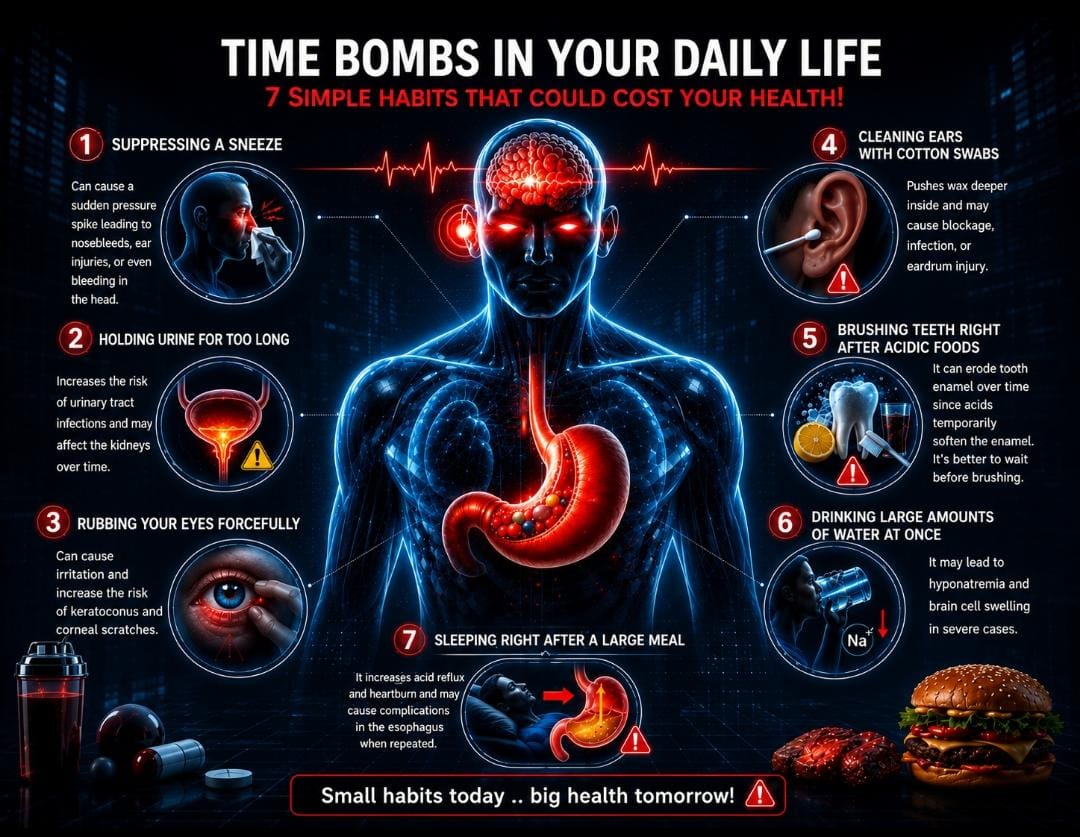
1. Suppressing a Sneeze: When a Natural Reflex Creates a Sudden Pressure Surge
Sneezing is not merely an annoying sound. It is a natural defensive reflex that helps the body expel irritants and foreign particles from the nose and respiratory tract.
However, attempting to suppress a sneeze by closing the nose and mouth may prevent the air and pressure generated by the sneeze from being released normally, redirecting the force toward the tissues surrounding the nose, ears, and face.
What happens inside your body?
When a sneeze is suppressed, pressure can rise suddenly within the nasal and middle-ear cavities, and some of this pressure may be transmitted to surrounding blood vessels and tissues.
The potential risk
In most cases, suppressing a sneeze does not lead to serious complications. However, forceful or repeated suppression may, in rare cases, cause injuries such as:
Nosebleeds, which may occur due to the rupture of small blood vessels inside the nose.
Rupture of tiny blood vessels in the eyes or face.
Ear injuries or pain, and in very rare cases, injury to the eardrum.
A sudden increase in pressure within the head, which may, in exceptional circumstances, contribute to the rupture of small blood vessels and bleeding.
In extremely rare cases, more serious injuries involving blood vessels or the respiratory tract have been reported.
Therefore, forcefully suppressing a sneeze is not recommended.
Medical advice
Allow the sneeze to come out naturally while covering your nose and mouth safely. You can wrap your arm around your face to reduce the spread of droplets or use a tissue.
Important note: If you experience recurrent nosebleeds after sneezing or develop unusual symptoms such as a sudden severe headache, visual disturbances, or severe ear pain, you should seek medical evaluation.
2. Holding Your Urine for Long Periods: When a Habit Becomes a Problem
The bladder is a muscular organ capable of stretching and storing urine for a period of time. However, repeatedly delaying urination for many hours is not a healthy habit.
What happens inside your body?
As the bladder fills, nerve signals become stronger, alerting you that you need to urinate. Repeatedly ignoring these signals may affect bladder function in some people, particularly when urinary retention occurs frequently or for prolonged periods.
The potential risk
Repeatedly holding urine may be associated with an increased risk of certain problems, including:
Difficulty completely emptying the bladder.
A higher risk of urinary tract infections in some individuals.
Impaired bladder muscle function in cases of chronic urinary retention.
In severe cases accompanied by true urinary retention, urine may flow backward into the upper urinary tract and affect the kidneys.
However, it is important to clarify that occasionally holding your urine does not usually lead to kidney failure, and urinary reflux is not an inevitable consequence of delaying urination.
Medical advice
Do not make holding your urine for many hours a daily habit. Respond to your body's signals when you feel the need to urinate. If you frequently experience difficulty urinating, weak urine flow, or a sensation that your bladder is not completely empty, consult a doctor.
3. Rubbing Your Eyes Forcefully: Temporary Relief That May Harm Your Eyes
Rubbing your eyes may provide temporary relief when you experience itching or fatigue, but it can become harmful when done forcefully or repeatedly.
What happens inside your body?
Repeated and forceful pressure on the cornea may strain its tissues and may be associated with an increased risk of changes in the shape of the cornea, particularly in people who are predisposed to keratoconus.
The potential risk
Forceful and repeated eye rubbing may lead to:
Increased eye irritation.
Worsening of allergies and itching.
A higher risk of keratoconus in susceptible individuals.
Superficial corneal scratches if the hands are contaminated or if a foreign body is present on the surface of the eye.
Retinal tears, however, are not considered a typical consequence of eye rubbing, and there is no strong evidence that eye rubbing is a common direct cause of retinal tears.
Medical advice
If you experience itching or dryness, consider using appropriate lubricating eye drops and avoid vigorous rubbing. If the itching is recurrent, it may be caused by an allergy or another underlying condition that requires appropriate treatment.
4. Cleaning Your Ears with Cotton Swabs: When You Push the Wax Deeper
Although many people use cotton swabs to clean their ears, the external ear canal has a natural mechanism that gradually helps remove earwax.
What happens inside your body?
When you insert a cotton swab into the ear canal, you may push the wax deeper rather than removing it.
The potential risk
This may lead to:
Earwax buildup and blockage of the ear canal.
Temporary hearing loss.
Irritation or scratches to the skin lining the ear canal.
An increased risk of outer ear infection.
If the swab is inserted too deeply, injury to the eardrum may occur.
Direct transfer of bacteria into the middle ear, however, is not the usual outcome because the eardrum forms a barrier separating the outer ear from the middle ear.
Medical advice
Clean only the outer part of the ear and avoid inserting cotton swabs into the ear canal. If you experience blockage or hearing loss due to earwax, it is best to consult an ENT specialist for safe removal.
5. Brushing Your Teeth Immediately After Acidic Foods and Drinks: When Oral Care Can Cause Damage
Brushing your teeth immediately after consuming oranges, lemons, or soft drinks may seem like a good idea, but timing matters.
What happens inside your body?
Acidic foods and drinks lower the pH in the mouth and may temporarily soften the surface of tooth enamel by causing the loss of some minerals.
If you brush your teeth vigorously immediately after exposure to acids, this may increase enamel wear over time.
The potential risk
Repeating this habit may increase the risk of tooth enamel erosion, particularly in people who frequently consume acidic foods and beverages.
Medical advice
After consuming acidic foods or drinks, you can rinse your mouth with water and then wait approximately 30 to 60 minutes before brushing your teeth, particularly after significant exposure to acids.
6. Drinking Large Amounts of Water All at Once: When Hydration Becomes a Risk
After heavy sweating or prolonged exercise, you may feel extremely thirsty and be tempted to drink a large amount of water quickly.
However, excessive water intake over a short period, especially in very large quantities, may in some circumstances lead to a potentially serious condition known as hyponatremia.
What happens inside your body?
When the body receives more water than the kidneys can eliminate, the concentration of sodium in the blood may decrease.
In severe cases, water can move into the body's cells, including brain cells, causing them to swell.
The potential risk
Symptoms may include:
Headache.
Nausea and vomiting.
Confusion.
Seizures.
Loss of consciousness.
However, it is important to emphasize that hyponatremia does not usually occur simply because you drink one or two glasses of water after feeling thirsty. It is generally associated with consuming excessive amounts of water over a short period, particularly during or after prolonged exercise when large amounts of plain water are consumed without appropriate electrolyte replacement.
Medical advice
Drink water gradually according to your thirst and your body's needs, and avoid forcing yourself to consume extremely large amounts in a short period. In cases of heavy sweating or prolonged physical exertion, some individuals may need to replace both fluids and electrolytes, depending on their health status and the intensity of the activity.
7. Going to Sleep Immediately After a Large Meal: Why Can It Increase Acid Reflux?
Eating a large meal and then lying down immediately may increase the likelihood of heartburn and reflux of stomach contents into the esophagus, particularly in people who already suffer from gastroesophageal reflux disease (GERD).
What happens inside your body?
When the stomach is full, lying down immediately after eating may make it easier for stomach contents to flow back into the esophagus. The absence of an upright position may also reduce the effect of gravity, which helps keep stomach contents in place.
The potential risk
In people who are prone to reflux, repeatedly engaging in this habit may lead to:
Increased heartburn.
A sour or acidic taste in the mouth.
Coughing or discomfort during the night.
Increased irritation of the esophagus with recurrent reflux.
In cases of chronic, untreated reflux, complications such as esophagitis may develop, and some patients may eventually develop changes in the lining of the esophagus, such as Barrett's esophagus.
However, it is important to emphasize that eating one large meal and going to sleep afterward does not cause these complications by itself. The risk is more strongly associated with chronic and persistent reflux.
Medical advice
If you suffer from acid reflux, try to leave at least 2 to 3 hours between your last meal and bedtime. Avoiding large, heavy meals in the evening and elevating the upper body during sleep may also help some patients.
After a meal, light walking may be a suitable option for some people, but it is not a treatment for acid reflux in itself.
Conclusion :
Not every habit we practice every day is dangerous, but some behaviors can become problematic when repeated excessively or performed incorrectly.
Forcefully suppressing a sneeze, holding urine for prolonged periods, rubbing the eyes vigorously, inserting cotton swabs into the ear canal, brushing the teeth immediately after acid exposure, drinking excessive amounts of water over a short period, and going to sleep immediately after a large meal are all examples of simple behaviors that deserve our attention.
The goal is not to live in fear of every everyday action. Rather, it is to understand our bodies better and recognize when a simple behavior is merely an occasional habit and when repeating it may become a genuine health risk.
Because health does not depend only on what we do. Sometimes, it also depends on knowing when to stop doing the small things that may quietly harm us.
Designed and published by HealthNato medical editorial team.
Fact-checked by HealthNato Scientific Team
on July 29, 2026 at 10:30 AM
Get new articles in your inbox
One short email a week, no spam.
Your privacy is important to us.
Related Articles
 General Health
The Hidden Battle After Abdominal Surgery: Understanding Postoperative Peritoneal Adhesions
 General Health
The Revolution in New Obesity Medications vs. Bariatric Surgery... Has the Era of the Scalpel Come to an End?
 General Health
5 Drinks That May Harm Your Kidneys and Why They Deserve a Second Look.
 General Health