IBS is Not Merely a Psychological Disorder: Modern Science Rewrites the Story After Identifying Its Protagonist, "The Second Brain"

Written by Prof. Dr. Fatma Younis
Scientific Development Director at HealthNato | Professor of Hepatology and Gastroenterology
Information reviewed by HealthNato Scientific Team
on July 12, 2026 at 3:00 AM
Key points
- "The Second Brain": The Enteric Nervous System (ENS)
- Why Do Patients Experience Severe Pain Despite "Normal" Clinical Findings?
- Why Do Symptoms Vary So Significantly from One Patient to Another?
- The Modern Paradigm in IBS Management
"All disease begins in the gut."
This maxim, attributed to the father of medicine, Hippocrates, over two millennia ago, seems to be revitalized by modern science today, driven by accelerating discoveries surrounding the complex relationship between the gut and the brain. For decades, Irritable Bowel Syndrome (IBS) has been linked in the minds of many to pure psychological stress or anxiety. Some patients were even accustomed to hearing the recurrent clinical phrase: "All your test results are normal... the issue is psychological." However, recent research has presented a more complete picture. IBS is not a purely psychological condition, nor is it just a motility disorder of the gastrointestinal tract. Rather, it is a complex functional gastrointestinal disorder where immunological, neurological, and biological factors intertwine alongside psychological elements, via an integrated network known as the Gut-Brain Axis.
1. When the Intestinal Epithelial Barrier Compromises Under normal physiological conditions, the epithelial cells lining the intestine are tightly bound to one another by what are known as Tight Junctions. These structures act as a selective barrier that permits the absorption of digested nutrients while restricting the passage of undesirable macromolecules and pathogens. When the regulation of this barrier is disrupted or its permeability increases in certain individuals, relatively large molecules, along with components produced by certain bacterial strains, can translocate into the intestinal wall, triggering a localized immune response as an automatic reflex. Mast Cell Activation: In response to these microenvironmental alterations, Mast Cells residing within the intestinal wall—particularly adjacent to nerve endings—may become activated. Upon activation, these cells degranulate and release mediators such as histamine and other pro-inflammatory cytokines, which may contribute to localized micro-inflammation and visceral hypersensitivity in some patients. In many cases, this inflammatory process remains highly localized and confined within the intestinal wall. Consequently, it does not manifest evidently in conventional systemic inflammatory markers like CRP or ESR, despite being sufficient to elicit chronic symptoms.
2. Why Do Patients Experience Severe Pain Despite "Normal" Clinical Findings? Visceral Hypersensitivity stands as one of the most critical contemporary explanations for IBS-related pain. Low-grade, persistent micro-inflammation can sensitize the nociceptive nerve fibers embedded within the intestinal wall. When these nerve endings are chronically exposed to mediators like histamine and tryptase, they become hyper-responsive to physiological stimuli. Consequently, the patient may experience severe pain during routine gastrointestinal functions, such as the regular passage of chyme or normal luminal distension by gases. Furthermore, mild stimuli that do not provoke any discomfort in healthy individuals can become painful for an IBS patient due to this heightened neural sensitization.
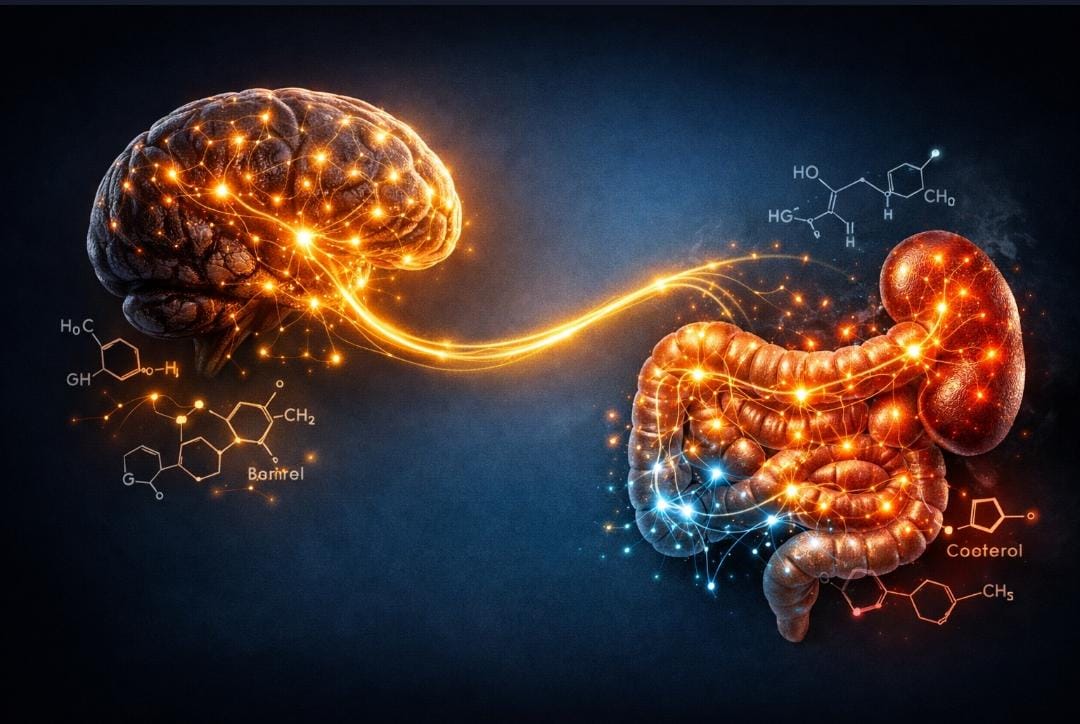
3. "The Second Brain": The Enteric Nervous System (ENS) The intestine is far more than a mere muscular tube dedicated to food digestion; it houses an intricate autonomous neural network known as the Enteric Nervous System (ENS), which is why it is frequently referred to as "The Second Brain." Moreover, the gastrointestinal tract is the primary site for Serotonin (5-HT) synthesis in the human body—a crucial neurotransmitter that plays a pivotal role in regulating intestinal motility and visceral sensation. In a subset of IBS patients, a disruption in serotonin regulation occurs, directly impacting bowel function: In Diarrhea-Predominant IBS (IBS-D): Enhanced serotonergic signaling can accelerate intestinal transit (hypermotility) and increase fluid secretion. In Constipation-Predominant IBS (IBS-C): A defect in serotonin regulation or a blunted response of its receptors (5-HT_3 and 5-HT_4) may occur, resulting in delayed colonic transit (hypomotility).
4. The Gut-Brain Axis: A Bidirectional Superhighway The gut and the brain maintain continuous communication via a complex network known as the Gut-Brain Axis, where signals flow incessantly in both directions. From Gut to Brain: Alterations in the gut microbiota (dysbiosis) or localized micro-inflammation can transmit afferent signals through nerves—particularly the Vagus Nerve—to the central nervous system. This biochemical signaling can influence mood and cognitive function in certain individuals, potentially contributing to symptoms like anxiety or brain fog. From Brain to Gut: Upon exposure to psychological stress, the brain triggers the release of stress hormones, such as cortisol. These systemic mediators can alter gastrointestinal motility, heighten visceral sensitivity, and increase intestinal permeability in some patients, thereby exacerbating symptoms and perpetuating a vicious cycle between the brain and the gut.
5. Why Do Symptoms Vary So Significantly from One Patient to Another? IBS does not manifest identically in all patients. One individual may suffer predominantly from constipation, while diarrhea is the overriding symptom in another, whereas bloating or chronic pain remains the primary complaint for a third group. This clinical heterogeneity arises because the underlying biological mechanisms are not uniform across the board: In some patients, microbiota dysbiosis is the predominant driver. In others, neural hypersensitivity is the primary culprit. A third group may suffer predominantly from a disruption in the gut-brain communication network. For this precise reason, there is no single treatment that fits everyone.
6. The Modern Paradigm in IBS Management As our understanding of the pathophysiology of this disorder evolves, therapeutic interventions have shifted from merely alleviating cramps or symptom suppression toward targeting the underlying factors contributing to the dysfunction. Supporting the Intestinal Mucosal Barrier: Emerging studies suggest that elements such as L-Glutamine and Short-Chain Fatty Acids (SCFAs) like Butyrate may support certain patients, particularly when increased intestinal permeability is suspected. However, further robust clinical trials remain necessary to identify the specific cohorts that derive the greatest benefit. Mitigating Enteric Nervous Sensitization: Therapeutic agents targeting inflammatory mediators, such as histamine, are currently being evaluated to reduce visceral hypersensitivity in strictly selected patient populations. Optimizing Microbiome Equilibrium: Research demonstrates that dietary modification can significantly alleviate symptoms in many patients, with the Low-FODMAP diet being the most extensively studied dietary intervention in this field. Additionally, specific, clinically validated probiotic strains may be beneficial, though clinical responsiveness varies heavily from one individual to another. Conclusion IBS is no longer viewed as a mere byproduct of psychological stress or a simple disturbance in bowel motility. Today, it is recognized as a multifaceted disorder involving complex cross-talk between the nervous system, local immunity, the microbiome, and epithelial barrier function, alongside the bidirectional dynamics of the gut-brain axis. Therefore, therapeutic success does not rely on prescribing a single standardized drug to all patients. Instead, it depends on identifying the most prominent biological mechanisms driving each individual case and tailoring an integrated, patient-centric treatment plan. Perhaps the most significant milestone achieved by modern medical science is the definitive validation that an IBS patient's pain is real—it possesses complex, verifiable biological foundations that demand precise understanding and clinical management, far beyond reducing it to a mere reflection of psychological state.
Written by Prof. Dr. Fatma Younis
Scientific Development Director at HealthNato | Professor of Hepatology and Gastroenterology
Information reviewed by HealthNato Scientific Team
on July 12, 2026 at 3:00 AM
Related articles
 General Health
The Hidden Battle After Abdominal Surgery: Understanding Postoperative Peritoneal Adhesions
 General Health
The Revolution in New Obesity Medications vs. Bariatric Surgery... Has the Era of the Scalpel Come to an End?
 General Health
7 Simple Habits That Could be Time Bombs in Your Daily Life !
 General Health