Artificial Intelligence Enters the Operating Room: Will AI Help Surgeons or Replace Them ?

Written by Prof. Dr. Mohamed Henaish
Professor and Consultant of General Surgery | Laparoscopy | Bariatric | Cosmetic and Oncologic Surgery
Fact-checked by HealthNato Scientific Team
on September 10, 2026 at 12:30 PM
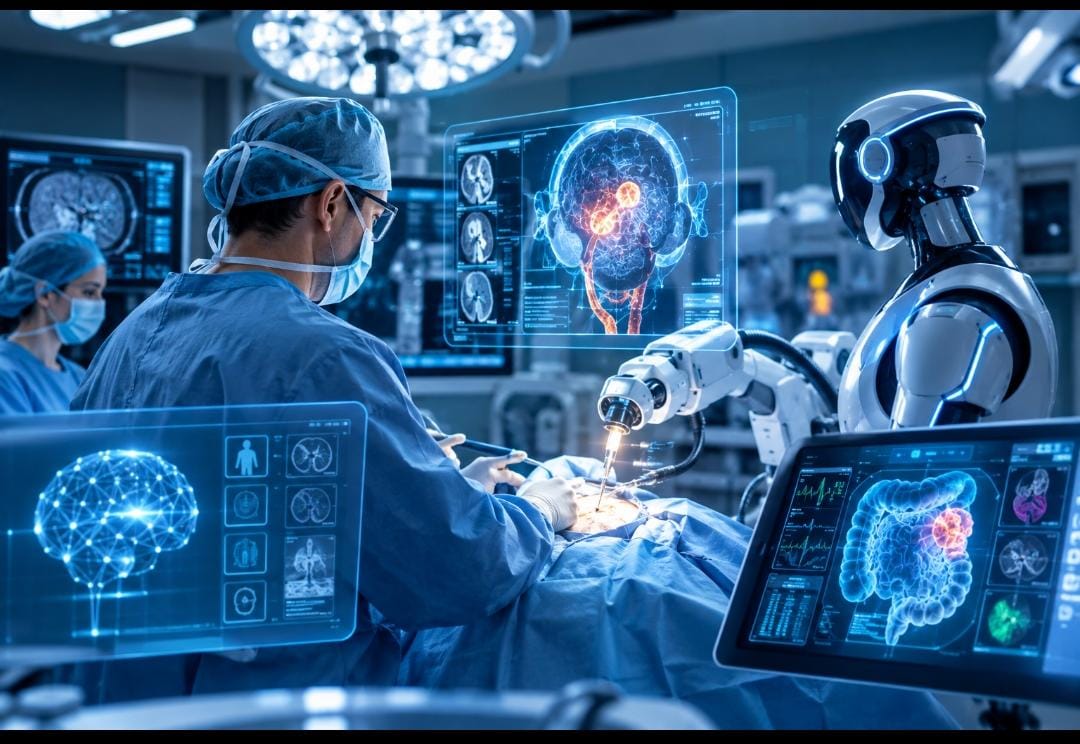
From reading medical scans to assisting the surgeon during the operation… How could artificial intelligence change the way surgeries are performed?
Imagine that you have entered an operating room, and instead of all the information being contained in files and medical images that the surgeon reviewed before the operation, there is now an intelligent system capable of analyzing huge amounts of information within seconds and helping the medical team see details that may be difficult to detect at the same speed.
It may identify a suspicious area on a medical image, remind the surgeon of an important piece of information, or analyze what is happening during the operation moment by moment.
But does this mean that a robot will soon begin performing operations on its own?
That is not the scenario most likely to become reality.
The more realistic idea is that the surgeon will become more capable with artificial intelligence by their side.
Before the Operation… Artificial Intelligence Starts with Medical Imaging
Before the patient reaches the operating room, the physician already has a huge amount of information:
Laboratory tests, medical imaging, medical history, medications, age, weight, and sometimes CT scans or MRI images containing a tremendous amount of detail.
Here, artificial intelligence can analyze some of these data very quickly and help identify patterns or details that may be important when planning the operation.
For example, algorithms may help analyze medical images, identify specific areas, or help estimate the likelihood of certain complications after surgery.
This does not mean that the computer “decides on the operation.”
Rather, it can be more like an assistant telling the surgeon:
“Here is some information you may need to pay attention to.”
Research in this field is increasing, but many surgical artificial intelligence systems still require further external testing and confirmation that they can operate safely under real-world conditions before being used on a wide scale.
And During the Operation…
This is where the idea becomes even more interesting.
During surgery, the surgeon is not looking at a “static image.”
They are dealing with moving tissues, blood vessels, organs that may change shape, and information that continuously appears and changes.
Therefore, researchers are developing systems capable of analyzing images and video during surgery and helping physicians identify certain anatomical structures or changes occurring during the procedure.
In the future, artificial intelligence may be capable of providing real-time alerts or information that helps the surgeon make decisions.
But this is not a simple process.
Artificial intelligence may be excellent at recognizing a particular pattern in data, but it may not understand everything happening in front of it in the same way that a surgeon understands the patient’s overall condition.
That is why it cannot yet be relied upon completely.
Can Artificial Intelligence Predict Complications?
Yes, and this is one of the very important areas.
Some systems can be trained using data from large numbers of patients to try to estimate the likelihood of certain complications occurring after surgery.
Instead of the physician looking at each risk factor separately, the system can combine a large number of variables at the same time and provide an estimate of the level of risk.
But there is an important difference between:
The system predicts a probability…
and
The system knows exactly what will happen.
Artificial intelligence does not have a crystal ball.
Can Artificial Intelligence Make Mistakes?
Absolutely… and that is why medical artificial intelligence cannot be treated as an “infallible truth.”
It provides an estimate based on data and may be wrong, particularly if the data it was trained on differ from the data of current patients.
In surgery, this issue becomes even more sensitive because the decision directly concerns the patient’s safety.
That is why verifying the performance of these systems in real-world environments and across different patient groups and datasets has become essential before relying on them widely.
Because not everything that works on a computer screen will necessarily work inside the operating room.
Will Artificial Intelligence Replace the Surgeon?
This is one of the most controversial questions.
And the answer is no… this is not the current direction.
Surgery is not simply about recognizing an image or executing a sequence of steps.
During an operation, the surgeon encounters unexpected situations, evaluates tissues, manages bleeding, changes the plan when circumstances change, weighs risks against benefits, and makes decisions based on their experience and the patient’s condition at that particular moment.
These factors make the human role extremely important and impossible to replace.
That is why researchers are increasingly discussing the concept of:
“Human-AI collaboration.”
The goal is not for the computer to tell the surgeon: “Do this.”
Rather, it is to provide information and analyses that may help the surgeon make a better decision.
So… What Will the Surgeon Become in the Future?
Perhaps the future surgeon will not be a person working alone in front of the patient, but someone working within a system that includes:
The surgeon + the medical team + robotics + advanced imaging + artificial intelligence.
- Artificial intelligence analyzes information.
- Robotics provides precision and control of movement.
- Imaging systems help reveal details that are not easily visible to the naked eye.
- And the surgeon remains the person who brings all of this information together, places it within a real clinical context, and makes the final decision.
And this may be the most important change in the concept of surgery in the coming years:
Not replacing the surgeon… but increasing their capabilities.
Conclusion
Artificial intelligence may change surgery, but not necessarily in the way science-fiction movies portray it.
The most likely scenario will not be:
“A robot sitting in the surgeon’s place and holding the scalpel.”
Rather:
“A surgeon equipped with intelligent tools that help them see and analyze more information than was previously possible, enabling them to make the best decision in a shorter time.”
And that is a major difference.
Artificial intelligence may become the surgeon’s additional set of eyes, rapid analyst, and digital assistant, but it does not eliminate the importance of medical expertise, clinical judgment, and the ability to deal with unexpected situations that cannot always be predicted.
Written by Prof. Dr. Mohamed Henaish
Professor and Consultant of General Surgery | Laparoscopy | Bariatric | Cosmetic and Oncologic Surgery
Fact-checked by HealthNato Scientific Team
on September 10, 2026 at 12:30 PM
Get new articles in your inbox
One short email a week, no spam.
Your privacy is important to us.
Related Articles
 General Health
The Hidden Battle After Abdominal Surgery: Understanding Postoperative Peritoneal Adhesions
 General Health
The Revolution in New Obesity Medications vs. Bariatric Surgery... Has the Era of the Scalpel Come to an End?
 General Health
7 Simple Habits That Could be Time Bombs in Your Daily Life !
 General Health