(Baby Botox).. Are Smaller Doses of Botox Always Safer? What Happens to Facial Muscles With Repeated Use?

Written by Prof. Dr. Mohamed Henaish
Professor and Consultant of General Surgery | Laparoscopy | Bariatric | Cosmetic and Oncologic Surgery
Information reviewed by HealthNato Scientific Team
on August 27, 2026 at 12:30 PM
Key points
- Baby Botox uses smaller doses of botulinum toxin, but a lower dose does not automatically make repeated treatment risk-free.
- Botulinum toxin temporarily blocks nerve-to-muscle communication, reducing muscle activity and dynamic facial wrinkles.
- Repeated chemical denervation can reduce muscle size and activity, although permanent facial muscle atrophy is not inevitable in everyone.
- There is not enough evidence to conclude that Baby Botox inevitably causes facial sagging or premature aging.
- Preventive Botox is not medically necessary for every person in their twenties, because facial aging depends on multiple factors beyond muscle movement.
- Rarely, repeated botulinum toxin injections can lead to antibodies that reduce treatment effectiveness, with risk related in part to cumulative dose and closely spaced treatments.
- A personalized treatment plan should consider the target muscle, dose, injection technique, treatment interval, facial anatomy, and whether treatment is still necessary.
In a plastic surgery clinic, one of the questions that comes up frequently is:
“I get Botox in small doses… does that mean it’s completely safe even if I keep repeating it?”
The answer is not simply yes or no.
Botulinum toxin, commonly known as Botox, is used medically and cosmetically as a localized injection to temporarily relax muscles or reduce sweating. It is considered an effective tool in aesthetic medicine when used at the appropriate dose, site, and timing.
But Botox is ultimately a drug that directly affects muscle activity. It is not simply a skincare product designed to improve the appearance of the skin.
That is why understanding what happens to facial muscles with repeated Botox treatment is important.
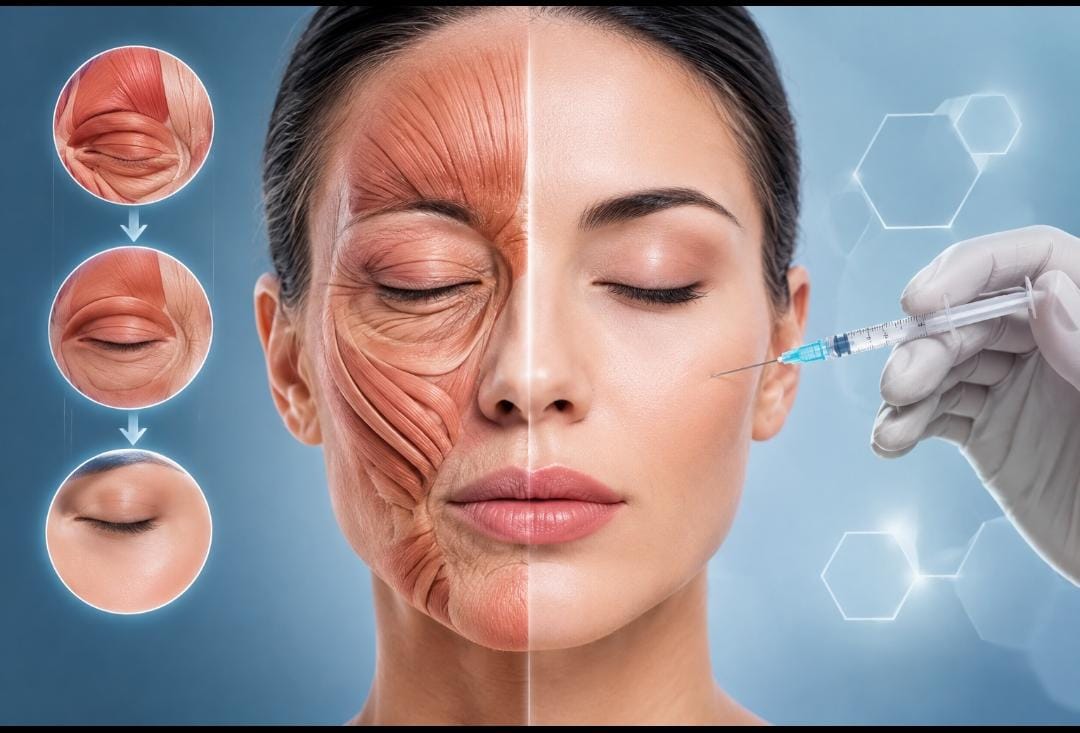
Botox Does Not Treat the Skin… It Changes Muscle Movement
Botulinum toxin works by temporarily disrupting communication between the nerve and the muscle. It does this by preventing the release of acetylcholine, a chemical messenger involved in muscle contraction.
As a result, the targeted muscle becomes less active, which can reduce dynamic wrinkles caused primarily by repeated facial muscle contractions.
For this reason, Botox is commonly used in areas such as the forehead, around the eyes, and between the eyebrows.
The full cosmetic effect usually develops within approximately two weeks and commonly lasts around 3–4 months.
However, when a muscle remains less active for prolonged periods, changes in muscle size and function can occur.
Can Repeated Botox Cause Facial Muscle Atrophy?
Yes, a reduction in muscle size and activity can occur with repeated chemical denervation. Studies have described muscular changes that may persist beyond the usual duration of the cosmetic effect.
But an important distinction is needed.
This does not mean that every person who receives Botox will develop permanent facial muscle atrophy. There is also not enough evidence to conclude that Baby Botox inevitably causes facial sagging or premature aging.
The bigger concern is excessive or repeated treatment without reassessment.
The face is not simply skin. It is an integrated structure made up of bone, muscles, fat, and skin. Persistent changes in one part of this system can influence facial appearance and balance.
Can Baby Botox Make the Face Look “Hollow” or Less Lively?
The answer depends on several factors, including which muscle is treated, the dose used, the depth and technique of injection, how frequently treatment is repeated, and the individual's facial anatomy.
Proper cosmetic Botox treatment is designed to target specific muscles with carefully selected amounts of toxin.
The goal is not to eliminate every facial movement. Instead, the aim is usually to reduce excessive or unwanted movement while preserving a natural degree of facial expression.
This is where the physician's experience becomes especially important.
A beautiful face is not necessarily a completely motionless face.
What Is Preventive Botox?
The idea of starting Botox at a young age to prevent wrinkles from developing later has become increasingly popular.
However, there is no general medical need to inject every person in their twenties simply to prevent future wrinkles.
Facial aging is influenced by much more than muscle movement. Age, cumulative sun exposure, changes in collagen and elastin, genetics, and lifestyle all contribute to the development of wrinkles and other signs of skin aging.
Therefore, a more appropriate question is:
Is there a genuine cosmetic concern that warrants treatment?
Another Potential Issue… Botox Resistance
With repeated botulinum toxin injections, the body can, in rare cases, develop antibodies that may reduce treatment effectiveness.
The rates of antibody formation are low with modern formulations, but the issue can become more relevant with high cumulative doses, booster injections, and very closely spaced treatments—particularly when intervals are shorter than three months.
However, a weaker response after a single treatment session does not automatically mean that immune resistance has developed.
Dose, injection technique, treatment timing, and differences in the muscles being targeted can also contribute to a reduced response.
How Can Botox Be Used More Rationally?
There is no single treatment schedule that is appropriate for every face.
However, several principles can help make repeated Botox treatment more thoughtful.
Do not inject simply because a fixed appointment has arrived. Reassess whether treatment is still necessary.
Use the lowest dose that achieves the desired result for the specific treatment area and cosmetic objective.
Avoid unnecessary booster injections shortly after treatment.
Do not treat Botox as a permanent treatment that must automatically be repeated.
Reassess facial movement, muscle activity, and overall facial appearance before each session.
Choose a physician who has a detailed understanding of facial anatomy rather than focusing only on injection technique.
Long-term data on decades of repeated cosmetic Botox use remain limited. Therefore, definitive guarantees about the effects of very prolonged repetitive treatment cannot currently be made.
The Bottom Line
Botox is not the enemy of the face, but it is also not a cosmetic treatment without limits.
It is a powerful medication that works by modifying muscle activity. When used thoughtfully and appropriately, it can produce effective and natural-looking results.
The concern begins when treatment becomes automatic:
Dose after dose… session after session… without asking whether treatment is still needed.
The goal of aesthetic medicine is not to make the face completely motionless. It is to maintain facial balance, natural expression, and an appearance that continues to look harmonious over time.
That is the difference between enhancing the face… and freezing the face.
Written by Prof. Dr. Mohamed Henaish
Professor and Consultant of General Surgery | Laparoscopy | Bariatric | Cosmetic and Oncologic Surgery
Information reviewed by HealthNato Scientific Team
on August 27, 2026 at 12:30 PM
Related articles
 General Health
The Hidden Battle After Abdominal Surgery: Understanding Postoperative Peritoneal Adhesions
 General Health
The Revolution in New Obesity Medications vs. Bariatric Surgery... Has the Era of the Scalpel Come to an End?
 General Health
7 Simple Habits That Could be Time Bombs in Your Daily Life !
 General Health