Body Contouring Surgery: Why Does the Procedure Differ from One Area to Another?

Written by Prof. Dr. Mohamed Henaish
Professor and Consultant of General Surgery | Laparoscopy | Bariatric | Cosmetic and Oncologic Surgery
Information reviewed by HealthNato Scientific Team
on October 20, 2026 at 12:30 PM
There is no single procedure suitable for all cases of loose skin following massive weight loss.
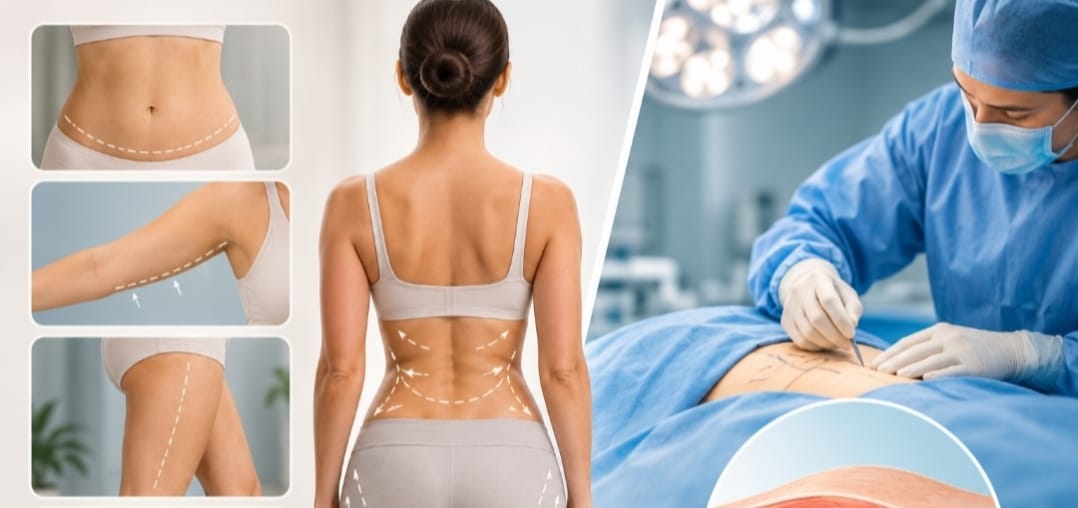
Removing excess skin from the abdomen differs surgically from tightening the arms, thighs, or breasts, not only in the location of the incisions, but also in the nature of the tissues being reshaped, the expected scars, and the complications that must be considered.
The difference between a good and an ideal result lies not in the amount of skin removed, but in achieving appropriate tightening while preserving tissue integrity.
When Loose Skin Extends Around the Body
Circumferential Body Lift
In some cases, excess skin is not limited to the abdomen but extends around the waist, flanks, and back.
In such cases, a circumferential body lift may be more appropriate than a traditional tummy tuck, as it addresses loose skin around the torso and may help improve waist contour and lift tissues in multiple areas.
However, the extensive nature of the surgery makes incision planning, wound closure, and the distribution of tension across the tissues particularly important.
Other conditions, such as abdominal muscle separation or a hernia, may also be addressed if necessary, but they are not an essential part of every procedure.
Arms and Thighs: The Challenge Goes Beyond Skin Removal
In arm and thigh lift procedures, the surgeon must achieve a noticeable improvement in limb contour while accounting for how the skin and underlying tissues move during daily activities.
The challenge lies in choosing the location and length of the incision and achieving sufficient tightening without placing excessive tension on the wound, while preserving blood vessels, nerves, and lymphatic pathways as much as possible.
Complications that warrant attention include fluid accumulation, delayed wound healing, widened scars, and swelling. Disruption of lymphatic drainage may also occur, particularly in certain thigh lift procedures.
Breast Lift Surgery: Reshaping, Not Just Lifting
Following massive weight loss, the breasts may change in shape and lose some of their fullness, in addition to experiencing skin laxity and downward displacement of the nipple and areola.
A breast lift (mastopexy) aims to remove excess skin, reshape the breasts, and reposition the nipple and areola to a more appropriate location.
The choice of technique depends on the degree of sagging, breast size, and skin quality.
An important technical consideration is preserving the blood supply to the nipple and areola as much as possible, while discussing the possibility of changes in sensation, scarring, and the potential impact of surgery on future breastfeeding.
Are All Procedures Performed in a Single Session?
Not necessarily. When loose skin affects multiple areas, staging the surgeries may be a more suitable option for some patients, depending on their overall health, the extent of the procedures, the expected duration of anesthesia, and the risks associated with surgery and recovery.
There is no single plan that works for everyone. The goal is to balance the desired degree of improvement against the surgical burden of each stage.
Conclusion
Body contouring procedures differ according to the targeted area, the nature of the skin and underlying tissues, and the degree of correction required. Surgical skill may lie in achieving an appropriate result with minimal tension on the wounds, while taking scarring, blood flow, and lymphatic drainage into account.
The success of body contouring is measured not merely by the removal of excess skin, but by the balance between improving appearance and preserving tissue integrity and function.
Written by Prof. Dr. Mohamed Henaish
Professor and Consultant of General Surgery | Laparoscopy | Bariatric | Cosmetic and Oncologic Surgery
Information reviewed by HealthNato Scientific Team
on October 20, 2026 at 12:30 PM
Related articles
 General Health
The Hidden Battle After Abdominal Surgery: Understanding Postoperative Peritoneal Adhesions
 General Health
The Revolution in New Obesity Medications vs. Bariatric Surgery... Has the Era of the Scalpel Come to an End?
 General Health
7 Simple Habits That Could be Time Bombs in Your Daily Life !
 General Health