Do Calcium and Vitamin D Supplements Really Protect Against Fractures? And What About Their Relationship with Kidney Stones and Potential Heart Risks?

Designed and published by HealthNato medical editorial team.
Information reviewed by HealthNato Scientific Team
on September 22, 2026 at 12:30 PM
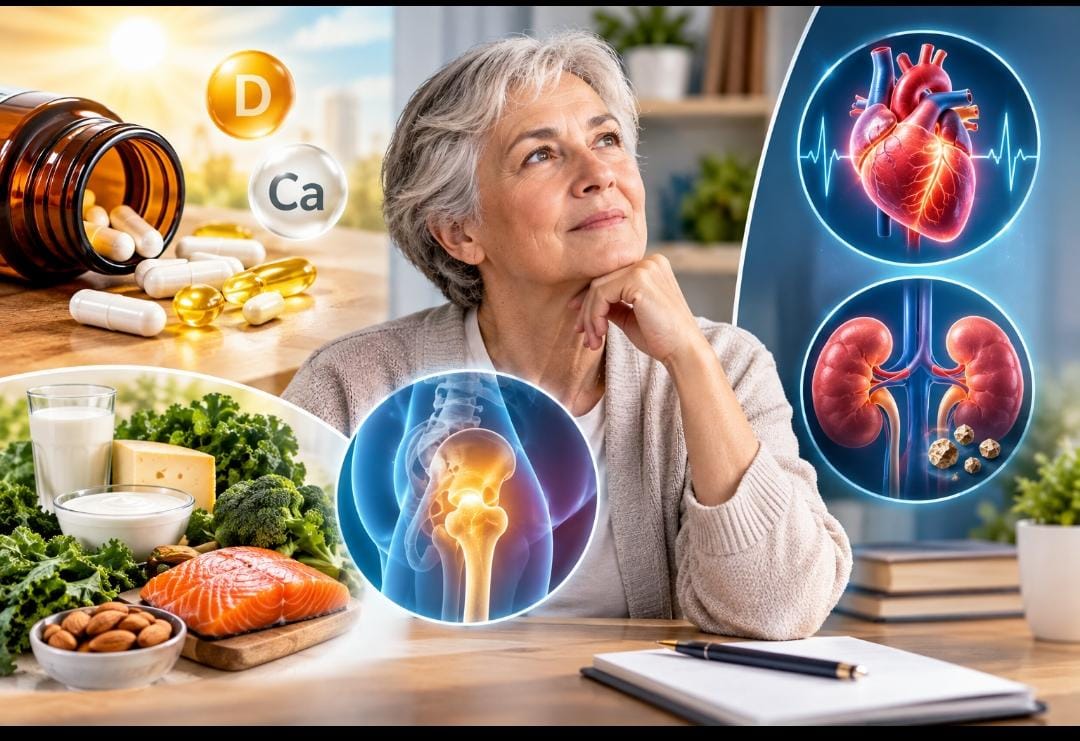
For many years, calcium and vitamin D have been widely associated with the prevention of osteoporosis and fractures, particularly with advancing age.
However, clinical studies and systematic reviews point to a more complex picture:
Getting enough calcium and vitamin D is important for bone health, but routinely taking supplements without a clear need does not necessarily mean a lower risk of fractures.
It is important to distinguish between a healthy person taking supplements simply for prevention and a patient who has osteoporosis, confirmed vitamin D deficiency, or significant risk factors for fractures.. these are very different situations.
1. Do They Really Protect Bones Against Fractures?
In a review of the evidence that included 11 randomized trials and more than 51,000 adults, vitamin D combined with calcium did not show a clear reduction in the risk of total fractures or hip fractures among community-dwelling adults who did not have known vitamin D deficiency, osteoporosis, or a previous history of fractures.
A recent draft recommendation from the U.S. Preventive Services Task Force also concluded that routine use of vitamin D, with or without calcium, does not provide a net benefit for the primary prevention of fractures in postmenopausal women and men aged 60 years or older who live in the community and do not have osteoporosis or vitamin D deficiency.
However, these findings do not mean that calcium or vitamin D are unimportant for bone health, nor do they mean that treatment should be stopped in people who have osteoporosis, confirmed deficiency, or a high risk of fractures.
The main issue is the routine use of supplements simply because of advancing age.
2. Food First.. But Is Calcium from Food Always Better?
Getting calcium from food remains an important part of a healthy diet.
It can be obtained from dairy products and some fortified foods, as well as certain vegetables and other dietary sources.
However, the difference between “natural calcium” and “calcium found in supplements” should not be portrayed as an absolute difference in the way the body handles them.
Calcium absorption is affected by the amount consumed, its source, the type of supplement, and the person’s nutritional status.
Therefore, the goal is not to avoid supplements altogether, but to use them when there is a genuine need and at the appropriate dose.
3. Kidney Stones
This is one of the clearer risks identified in the studies.
In an analysis of randomized trials, combined calcium and vitamin D supplementation was associated with a small but statistically significant increase in the occurrence of kidney stones.
In contrast, calcium alone did not show a clear increase in kidney stone risk in the same analysis, highlighting the importance of not treating all supplements as if they carry the same risks.
Calcium supplements can also cause gastrointestinal symptoms, such as constipation, in some people.
Therefore, the statement that “supplements are completely safe because they are just vitamins and minerals” is not accurate.
4. Do Calcium Supplements Threaten Heart Health?
This is one of the most debated issues.
Some studies have suggested a possible relationship between calcium supplements and the risk of cardiovascular disease, while other studies and clinical trials have not found a clear association.
Therefore, it cannot be stated that calcium supplements definitely cause arterial calcification or heart attacks.
So far, scientific authorities indicate that the relationship between calcium supplementation and cardiovascular health remains unresolved and requires further research.
This is a very important point: the presence of signals that warrant further investigation does not prove that supplements “deposit in the arteries” in everyone who takes them.
6. Should Vitamin D and Calcium Levels Be Tested Before Taking Supplements?
Not everyone needs a series of laboratory tests before taking any dietary amount of calcium or vitamin D.
Routine screening for vitamin D deficiency in all adults who have no symptoms or specific risk factors is also not generally recommended.
The decision depends on the person’s health status, diet, medications, risk factors for osteoporosis and fractures, and the possibility of a deficiency or a problem with nutrient absorption.
People who have symptoms, risk factors, or certain medical conditions may require a more specific medical and laboratory evaluation.
7. The Smarter Approach: Assess Your Needs First.. Supplement When Necessary
The most rational approach is neither to fear calcium or vitamin D nor to take supplements routinely. Instead, it starts with a balanced diet.
The next step is to assess how much calcium and vitamin D the person is actually getting, while considering age, health status, medications, and risk factors for osteoporosis and fractures.
When supplements are genuinely needed, the goal should be to reach the appropriate amount rather than taking high doses based simply on the belief that more will provide greater protection against bone loss.
In people with osteoporosis, confirmed deficiency, or a high risk of fractures, calcium and vitamin D supplements may be part of the treatment plan, but they should be used as part of a comprehensive medical assessment and not as a substitute for treatment specifically directed at osteoporosis when such treatment is needed.
Therefore, preventive health is not about flooding the body with supplements, nor is it about being afraid of them. It is about understanding the actual need and using them when there is a clear benefit.
A dietary supplement may be beneficial when it addresses a genuine deficiency or need.. but it is not necessarily more beneficial simply because you are getting older.
Designed and published by HealthNato medical editorial team.
Information reviewed by HealthNato Scientific Team
on September 22, 2026 at 12:30 PM
Related articles
 General Health
The Hidden Battle After Abdominal Surgery: Understanding Postoperative Peritoneal Adhesions
 General Health
The Revolution in New Obesity Medications vs. Bariatric Surgery... Has the Era of the Scalpel Come to an End?
 General Health
7 Simple Habits That Could be Time Bombs in Your Daily Life !
 General Health