Can Sleeping More Than 8 Hours Cause Death?

Designed and published by HealthNato medical editorial team.
Fact-checked by HealthNato Scientific Team
on October 5, 2026 at 12:30 PM
The surprise came from a follow-up that lasted more than 30 years
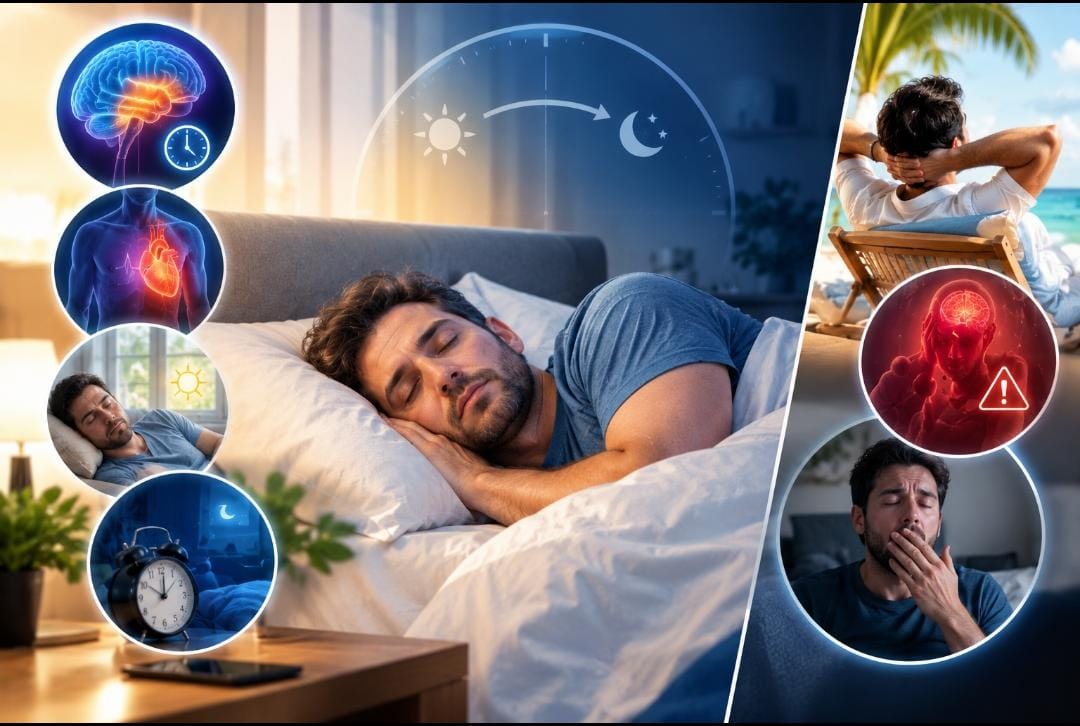
A recent study published in the Journal of Sleep Research followed 3,305 people from Taiwan for approximately 30 years and found that the lowest mortality rate was among those who habitually slept 7–8 hours per day.
Those who habitually slept 9 hours or more had an approximately 17% higher risk of all-cause mortality compared with the 7–8-hour sleep group.
But there is one important word here: association… not proof of causation.
The study does not say that sleeping 9 hours “kills,” nor that waking up after 9 hours will make you more likely to die.
Long sleep in some people may instead be a reflection of an existing health problem rather than its cause.
So, should I stop sleeping in on vacation?
Of course not—and here comes the second surprise.
A very recent study involving more than 85,000 people from the UK Biobank found that people who experienced sleep deprivation and then engaged in catch-up sleep did not show the same increase in risk seen among those who remained sleep-deprived without catching up, particularly with severe sleep deprivation.
In other words:
An extra hour after a bad week of sleep is not the same as routinely sleeping 9 or 10 hours every night.
The problem is not giving your body a chance to recover…
The problem is when long sleep becomes a persistent pattern, or when you need many hours of sleep and still wake up exhausted.
The extra hour is not the problem… the question is: Why do you need it?
If you sleep 6 hours throughout the week and then sleep 7 or 8 hours during your days off, your body may simply be trying to recover some of the sleep it has missed.
But if you regularly sleep 9 or 10 hours and still feel that you need more, then it is worth looking at the situation differently.
Sometimes, long sleep is not a sign that you simply “love sleeping”…
It may be one of the indicators that deserves further investigation.
Factors such as sleep disorders, certain chronic diseases, medications, mood disorders, or disruptions in the body’s circadian rhythm may all play a role.
The Bottom Line..
Don’t be afraid of an extra hour of sleep during your vacation.
And don’t consider long sleep healthy simply because it is sleep.
The goal is not to sleep as little as possible, but to get enough, regular sleep that suits your body’s needs.
And more important than the number of hours displayed on your phone in the morning:
Do you wake up refreshed? Do you sleep regularly? And do you consistently need long hours of sleep just to get through your day?
Because sometimes…
Extra sleep is the rest your body needs, and sometimes it is a message from your body that deserves to be heard.
Designed and published by HealthNato medical editorial team.
Fact-checked by HealthNato Scientific Team
on October 5, 2026 at 12:30 PM
Get new articles in your inbox
One short email a week, no spam.
Your privacy is important to us.
Related Articles
 General Health
The Hidden Battle After Abdominal Surgery: Understanding Postoperative Peritoneal Adhesions
 General Health
The Revolution in New Obesity Medications vs. Bariatric Surgery... Has the Era of the Scalpel Come to an End?
 General Health
7 Simple Habits That Could be Time Bombs in Your Daily Life !
 General Health