Dangerous Bacteria Without Symptoms May Reshape Infants’ Gut…

Written by Dr. Mona Saeed
Family Medicine Physician & Clinical Nutrition and Weight Management Specialist | Scientific Development Team,
HealthNato
Information reviewed by HealthNato Scientific Team
on October 8, 2026 at 12:30 PM
Dangerous Bacteria Without Symptoms May Reshape Infants’ Gut…
When there are no symptoms… does that mean everything is fine inside the baby’s gut?
Clostridioides difficile (or C. difficile) is usually associated in our minds with severe diarrhea, colitis, and serious complications, particularly in adults.
But infants represent a different mystery.
As many as approximately 40–90% of infants in some industrialized communities may carry this bacterium in their gut without developing the usual disease. For this reason, its presence during the first years of life has long been considered, in most cases, a largely harmless phenomenon.
But a recent study led by researchers from Children’s Hospital of Philadelphia (CHOP) and published in Science raises a more complex question:
Does the absence of symptoms really mean the absence of an effect?
The answer suggested by the study: No, not necessarily.
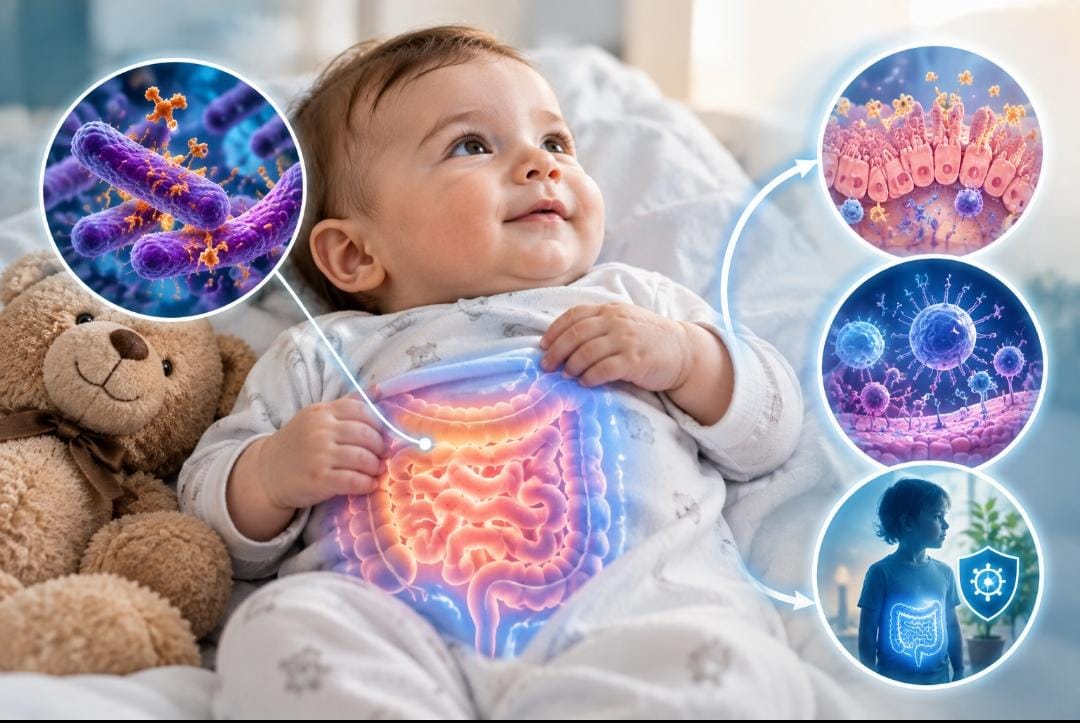
The infant does not appear ill… but the gut may still respond
The researchers used a range of models, including newborn mice, laboratory models made from human intestinal tissue, as well as analysis of intestinal biopsies from infants carrying the bacterium.
In the mouse model, bacterial colonization did not lead to the overt disease typically seen in adults.
However, inflammatory responses and changes in the cells lining the intestine and in tissue-repair mechanisms were observed.
In other words:
The gut was not biologically “silent,” even when clinical symptoms were absent.
The surprise was not only the bacterium… but its toxins
The researchers found that the effects on the intestinal lining were largely associated with C. difficile toxins, rather than simply with the presence of the bacterium itself.
These toxins drove intestinal cells into responses associated with inflammation and damage repair, and also affected the behavior of intestinal stem cells and the way some new cells develop.
In animal models, not all of these changes disappeared quickly after exposure ended. Some effects were still observed later in adulthood.
And this is where the significance of the study lies:
The microbe may not cause obvious disease at this stage of life, but it may interact with a gut that is still developing.
The Immune System
The effects did not stop at the intestinal lining.
The researchers found changes in the immune environment within the gut in mouse models, including changes in certain types of immune cells and cells involved in responses to damage and tissue repair.
Even more intriguingly, some of these changes persisted into adulthood in the mice.
But:
This does not mean that a child carrying C. difficile will go on to develop allergies, asthma, or an immune disease.
The study opens the door to further research, but it did not establish that such findings occur in the same way in humans. Whether these early changes actually lead to future diseases still requires long-term studies.
The Effect on Infants
This is one of the most important aspects of the study.
The researchers analyzed intestinal biopsies from five infants along with corresponding stool samples and found evidence that human intestinal cells at this stage of life can be affected by C. difficile toxins, consistent with the findings observed in the experimental models.
However, the number of infants was very small, so these findings alone cannot be used to conclude that every infant carrying the bacterium experiences long-term damage.
We are looking at an important scientific signal… not a final verdict.
Future Solutions
The researchers tested a vaccine targeting C. difficile using an mRNA-based approach delivered in lipid particles and found that vaccinating the mother in the animal model helped protect the offspring from some toxin-dependent effects.
But this finding does not mean that a maternal vaccine is currently available to protect infants against C. difficile.
Rather, it is an interesting step that could open the door to a future preventive strategy if subsequent studies demonstrate its safety and effectiveness in humans.
In the End…
The most important message from this study is:
“The absence of overt disease does not necessarily mean the absence of biological activity.”
At a stage when the intestinal lining and immune system are still developing, exposure to C. difficile toxins appears capable of leaving a biological imprint on cells and tissues, and these changes may potentially have future significance.
But:
Do these changes actually translate into disease or long-term health differences in human children?
That is what future research will have to answer.
For now, we need to understand that an infant’s microbiome is not simply a collection of bacteria living in the gut…
It is part of a living ecosystem that is taking shape during one of the most sensitive stages of life.
Written by Dr. Mona Saeed
Family Medicine Physician & Clinical Nutrition and Weight Management Specialist | Scientific Development Team,
HealthNato
Information reviewed by HealthNato Scientific Team
on October 8, 2026 at 12:30 PM
Related articles
 General Health
The Hidden Battle After Abdominal Surgery: Understanding Postoperative Peritoneal Adhesions
 General Health
The Revolution in New Obesity Medications vs. Bariatric Surgery... Has the Era of the Scalpel Come to an End?
 General Health
7 Simple Habits That Could be Time Bombs in Your Daily Life !
 General Health