A New Capsule Expands Inside the Stomach and Stays for 48 Hours: Could It Change the Future of H. pylori Treatment?

Written by Prof. Dr. Fatma Younis
Scientific Development Director at HealthNato | Professor of Hepatology and Gastroenterology
Information reviewed by HealthNato Scientific Team
on October 24, 2026 at 12:30 PM
This is what researchers in Norway are working toward with a new drug-delivery technology that could open up a different approach to treating Helicobacter pylori infection, one of the leading causes of stomach ulcers.
How Does the New Capsule Work?
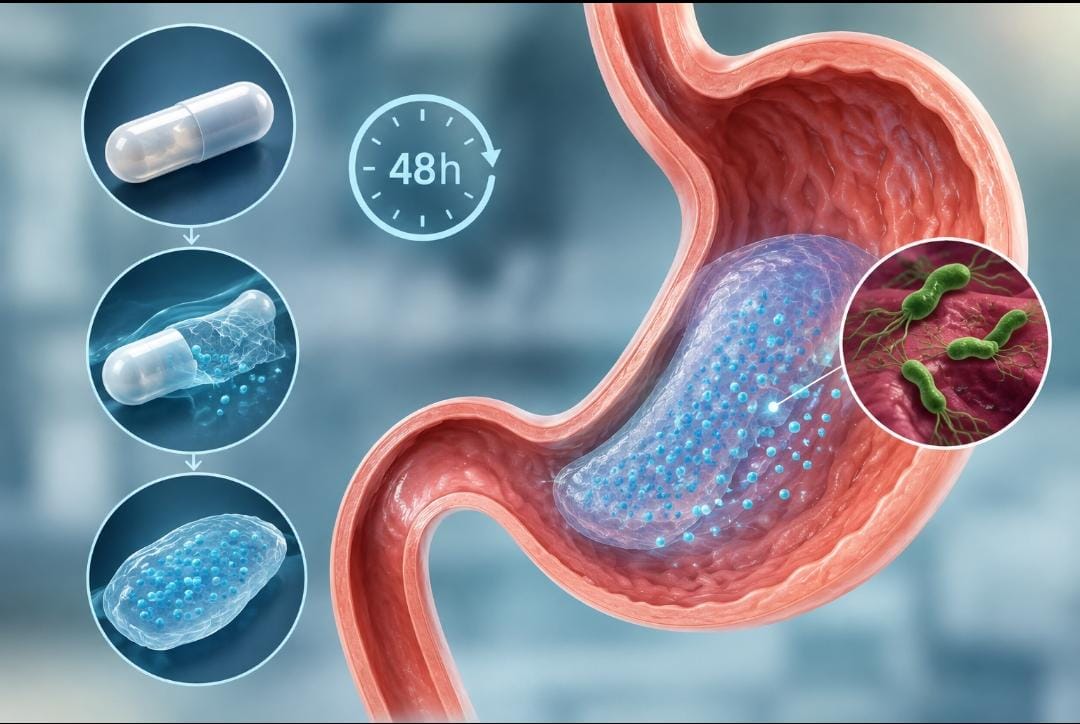
Researchers at UiT The Arctic University of Norway have developed a drug-delivery system based on polymeric materials that, after the capsule's outer shell dissolves in the stomach, form an expandable gel-like membrane that is difficult to pass through the stomach outlet into the intestine.
The membrane carries the antibiotic ciprofloxacin and releases it gradually. In laboratory tests, it was able to withstand stomach contractions for at least 48 hours.
The aim is to prolong the drug's residence time in the stomach and allow it to be delivered to the site of infection for a longer period.
Why Could This Matter?
Treatment for H. pylori infection typically involves a combination of medications, including antibiotics and drugs that reduce stomach acid production, taken according to a specific treatment regimen.
Side effects and frequent dosing may make it difficult for some patients to complete their treatment.
By keeping medication in the stomach for longer, this technology could help researchers develop more efficient drug-delivery methods and potentially improve treatment in the future.
Is the Capsule Ready for Use?
Not yet. The study was published in Carbohydrate Polymer Technologies and Applications. Tests on human cells showed encouraging preliminary findings regarding biocompatibility. However, these results alone are not enough to establish the technology's safety and effectiveness in patients.
Prolonging an antibiotic's presence in the stomach does not automatically mean that other medications can be eliminated or that treatment doses can be reduced. Further research and clinical evidence are needed to establish its safety and efficacy and determine how it behaves in the human stomach.
The Takeaway
The next step in treating H. pylori may not lie solely in developing a new antibiotic, but also in finding better ways to keep medication at its intended site for longer.
However, turning this concept into a treatment that reduces dosing frequency or improves cure rates remains a research goal that has yet to be proven.
Written by Prof. Dr. Fatma Younis
Scientific Development Director at HealthNato | Professor of Hepatology and Gastroenterology
Information reviewed by HealthNato Scientific Team
on October 24, 2026 at 12:30 PM
Related articles
 General Health
The Hidden Battle After Abdominal Surgery: Understanding Postoperative Peritoneal Adhesions
 General Health
The Revolution in New Obesity Medications vs. Bariatric Surgery... Has the Era of the Scalpel Come to an End?
 General Health
7 Simple Habits That Could be Time Bombs in Your Daily Life !
 General Health