GLP-1 Weight-Loss Injections Do More Than Reduce Weight.. What Do They Do to the Liver?

Written by Prof. Dr. Fatma Younis
Scientific Development Director at HealthNato | Professor of Hepatology and Gastroenterology
Fact-checked by HealthNato Scientific Team
on September 18, 2026 at 12:30 PM
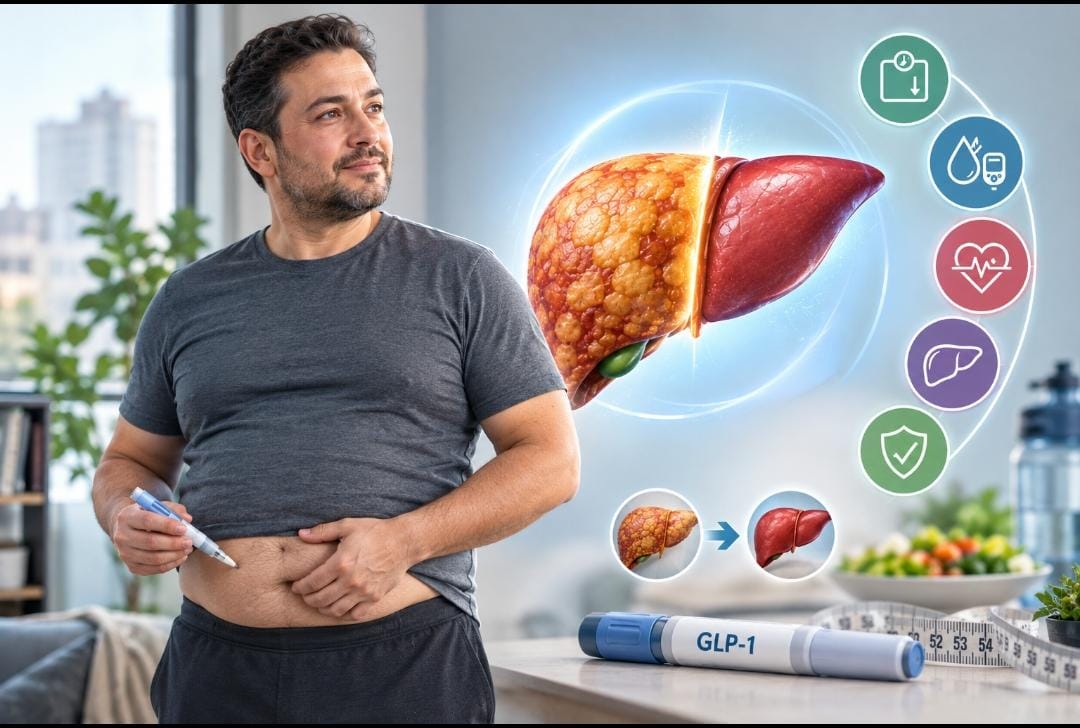
From weight loss and improved insulin resistance to a reduction in liver inflammation and fibrosis.. How have GLP-1 medications changed the treatment landscape for Metabolic Dysfunction-Associated Steatohepatitis (MASH)?
For a long time, the discussion surrounding GLP-1 medications focused primarily on diabetes and weight loss.
But in recent years, another story has emerged in clinical research:
Can medications that help patients lose weight do something even more important inside the liver itself?
The answer is becoming clearer now.
Clinical trials have shown that some medications acting through the GLP-1 pathway can help improve Metabolic Dysfunction-Associated Steatohepatitis (MASH).
Moreover, semaglutide has become the first GLP-1 medication in the United States to receive approval from the U.S. Food and Drug Administration (FDA) for the treatment of MASH in adults with moderate to advanced liver fibrosis, provided that they have not progressed to full-blown cirrhosis.
But how does this happen? And is the benefit simply a natural consequence of weight loss? Or is there a deeper effect?
First.. What Is MASH?
MASH is the new acronym for what was previously known as NASH, and it represents the inflammatory form of Metabolic Dysfunction-Associated Steatotic Liver Disease (MASLD).
The problem usually begins with the accumulation of fat inside liver cells, particularly in association with obesity, insulin resistance, type 2 diabetes, and lipid disorders.
But fat accumulation alone is not the end of the story.
In some patients, fat accumulation is associated with inflammation and damage to liver cells, and as the inflammatory process continues, the formation of fibrous tissue — that is, fibrosis — may begin.
And this is where the real danger begins.
Advanced fibrosis may eventually progress to liver cirrhosis and chronic liver complications. Therefore, the therapeutic goal is no longer simply to “clean the liver of fat,” but rather to stop or reverse the inflammatory and fibrotic progression of the disease as much as possible.
This Is Where GLP-1 Medications Entered the Picture
Medications that activate the GLP-1 receptor help increase feelings of satiety, reduce food intake, improve blood glucose control, and improve certain aspects of insulin resistance, thereby helping patients lose weight.
This point is particularly important for the liver.
Because weight loss — especially a reduction in visceral fat and an improvement in insulin resistance — can reduce one of the major drivers of fatty liver disease.
But the story is not simply:
(Medication) causes (weight loss), which leads to (a better liver).
Multiple metabolic changes occur simultaneously, while some of the potential direct effects on the liver are still under investigation.
This has made the clinical question more precise:
Do the liver tissues themselves change in addition to the weight loss?
And This Is Where the Biopsy Results Came In
Semaglutide.. The Evidence That Took the Story to a New Level
In the Phase 3 ESSENCE trial, patients with biopsy-confirmed MASH and moderate to advanced fibrosis participated in the study.
In the interim analysis at week 72 — approximately one and a half years of treatment — semaglutide showed clear superiority compared with placebo:
- Resolution of liver inflammation: The medication successfully resolved MASH and cleared the condition from the liver cells in approximately 63% of patients, without worsening liver fibrosis.
- Regression of liver fibrosis: Treatment resulted in improvement and regression of fibrosis stages, with improvement in liver tissue in 37% of patients.
- The double achievement (complete resolution + fibrosis improvement): The medication achieved both outcomes simultaneously — resolution of liver inflammation and regression of fibrosis — in approximately one-third of patients (33%).
- Weight loss: The medication helped patients reduce their body weight by an average of 10.5% of total body weight, compared with only 2% among those who received placebo.
And here an important point emerges:
The trial did not measure weight alone; it also examined the liver tissue itself through biopsy.
This makes the findings more significant than simply seeing an improvement in liver enzymes on blood tests.
What About Tirzepatide (Mounjaro)?
Tirzepatide offers a newer mechanism of action because it has a dual effect, and it has shown very strong results in clinical research at week 52, after one year of treatment:
- Resolution of MASH: The rate of MASH resolution increased with the dose, reaching 62%.
- Repair and improvement of liver fibrosis: The medication resulted in improvement and regression of fibrosis stages in more than 50% of patients across the different doses.
- The key medical difference between the two medications:
Despite the promising and very strong results seen with tirzepatide, there is an important regulatory difference between it and semaglutide: semaglutide has completed its final stages of clinical trials and has received official approval from the U.S. Food and Drug Administration (FDA) for patients with MASH and fibrosis.
However, tirzepatide is still in the clinical research phase (Phase 2) for this specific liver indication and has not yet received final official approval for the treatment of MASH, unlike semaglutide, despite its excellent results.
Does This Mean That Every Patient With Fatty Liver Needs a GLP-1 Medication?
No.
This is one of the most important points that should not get lost amid the attention surrounding weight-loss medications.
The presence of fat in the liver on imaging does not automatically mean that the patient has MASH, nor does it automatically mean that they have advanced fibrosis.
The treatment goal also varies from one patient to another depending on:
- The degree of fibrosis. - Whether MASH is present or not. - Obesity. - Diabetes and insulin resistance. - Lipid disorders. - The risk of disease progression. - Coexisting medical conditions. - And whether the medication is appropriate for the individual patient.
Therefore, determining disease severity and assessing fibrosis have become essential components of the treatment decision, rather than simply knowing that the liver is “fatty.”
The updated guidelines of the American Association for the Study of Liver Diseases (AASLD) also emphasize that the use of semaglutide in Metabolic Dysfunction-Associated Steatohepatitis (MASH) requires appropriate patient selection and monitoring of efficacy and safety.
So.. What Exactly Do GLP-1 Medications Do to the Liver?
The clinical effects can be viewed as several interconnected pathways:
Weight loss ↓ ↓ Reduced visceral fat and insulin resistance ↓ Improved glucose control and metabolic function ↓ Reduced metabolic stress on the liver ↓ Improvement in MASH in some patients ↓ Potential improvement in fibrosis or slowing of its progression
However, this sequence does not mean that every patient will go through the same stages, or that advanced fibrosis will automatically disappear.
Side Effects..
The picture is not entirely positive.
The most common side effects of these medications are related to the gastrointestinal system, including nausea, vomiting, diarrhea, constipation, and abdominal pain or discomfort, and they are often more noticeable during dose escalation.
Weight loss itself may also be accompanied by a loss of muscle mass. Therefore, good clinical management of these medications should not focus solely on the number on the scale, but also on the quality of weight loss and the preservation of muscle mass, nutrition, and physical activity.
This point has become even more important with the long-term use of GLP-1 medications, particularly as scientific discussion continues regarding muscle and bone mass loss, treatment adherence, and weight regain after discontinuation.
Summary
GLP-1 medications are beginning to change the concept of treating obesity and fatty liver disease at the same time.
They are no longer simply medications that help patients reach a lower body weight. Clinical trials have shown that some of these treatments may also be associated with meaningful improvements in steatohepatitis and certain measures of fibrosis.
Most importantly, semaglutide has now become an FDA-approved treatment for adults with Metabolic Dysfunction-Associated Steatohepatitis (MASH) and moderate to advanced fibrosis (F2–F3), before the stage of cirrhosis.
Today, controlling obesity, diabetes, insulin resistance, and lipid disorders has become a central part of the fight against fatty liver disease, and GLP-1 medications have become one of the important pharmacological tools in this fight.
Written by Prof. Dr. Fatma Younis
Scientific Development Director at HealthNato | Professor of Hepatology and Gastroenterology
Fact-checked by HealthNato Scientific Team
on September 18, 2026 at 12:30 PM
Get new articles in your inbox
One short email a week, no spam.
Your privacy is important to us.
Related Articles
 General Health
The Hidden Battle After Abdominal Surgery: Understanding Postoperative Peritoneal Adhesions
 General Health
The Revolution in New Obesity Medications vs. Bariatric Surgery... Has the Era of the Scalpel Come to an End?
 General Health
7 Simple Habits That Could be Time Bombs in Your Daily Life !
 General Health