Gut Bacteria May Contribute to Colon Cancer.. New Scientific Achievement Successfully Blocks Their Toxins

Written by Prof. Dr. Fatma Younis
Scientific Development Director at HealthNato | Professor of Hepatology and Gastroenterology
Information reviewed by HealthNato Scientific Team
on November 2, 2026 at 12:30 PM
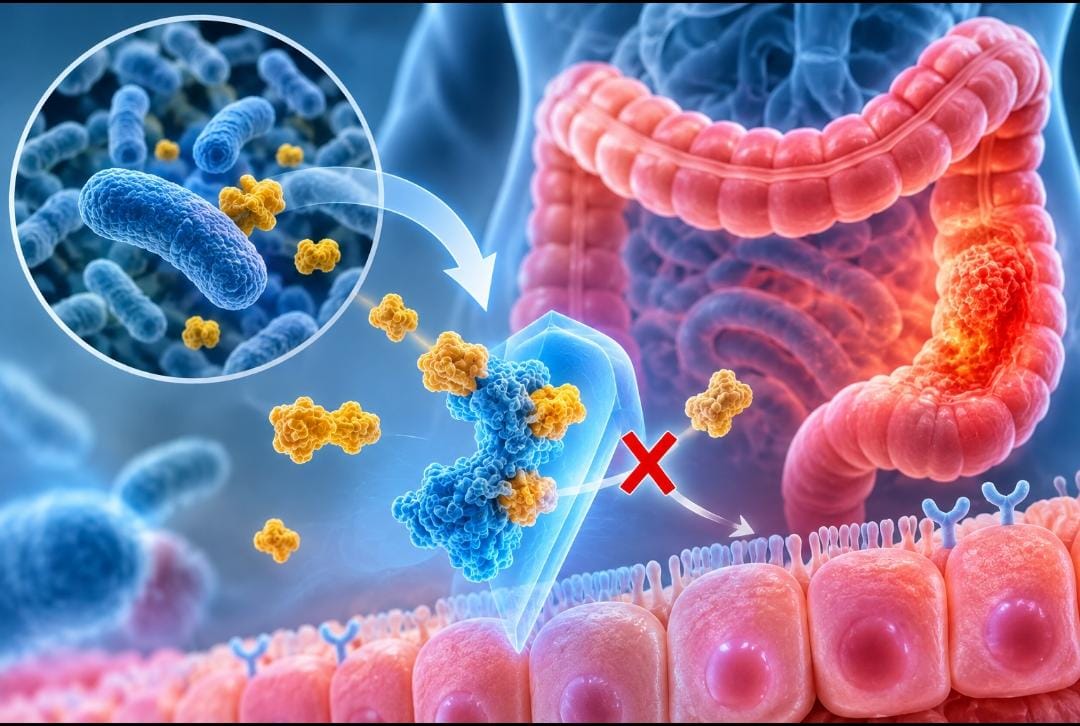
Recently, researchers succeeded in identifying how one of these toxins attaches to and attacks colon cells. They then developed a molecule that acts as a "decoy" to intercept the toxin before it can damage the cells.
How Does the Bacteria Begin Its Attack on the Colon?
The study focused on a bacterium known as Bacteroides fragilis, which naturally occurs in the human gut.
However, some strains produce a toxin known as BFT, or Bacteroides fragilis toxin. It can disrupt the protective intestinal barrier and trigger inflammation. Its activity has also been linked to the development of colon tumors in experimental studies.
For years, scientists understood the effects of this toxin, but they had not precisely identified the protein it uses to attach to colon cells and initiate its attack.
Identifying the Entry Point.. A Protein That Turns Cells into Targets
In the new study, led by researchers at the Johns Hopkins Kimmel Cancer Center, the team identified a protein known as Claudin-4. This protein helps intestinal cells form tight junctions that maintain the integrity of the intestinal barrier, which acts as a protective shield against the entry of bacteria and their toxins.
Using advanced techniques, the researchers discovered that this protein serves as a key binding point that BFT needs to reach the cells.
When the researchers disabled the gene responsible for producing Claudin-4 in intestinal cells, the toxin lost its ability to bind to them.
This led to an even more intriguing idea: What if the toxin could be tricked and diverted away from actual cells?
A Molecular Decoy That Tricks the Toxin Before It Attacks Cells
Building on this discovery, the researchers designed a soluble protein containing parts of Claudin-4, allowing it to act as an alternative receptor that attracts and binds to the toxin away from colon cells.
The concept can be compared to placing a false target in front of the bacterial toxin, drawing it away from intestinal cells.
When this design was tested in mice, the decoy protein successfully intercepted the toxin and reduced the damage it caused. This suggests the possibility of intervening at the beginning of the damage process rather than waiting for it to occur.
The findings are promising, but they do not mean that scientists have already developed an approved treatment or preventive method for colon cancer.
The experiments involving the decoy protein were conducted in animal models, and further research is needed to establish its safety and effectiveness in humans and determine whether it can be used medically.
Likewise, the presence of Bacteroides fragilis in the gut does not mean that a person carries a toxin-producing strain, nor does it necessarily mean they will develop cancer. The risk is associated with specific bacterial characteristics and multiple other contributing factors.
The Bottom Line
The significance of this discovery lies not only in confirming the role of a bacterial toxin in damaging the colon, but also in identifying the binding point it exploits to reach cells and presenting an experimental strategy to intercept it before the damage begins.
In the future, this could open a new avenue for preventing certain types of colon cancer by targeting microbial factors that contribute to disease development, rather than focusing solely on cancer cells after they have emerged.
Written by Prof. Dr. Fatma Younis
Scientific Development Director at HealthNato | Professor of Hepatology and Gastroenterology
Information reviewed by HealthNato Scientific Team
on November 2, 2026 at 12:30 PM
Related articles
 General Health
The Hidden Battle After Abdominal Surgery: Understanding Postoperative Peritoneal Adhesions
 General Health
The Revolution in New Obesity Medications vs. Bariatric Surgery... Has the Era of the Scalpel Come to an End?
 General Health
7 Simple Habits That Could be Time Bombs in Your Daily Life !
 General Health