How Can Gut Bacteria Affect the Healing of Intestinal Anastomoses?


Written by Prof. Dr. Mohamed Henaish
Professor and Consultant of General Surgery | Laparoscopy | Bariatric | Cosmetic and Oncologic Surgery
Fact-checked by HealthNato Scientific Team
on September 2, 2026 at 12:30 PM
In colon surgery, there is a very important moment:
After removing the diseased part of the intestine, the surgeon reconnects the two ends with a new anastomosis.
The anastomosis may have been created precisely, with no obvious tension on the tissues, and adequate blood and oxygen supply to it may appear to be present, yet leakage from the anastomosis (Anastomotic Leak) may still occur.
So, is the problem always with the surgery?
Not necessarily, because the anastomosis does not fail because of a single factor..
We now know that anastomotic healing is a complex biological process involving technical factors, blood and oxygen supply, inflammation and immunity, nutritional status, infection, as well as the microbial environment surrounding the anastomosis.
This is where scientists have begun to focus on the role of the gut microbiome (Gut Microbiome), which is an integrated community of microorganisms that live within the human gastrointestinal tract, particularly in the large intestine.
Not as an “enemy” all the time, but rather as one of the biological factors that may support healing under certain circumstances and may contribute to weakening it under others. More accurately, it may be one of the players within a complex chain that affects the ability of the anastomosis to heal.
---
What happens after the surgery is over?
Creating the anastomosis is not the end of the story, but rather the beginning of a new phase of healing.
Inflammatory cells, fibroblasts, and new blood vessels begin repairing the tissue, and collagen becomes increasingly important in restoring the strength of the anastomosis.
But this process takes place inside the intestine, which is one of the areas of the body with the highest density of bacteria.
After surgery, the environment surrounding the anastomosis changes: the nutrients reaching the bacteria change, intestinal motility changes, the mucosal barrier changes, and local conditions within the tissues change. The microbiome is also affected by bowel preparation and antibiotics.
These changes may allow some microorganisms to increase in number or acquire more harmful characteristics.
And here comes the question:
Can these changes affect anastomotic healing?
Current evidence indicates that there is indeed an effect, but the extent of this role is still under investigation.
---
When a Normal Bacterium — Enterococcus faecalis — Becomes Part of the Problem..
One of the microorganisms that has been studied extensively in this field is:
Enterococcus faecalis — Enterococcus faecalis (fecal enterococci)
It is a bacterium that can naturally exist in the gastrointestinal tract, and therefore, its presence alone does not mean that disease is present.
However, some of its strains are capable of secreting (enzymes) that work like “scissors,” cutting and breaking down the substances that strengthen tissues, particularly collagen.
And it does not stop there; it also “provokes” the body’s own cells to secrete a destructive enzyme called (MMP-9), which in turn works to break down the wound area and destroy its cohesive tissue.
And here the important idea emerges:
The bacteria may not attack the “sutures” themselves, but they can weaken the tissue surrounding the anastomosis by affecting collagen and the matrix that gives the tissue its strength.
Animal studies have supported this mechanism, and an association has also been found between the presence of collagenase-producing organisms (a collagen-destroying enzyme) and anastomotic leakage in some human studies.. This evidence still demonstrates association more than it demonstrates causality.
---
Do antibiotics harm the anastomosis?
This is a point that requires precision.
Antibiotics can alter the composition of the microbiome and may affect bacterial colonization resistance (Colonization Resistance), which helps the intestine prevent certain microorganisms from expanding.
But this does not mean that antibiotics used around surgery cause anastomotic leakage or should be avoided.
On the contrary, in elective colon surgeries, guidelines support the use of oral antibiotics together with mechanical bowel preparation in appropriate settings to reduce surgical infections.
Therefore, the optimal goal at present has become:
How can we reduce the risk of infection while, at the same time, preserving as much as possible a microbial environment that supports healing?
This remains an area of research.
---
Not All Microbiomes Are Harmful
This is a fundamental point.
The microbiome is not a group of “bad bacteria” waiting for an opportunity to attack the surgeon.
It is an integrated community of microorganisms, and some of its components may be beneficial, while certain microbial patterns or bacterial functions may become more harmful when the environment changes after surgery.
Likewise, finding a particular bacterium near the anastomosis does not prove that it caused the leakage. It may be a cause, a consequence, or part of a larger chain.
---
Is Stool Analysis Alone Enough?
Of course not.. because the microbiome found in stool is not necessarily the same as the microbiome present on the surface of the surgical anastomosis.
For this reason, some research is moving toward studying samples closer to the anastomosis itself and studying the functions and activity of bacteria rather than simply their names.
And here an important idea emerges:
The function of a bacterium may be more important than its mere presence.
---
Can the Microbiome Be Modified to Prevent Leakage?
This is the most exciting part for the future, but it has not yet become a clinical treatment.
Strategies currently being studied include modifying bowel preparation, selecting antibiotics, nutritional interventions, probiotics, targeting collagen-degrading enzymes, and certain compounds that have shown promising results in experimental models.
However, some of these results are still limited to laboratory or animal studies.
So far, there is no standardized diet or microbial supplement that can be prescribed to all patients as a proven method for preventing anastomotic leakage.
---
Conclusion..
The Anastomosis Does Not Heal Through Sutures or Staples Alone
Anastomotic leakage is not a problem with a single cause, but rather a potential result of the interaction between multiple technical and biological factors, beginning with how the anastomosis is created and the adequacy of blood and oxygen supply to it, and extending to inflammation, immunity, nutrition, infection, and the microbial environment.
Gut microbiome research today provides an important insight into what these bacteria do within the surgical environment.
But we have not yet reached the stage where we can predict anastomotic leakage through the microbiome alone, or prevent it with a nutritional supplement or a standardized microbial protocol.
Intestinal anastomoses do not depend on sutures or staples alone..
They are living tissues attempting to heal within one of the most microbiologically complex environments in the human body.
Perhaps the future of colon surgery will not lie solely in improving surgical technique, but also in understanding what happens biologically around the anastomosis after the surgeon’s role in the operating room has ended.
Written by Prof. Dr. Mohamed Henaish
Professor and Consultant of General Surgery | Laparoscopy | Bariatric | Cosmetic and Oncologic Surgery
Fact-checked by HealthNato Scientific Team
on September 2, 2026 at 12:30 PM
Get new articles in your inbox
One short email a week, no spam.
Your privacy is important to us.
Related Articles
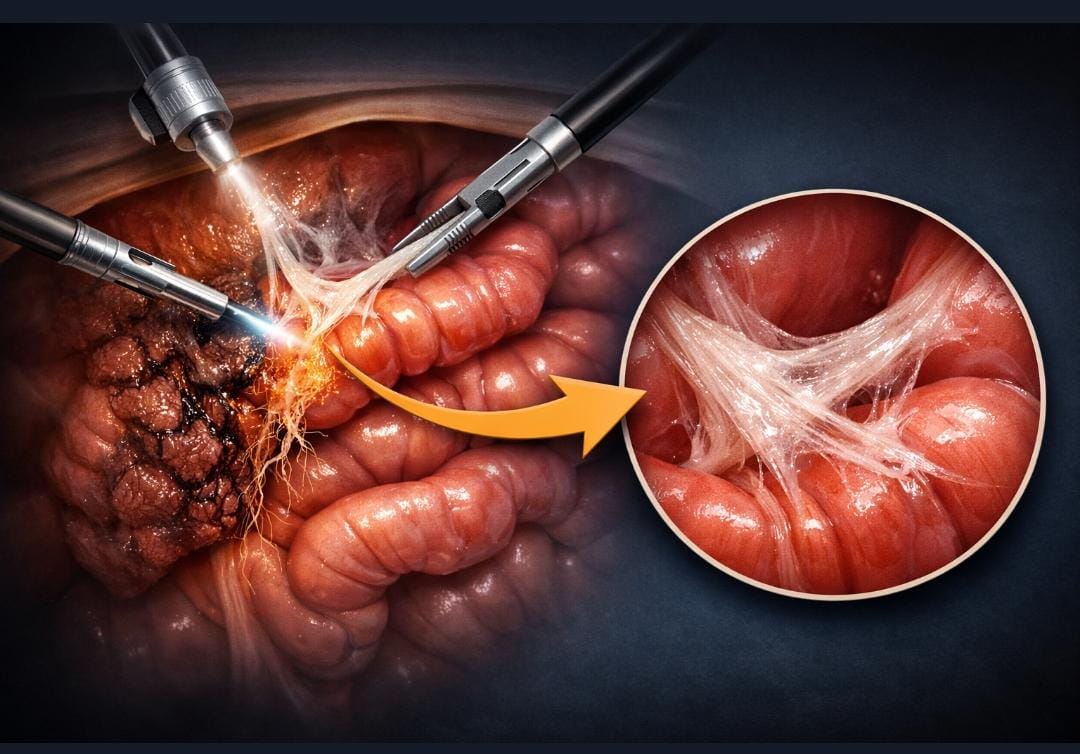 General Health
The Hidden Battle After Abdominal Surgery: Understanding Postoperative Peritoneal Adhesions
 General Health
The Revolution in New Obesity Medications vs. Bariatric Surgery... Has the Era of the Scalpel Come to an End?
 General Health
7 Simple Habits That Could be Time Bombs in Your Daily Life !
 General Health