Irritable Bowel Syndrome or Inflammatory Bowel Disease? When Symptoms Look Similar but the Story Is Completely Different

Written by Prof. Dr. Fatma Younis
Scientific Development Director at HealthNato | Professor of Hepatology and Gastroenterology
Fact-checked by HealthNato Scientific Team
on September 9, 2026 at 12:30 PM
How can you distinguish between a troublesome disorder that can be controlled and an inflammatory disease that requires accurate diagnosis and treatment?
Cramping… bloating… diarrhea… changes in stool form or bowel movement frequency.
These are very common symptoms, to the point that the word “colon” has sometimes become the quick explanation for almost any digestive problem.
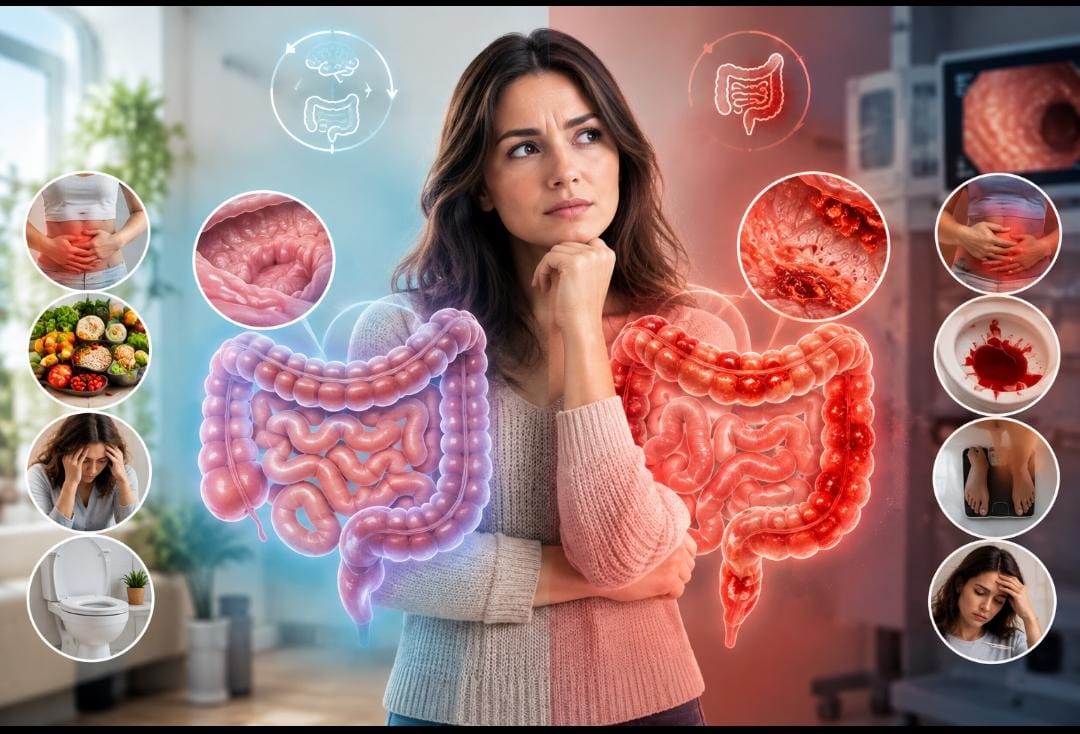
But there is a major difference between having a sensitive bowel with impaired function and having an intestine that is actually inflamed.
This is where the difference between Irritable Bowel Syndrome (IBS) and Inflammatory Bowel Disease (IBD) becomes important.
And it is precisely the similarity between their symptoms that makes confusing the two so common.
First… Irritable Bowel Syndrome (IBS)
Irritable Bowel Syndrome (IBS) is classified among Disorders of Gut-Brain Interaction.
In simpler terms, the problem is not necessarily the presence of inflammation or injury in the intestine, but rather a disturbance in the way the digestive system interacts with neural and sensory signals and regulates bowel movement.
The most common symptoms include:
- Recurrent abdominal pain or discomfort. - Bloating and gas. - Diarrhea, constipation, or alternating between the two. - Changes in bowel movement frequency or stool form. - Sometimes, a feeling of incomplete evacuation.
Although it can be troublesome and affect quality of life, it does not, in itself, cause visible damage to the digestive tract.
So… What Is Inflammatory Bowel Disease (IBD)?
Here, the story changes completely.
Inflammatory Bowel Disease (IBD) is a term for a group of chronic inflammatory diseases that mainly include:
- Crohn’s Disease - Ulcerative Colitis
In these conditions, there is genuine inflammation in the digestive tract that can be detected through laboratory tests, endoscopy, and imaging, and over time it may lead to tissue damage and complications if it is not adequately controlled.
Crohn’s disease can affect different parts of the digestive tract, whereas ulcerative colitis primarily affects the colon and rectum. The nature and depth of inflammation also differ between the two diseases.
The Problem… The Symptoms May Look Similar
And this is where many people fall into the trap.
Diarrhea, abdominal pain, and cramps can occur in both Irritable Bowel Syndrome (IBS) and Inflammatory Bowel Disease (IBD).
However, certain signs should make us stop interpreting everything as “IBS.”
Among the most important are:
- Rectal bleeding or blood in the stool. - Unintentional weight loss. - Anemia. - Fever. - Persistent or severe diarrhea. - Symptoms that wake the patient from sleep.
A family history of inflammatory bowel disease or certain gastrointestinal diseases may also change the level of clinical suspicion.
The presence of these signs does not automatically mean that a person has IBD, but it does mean that the situation deserves medical evaluation rather than simply settling for a diagnosis of “IBS.”
Is There Inflammation in IBS?
This is an important point that deserves clarification.
The modern understanding of the disease is more complex and is associated with changes in the interaction between the brain and the gut, visceral sensitivity, gastrointestinal motility, certain changes in the microbiome, and other factors.
However, this is different from the clear tissue inflammation that characterizes IBD.
Therefore, the term “colitis” should not be used to describe every person experiencing symptoms of IBS.
How Does a Doctor Distinguish Between the Two?
In cases of IBS, diagnosis relies largely on the pattern of symptoms, their history, and the clinical examination, with limited testing when necessary to rule out other diseases.
The guidelines of the American College of Gastroenterology (ACG) indicate that a positive diagnosis of IBS can be based on the patient’s medical history, clinical examination, and symptom pattern, rather than subjecting the patient to a long series of unnecessary tests when there are no alarm signs.
When IBD is suspected, however, the physician may need a different set of diagnostic tools, such as:
- Blood tests to look for anemia, signs of inflammation, or other complications. - Stool tests, including inflammatory markers such as Fecal Calprotectin. - Endoscopy and biopsy when necessary. - Imaging in some cases, particularly when Crohn’s disease is suspected.
The American College of Gastroenterology guidelines recommend using fecal calprotectin and CRP in some patients suspected of having IBS with diarrhea, to help rule out IBD.
Fecal inflammatory markers have also generally become an important part of the assessment and monitoring of inflammatory bowel diseases.
What About Treatment?
Here, too, there is no true similarity between the two conditions.
In cases of IBS, treatment is primarily aimed at controlling symptoms and improving quality of life.
It may include:
- Dietary modifications. - Increasing soluble fiber when appropriate and avoiding foods and beverages that worsen symptoms. - Physical activity and good sleep. - Managing stress and psychological factors associated with symptoms. - Medications targeting constipation, diarrhea, or pain when necessary.
The guidelines of the American College of Gastroenterology (ACG) recommend a limited trial of a Low-FODMAP diet, a popular dietary approach prescribed by physicians to help alleviate symptoms of IBS and digestive problems, to improve overall symptoms in some patients with IBS. They also support the use of soluble fiber.
In IBD, however, the goal is not simply to relieve symptoms.
The primary goal is to control inflammation, achieve disease remission and maintain it, and reduce the risk of intestinal damage and complications.
The patient may require anti-inflammatory medications, immunosuppressants, biologic therapies, targeted molecular medications, and in some cases, surgery.
Can IBS Turn Into Inflammatory Bowel Disease?
No… IBS does not simply turn into Crohn’s disease or ulcerative colitis.
However, a person can certainly develop an inflammatory bowel disease later in life, or IBS-like symptoms may coexist in someone who already has an inflammatory bowel disease.
This is where the importance of accurate diagnosis lies, rather than assuming that every abdominal symptom means the same thing.
The Bottom Line
Not every abdominal pain is inflammation… and not everything we call “the colon” should be considered IBS.
If the symptoms consist of recurrent abdominal pain accompanied by changes in bowel movements and bloating, without alarm signs, then IBS may be one of the common possibilities.
However, the presence of blood in the stool, unintentional weight loss, anemia, fever, persistent nighttime symptoms, or severe and persistent diarrhea warrants a more thorough medical evaluation.
A person should not start a strict diet or take medications or supplements randomly before the cause is known.
Irritable Bowel Syndrome (IBS) is a disorder of gut-brain interaction that can cause pain, bloating, and troublesome changes in bowel habits, but it does not cause visible damage to the intestine.
Inflammatory Bowel Disease (IBD), on the other hand, is a genuine inflammatory disease that includes Crohn’s disease and ulcerative colitis, and it may lead to tissue damage and complications requiring regular treatment and follow-up.
The difference between the two is not determined by the severity of pain alone…
It is determined by the complete story: the pattern of symptoms, alarm signs, investigations, and sometimes endoscopy and biopsy.
Therefore, instead of hastily assuming that it is IBS…
We should ask first:
Are we dealing with a sensitive intestine… or an inflamed intestine ?
Written by Prof. Dr. Fatma Younis
Scientific Development Director at HealthNato | Professor of Hepatology and Gastroenterology
Fact-checked by HealthNato Scientific Team
on September 9, 2026 at 12:30 PM
Get new articles in your inbox
One short email a week, no spam.
Your privacy is important to us.
Related Articles
 General Health
The Hidden Battle After Abdominal Surgery: Understanding Postoperative Peritoneal Adhesions
 General Health
The Revolution in New Obesity Medications vs. Bariatric Surgery... Has the Era of the Scalpel Come to an End?
 General Health
7 Simple Habits That Could be Time Bombs in Your Daily Life !
 General Health