How Does Blood Pressure Fool You? The Effect of a Hot Bath on Blood Pressure

Written by Prof. Dr. Fatma Younis
Scientific Development Director at HealthNato | Professor of Hepatology and Gastroenterology
Information reviewed by HealthNato Scientific Team
on October 16, 2026 at 12:30 PM
How Does Blood Pressure Fool You? The Effect of a Hot Bath on Blood Pressure
Your blood pressure reading may be normal at the doctor’s office, yet rise at home, at work, or during daily activities.
This condition is known as masked hypertension, a problem that may go undetected despite being associated with an increased risk of cardiovascular disease.
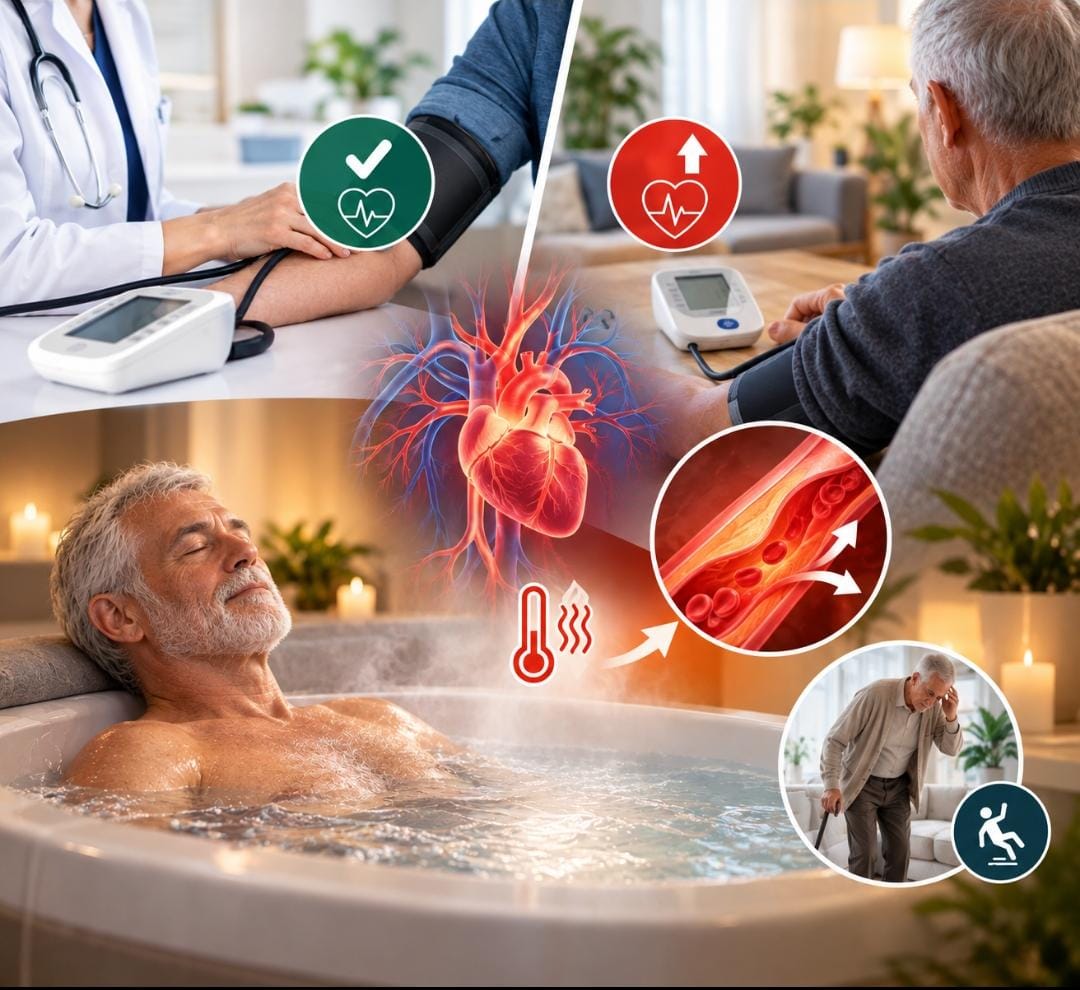
However, recent research has opened another avenue for discussion: Can immersion in hot water help improve blood flow and temporarily lower blood pressure? And what do we actually know about its relationship with vascular health and the risk of falls among older adults?
Masked Hypertension: When an Office Reading Is Not Enough
Masked hypertension occurs when blood pressure readings are normal at the doctor’s office but elevated outside the clinical setting, such as at home, at work, or during the night.
It may be associated with various factors and does not necessarily mean that blood pressure decreases because the clinical environment is calm.
In a preliminary study presented at the American Heart Association’s scientific meetings in 2026, involving 758 older adults aged 78–98 years, signs of masked hypertension were found in approximately 15% of participants.
The condition was also associated with a 70% higher rate of falls compared with people who had clearly elevated blood pressure both in the clinic and at home.
However, these findings do not establish masked hypertension as the sole cause of falls. Falls among older adults may result from multiple factors, including balance disorders, medications, orthostatic hypotension, and vision problems.
To detect hidden blood pressure elevation, it is recommended to use a reliable upper-arm blood pressure monitor after sitting and resting for a few minutes. Measurements should be taken at different times and recorded to share with a doctor. When necessary, the doctor may recommend 24-hour ambulatory blood pressure monitoring.
A Hot Bath: A Rapid Effect on Blood Vessels
In a recent study from the University of Western Australia, researchers compared the response to immersion in water heated to 40°C for 30 minutes with the effect of riding a stationary bicycle for the same duration.
The study included 25 older adults with overweight and found that immersion in hot water was associated with an immediate average reduction of 6 mmHg in systolic blood pressure and 10 mmHg in diastolic blood pressure, although responses varied between individuals.
Heat helps dilate blood vessels near the skin’s surface, increasing blood flow to the skin and changing vascular resistance.
However, this does not mean that a hot bath treats chronic hypertension, nor does it prove that it is more effective than exercise in the long term.
It should also be noted that very hot water may cause dizziness or a drop in blood pressure in some people, particularly older adults, those taking blood pressure-lowering medications, and those with dizziness, a history of falls, or a history of hypotension.
In Conclusion
Although immersion in hot water has shown a promising physiological effect and can temporarily lower blood pressure, the small study is not sufficient to turn this response into a general treatment recommendation. Accordingly, current evidence is insufficient to consider it an established treatment for hypertension or a substitute for medication and regular physical activity.
The most important message is that a normal blood pressure reading at the doctor’s office does not always rule out hypertension.
Measurements outside the clinical setting are also important, because appropriate medical evaluation and consistent healthy habits remain the foundation for protecting the heart and preserving balance and independence with advancing age.
Written by Prof. Dr. Fatma Younis
Scientific Development Director at HealthNato | Professor of Hepatology and Gastroenterology
Information reviewed by HealthNato Scientific Team
on October 16, 2026 at 12:30 PM
Related articles
 General Health
The Hidden Battle After Abdominal Surgery: Understanding Postoperative Peritoneal Adhesions
 General Health
The Revolution in New Obesity Medications vs. Bariatric Surgery... Has the Era of the Scalpel Come to an End?
 General Health
7 Simple Habits That Could be Time Bombs in Your Daily Life !
 General Health