The Revolution in New Obesity Medications vs. Bariatric Surgery... Has the Era of the Scalpel Come to an End?


Written by Prof. Dr. Mohamed Henaish
Professor and Consultant of General Surgery | Laparoscopy | Bariatric | Cosmetic and Oncologic Surgery
Information reviewed by HealthNato Scientific Team
on July 26, 2026 at 10:30 AM
Key points
- Semaglutide and tirzepatide help reduce appetite, improve satiety, and support significant weight loss when combined with lifestyle changes.
- Bariatric surgery generally produces greater and more durable weight loss, especially in people with severe obesity and obesity-related diseases.
- Stopping anti-obesity medications may lead to weight regain, highlighting that obesity is a chronic disease requiring long-term management.
- Choosing between medication, surgery, or a combination of both should be based on an individualized medical assessment rather than a single treatment approach.
For many years, bariatric surgeries, such as sleeve gastrectomy and gastric bypass, have been among the most powerful treatment options available for people living with severe obesity, especially when obesity is associated with type 2 diabetes, high blood pressure, or sleep apnea. However, in recent years, new medications have emerged that have brought about a major shift in obesity treatment, most notably semaglutide and tirzepatide. These medications work by mimicking the effects of natural hormones produced by the body to help regulate appetite, satiety, and blood glucose levels. With the significant weight-loss results achieved by these medications, an important question has begun to emerge: Have modern obesity medications become an alternative to surgery? And can injections achieve results comparable to bariatric surgery in the long term? The simple answer is that there is no single option that is suitable for everyone. Medications and surgery are different therapeutic tools, and each has its own place in obesity treatment. For some patients, combining both approaches may be the best option.
First: How Do Modern Obesity Medications Work?
Some modern obesity medications work by mimicking the effects of natural hormones released by the body after eating. These hormones help regulate appetite, satiety, and blood glucose levels. Their main effects include:
1. Reducing Appetite and Increasing Satiety.
These medications act on specific areas of the brain responsible for regulating appetite, helping a person feel full for longer and reducing the desire to consume large amounts of food. This enables patients to reduce the amount of food they eat without experiencing the persistent hunger that may accompany traditional weight-loss attempts.
2. Slowing the Emptying of the Stomach.
Some of these medications may slow the movement of food from the stomach into the intestines, particularly at the beginning of treatment, which can help maintain a feeling of fullness for a longer period.
3. Improving Blood Glucose Control.
These medications help improve the body's response to insulin and also reduce the secretion of glucagon, a hormone that raises blood glucose levels, thereby helping to improve blood sugar control. For this reason, these medications have become particularly important for people living with obesity and type 2 diabetes.
- The Important Point These effects depend on continuing treatment. When the medication is discontinued, the pharmacological effects it provides gradually wear off, and appetite may increase again. As a result, some patients may regain part of the weight they have lost. This does not mean that the medications are ineffective. Rather, it means that obesity is a chronic disease that may require long-term treatment, just like many other chronic conditions.
Second: What Do Bariatric Surgeries Do Inside the Body?
Bariatric surgery is not simply about reducing the size of the stomach, as some people believe. These procedures can produce important changes in appetite, hormones, and the way the body processes food and glucose.
- Sleeve Gastrectomy During sleeve gastrectomy, a large portion of the stomach is removed, including the area that produces a significant amount of ghrelin, one of the hormones that contributes to feelings of hunger. As a result, patients may experience a significant reduction in appetite after surgery, in addition to being able to eat smaller amounts of food because of the reduced stomach size.
- Gastric Bypass During gastric bypass surgery, the pathway of food through the digestive system is altered, resulting in important hormonal and metabolic changes. One of the most notable changes is an increase in the secretion of certain satiety hormones, such as GLP-1 and PYY, which help reduce appetite and improve blood glucose control.
Surgery can also affect the way the body processes glucose and insulin, which is one of the reasons its effects go beyond simple weight loss. For this reason, these procedures are known as metabolic and bariatric surgeries, rather than simply stomach-reduction surgeries.
Third: Which Has a Greater Impact on Weight... Medications or Surgery?
Modern obesity medications have achieved significant weight-loss results, particularly when used at obesity-treatment doses under medical supervision. Studies have shown that some of these medications can lead to a substantial percentage of total body weight loss, exceeding 15% in some cases, while some studies of tirzepatide have demonstrated even greater results in certain patients. However, when outcomes are considered overall, bariatric surgery remains one of the most effective interventions for achieving substantial and sustained weight loss, particularly among people living with severe obesity. Nevertheless, the results of medication and surgery cannot be compared based on a single number alone. Outcomes vary depending on the type of surgery, the type of medication, the duration of treatment, the patient's individual characteristics, and their commitment to lifestyle changes.
Fourth: What About Type 2 Diabetes ?
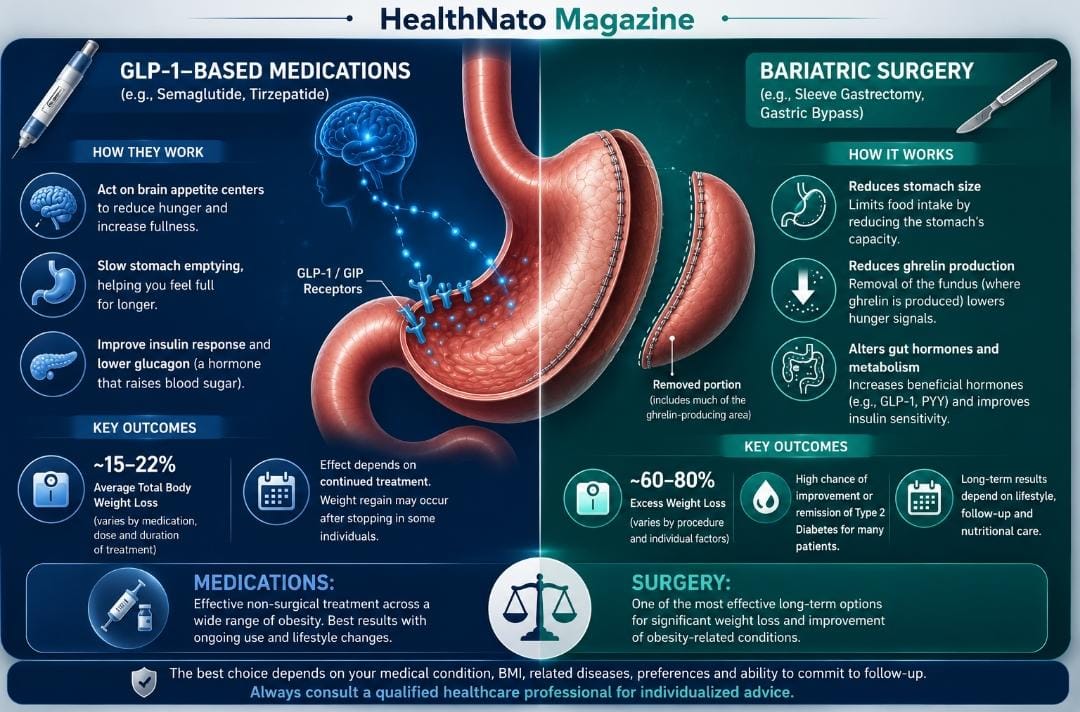
Both modern obesity medications and bariatric surgery can significantly improve the control of type 2 diabetes associated with obesity. In some cases, bariatric surgery, particularly gastric bypass, may lead to rapid and significant improvements in blood glucose levels, and some patients may reach a stage where they require fewer diabetes medications or may discontinue them under medical supervision. However, it is important to emphasize that this does not necessarily mean that diabetes has been permanently cured. Outcomes vary from one person to another, and surgery is not appropriate for every patient. At the same time, modern obesity medications provide strong improvements in blood glucose control for many patients, with the important advantage that they do not require surgical intervention.
Fifth: What Happens When Obesity Medications Are Discontinued ?
This is one of the most important points that patients need to understand. Obesity is a chronic disease, and the body has biological mechanisms that tend to drive weight regain after weight loss. Therefore, discontinuing the medication may lead to increased appetite and regain of some of the lost weight in some patients. Studies have shown that weight regain after discontinuing certain modern obesity medications is common. Therefore, these medications should not be viewed simply as a "temporary weight-loss course" that ends once the desired weight is reached. At the same time, surgery does not make weight regain impossible. Some patients may regain part of their weight several years after surgery, particularly over time or with the return of unhealthy eating habits. However, surgery generally provides greater long-term weight loss compared with many of the currently available medical treatments.
Sixth: Has Surgery Become a Thing of the Past ?
Absolutely not. The emergence of modern obesity medications has not eliminated the role of surgery, but it has changed the way we think about obesity treatment. Surgery remains a powerful and important option for patients living with severe obesity, particularly when it is accompanied by weight-related health complications. At the same time, newer medications provide an important treatment opportunity for people who do not require surgery, do not wish to undergo surgery, or cannot undergo surgery for medical reasons. Some patients may also benefit from using medications before surgery to help reduce weight and improve their health, while others may require medical treatment after surgery if they experience weight plateau or significant weight regain over time.
When Is Bariatric Surgery an Appropriate Option ?
Surgery may be an appropriate option for some patients who have: Severe or morbid obesity, according to their body mass index and overall health status. Obesity associated with weight-related diseases, such as type 2 diabetes or sleep apnea. Insufficient results from dietary treatment, medication, and lifestyle modification. A need for a more effective and sustainable intervention for weight loss and improvement of associated health conditions. However, the decision to undergo surgery should not be based on body mass index alone. It should also take into consideration the patient's overall health, coexisting medical conditions, and ability to commit to appropriate follow-up and nutritional care after surgery.
And When May Medications Be an Appropriate Option ?
Modern obesity medications may be an appropriate option for people who: Have obesity or overweight accompanied by weight-related health problems. Do not wish to undergo surgery. Have medical reasons that make surgery unsuitable for them. Require long-term medical treatment alongside improvements in diet and physical activity. In all cases, these medications should be used under medical supervision, as the choice of medication, dosage, and monitoring of side effects depend on each individual's health condition.
The Future: Will the Battle Be Between Medication and Surgery ?
Perhaps this is the wrong question to ask. The future may not depend on choosing between "injections or surgery," but rather on selecting the right treatment for each patient. One patient may need medication alone, another may require surgery, while a third may benefit from combining surgery and medical treatment at different stages of their obesity treatment journey. Medications may be used to help achieve weight loss before surgery, improve overall health and reduce risks, or after surgery when weight regain occurs or the desired outcome has not been achieved. This makes obesity treatment more like a comprehensive, long-term treatment plan rather than simply a surgery, an injection, or a temporary diet.
Conclusion :
Modern obesity medications, such as semaglutide and tirzepatide injections, have brought about a genuine revolution in the treatment of obesity and demonstrated that medical therapy can achieve substantial weight loss and improve many health problems associated with obesity. However, this development does not mean that the era of bariatric surgery has come to an end. Surgery remains one of the most powerful treatment options for achieving substantial and sustained weight loss, while modern medications provide an effective non-surgical option for a wide range of patients. Most importantly, obesity is not simply a matter of willpower or overeating. It is a complex chronic disease involving appetite, hormones, metabolism, psychological factors, and environmental influences. Therefore, the real question is no longer:
Should I choose injections or Surgery ? But rather :
What is the most appropriate treatment for my health condition ? Do I need medication, surgery, or a combination of both ?
In obesity treatment, there is no single approach that works for everyone... but there is an appropriate treatment plan for every patient when it is selected correctly.
Written by Prof. Dr. Mohamed Henaish
Professor and Consultant of General Surgery | Laparoscopy | Bariatric | Cosmetic and Oncologic Surgery
Information reviewed by HealthNato Scientific Team
on July 26, 2026 at 10:30 AM
Related articles
 General Health
The Hidden Battle After Abdominal Surgery: Understanding Postoperative Peritoneal Adhesions
 General Health
7 Simple Habits That Could be Time Bombs in Your Daily Life !
 General Health
5 Drinks That May Harm Your Kidneys and Why They Deserve a Second Look.
 General Health