The Morning Blood Sugar Mystery: Why Does Your Blood Sugar Rise Even Though You Fasted All Night?


Written by Prof. Dr. Fatma Younis
Scientific Development Director at HealthNato | Professor of Hepatology and Gastroenterology
Information reviewed by HealthNato Scientific Team
on July 30, 2026 at 1:30 PM
Key points
- The Dawn Phenomenon occurs when early-morning hormones such as cortisol, growth hormone, glucagon, and adrenaline stimulate the liver to release glucose, leading to higher morning blood sugar in some people with diabetes.
- The Somogyi Effect is considered less common than previously believed and describes rebound hyperglycemia that may occur after documented nighttime hypoglycemia.
- Continuous glucose monitoring (CGM) or overnight blood glucose measurements can help distinguish the Dawn Phenomenon from nighttime hypoglycemia, as a single morning reading is not sufficient.
- Managing morning hyperglycemia depends on identifying its underlying cause, so insulin or diabetes medication should not be adjusted without medical guidance.
You go to bed with a stable blood sugar level and spend eight hours fasting without eating a single bite. Yet, when you check your blood sugar immediately after waking up, you are surprised to find that it has risen significantly.
This happens frequently in people with type 1 or type 2 diabetes, as well as in some individuals with insulin resistance. The obvious explanation is often: "I must have eaten something wrong the night before." But the real explanation may be related to what happens inside the body during sleep.
Two different mechanisms are often confused: the Dawn Phenomenon and the Somogyi Effect.
1. The Dawn Phenomenon: When the Body Prepares to Wake Up
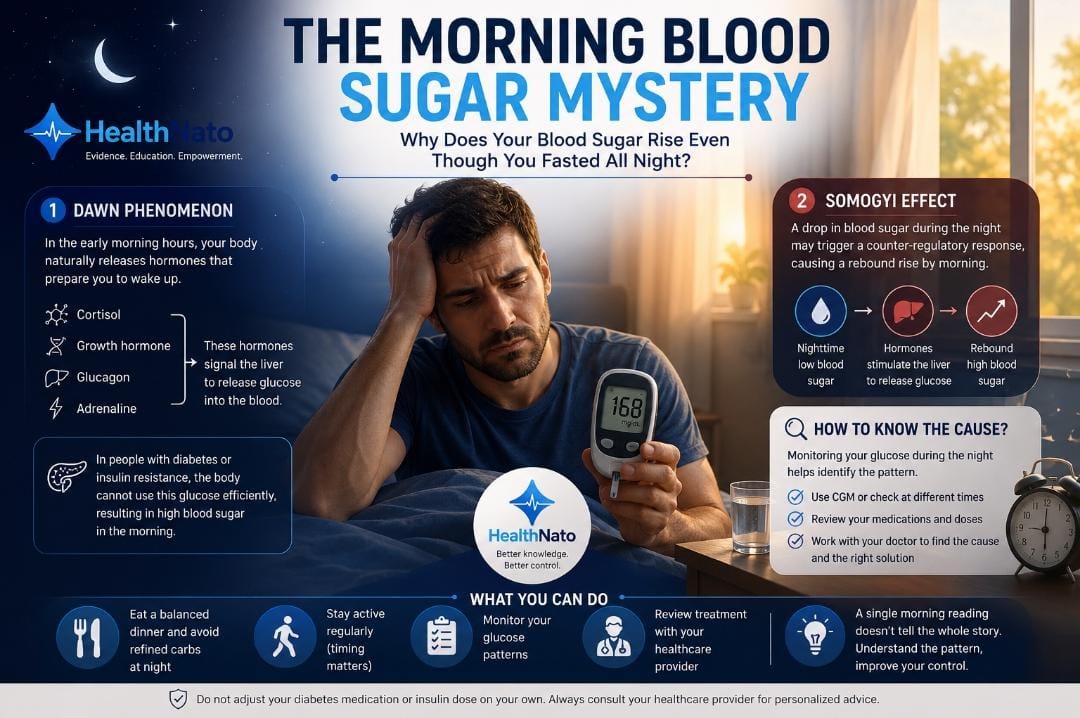
The Dawn Phenomenon refers to a natural rise in blood glucose that occurs in the early morning hours. It is driven by normal hormonal changes that help the body prepare for waking and daily activity.
What happens during sleep?
In the early morning hours, the body increases the release of several hormones, including:
Cortisol
Growth hormone
Glucagon
Adrenaline
These are known as counter-regulatory hormones because they oppose the action of insulin and help maintain adequate blood glucose levels.
They signal the liver to release more glucose into the bloodstream through processes such as glycogen breakdown and gluconeogenesis.
In a healthy person, the pancreas usually responds by releasing enough insulin to keep blood glucose within a normal range.
In people with diabetes or significant insulin resistance, however, insulin production or insulin sensitivity may be insufficient to handle this additional glucose release. As a result, blood sugar may rise by the time they wake up.
2. The Somogyi Effect: When Low Blood Sugar Is Followed by a Rebound Rise
The Somogyi Effect, also called rebound hyperglycemia, describes a proposed mechanism in which blood glucose falls too low during the night and the body responds by releasing counter-regulatory hormones.
These hormones—including adrenaline, cortisol, glucagon, and growth hormone—work to raise blood glucose by stimulating the liver to release glucose into the bloodstream.
The result may be a high blood sugar level by morning.
However, it is important to note that the Somogyi Effect remains controversial, and modern studies have not consistently confirmed it as a common explanation for morning hyperglycemia. In many patients, the Dawn Phenomenon or other causes are more likely.
This is why patients should not automatically assume that a high morning glucose level means they experienced nocturnal hypoglycemia.
How Can You Tell What Is Causing Your Morning High?
A single blood glucose reading immediately after waking cannot reliably distinguish between these causes.
Your doctor may recommend checking your glucose during the night, using a continuous glucose monitor (CGM), or occasionally measuring your blood glucose around the early morning hours.
The general pattern can provide useful clues:
Normal or elevated glucose overnight followed by a morning rise: This may be consistent with the Dawn Phenomenon.
Documented low glucose during the night followed by a morning rise: This may suggest rebound hyperglycemia, although other explanations should also be considered.
Importantly, routinely waking up at 3:00 a.m. for several nights is not necessary for everyone. A CGM can often provide a much clearer picture of overnight glucose patterns.
What Should You Do If Your Morning Blood Sugar Is High?
The right approach depends on the underlying cause.
If the pattern is consistent with the Dawn Phenomenon:
Your doctor may consider:
Reviewing your evening meal and carbohydrate intake.
Assessing your overall dietary pattern and physical activity.
Reviewing the timing and dosage of diabetes medications.
Adjusting insulin therapy when appropriate.
Monitoring overnight glucose patterns.
Regular physical activity can improve insulin sensitivity, but the timing and intensity of exercise should be individualized, especially for people using insulin or medications that can cause hypoglycemia.
If nighttime hypoglycemia is confirmed:
The priority is to identify why the blood sugar is falling too low.
This may involve reviewing:
Evening insulin doses.
The timing of diabetes medications.
Meal composition and timing.
Alcohol consumption.
Physical activity, particularly late in the evening.
Any adjustment to insulin or glucose-lowering medication should be made with medical guidance, rather than simply reducing the dose independently.
HealthNato Medical Takeaway
A high blood sugar reading in the morning does not necessarily mean that you ate too much the night before.
The body undergoes complex hormonal changes during sleep, and these can influence blood glucose levels even when you have not eaten for many hours.
The Dawn Phenomenon is a common explanation for morning hyperglycemia, while the Somogyi Effect is a proposed but controversial explanation that requires documented nighttime hypoglycemia before it can be considered.
The most important step is to understand what happens to your blood glucose during the night rather than relying on a single morning reading.
Because the appropriate treatment depends on the cause, persistent morning hyperglycemia should be discussed with your healthcare provider, who can use glucose monitoring and your treatment history to determine the most appropriate strategy.
Your morning blood sugar is not just a number—it may be a window into what your body has been doing while you sleep.
Written by Prof. Dr. Fatma Younis
Scientific Development Director at HealthNato | Professor of Hepatology and Gastroenterology
Information reviewed by HealthNato Scientific Team
on July 30, 2026 at 1:30 PM
Related articles
 General Health
The Hidden Battle After Abdominal Surgery: Understanding Postoperative Peritoneal Adhesions
 General Health
The Revolution in New Obesity Medications vs. Bariatric Surgery... Has the Era of the Scalpel Come to an End?
 General Health
7 Simple Habits That Could be Time Bombs in Your Daily Life !
 General Health