When an Old Gastric Band Fails and Becomes a Hidden Problem: Is Revisional Surgery the Solution?

Written by Prof. Dr. Mohamed Henaish
Professor and Consultant of General Surgery | Laparoscopy | Bariatric | Cosmetic and Oncologic Surgery
Information reviewed by HealthNato Scientific Team
on August 19, 2026 at 3:30 PM
Key points
- Late complications of gastric banding can include band slippage, band erosion, severe reflux, vomiting, swallowing difficulties, and enlargement of the upper stomach or esophagus.
- Weight regain does not necessarily mean that the gastric band has malfunctioned. Changes in eating behavior, physical activity, adaptation to the procedure, and metabolic factors can all contribute.
- Revisional bariatric surgery may involve band removal alone or conversion to sleeve gastrectomy or gastric bypass. In some patients, a staged approach may be safer when inflammation, erosion, or significant scar tissue is present.
Years ago, the Gastric Band was one of the most widely used bariatric procedures for the treatment of severe obesity. Today, after many years of follow-up, some patients face a different problem: the same band that initially helped them lose weight can eventually become the source of complications requiring medical or surgical intervention.
So, what can happen to a gastric band years after implantation? When does it need to be removed? And can it be followed by sleeve gastrectomy or gastric bypass?
First: What Is a Gastric Band?
Gastric banding is a type of bariatric surgery designed to help treat severe obesity.
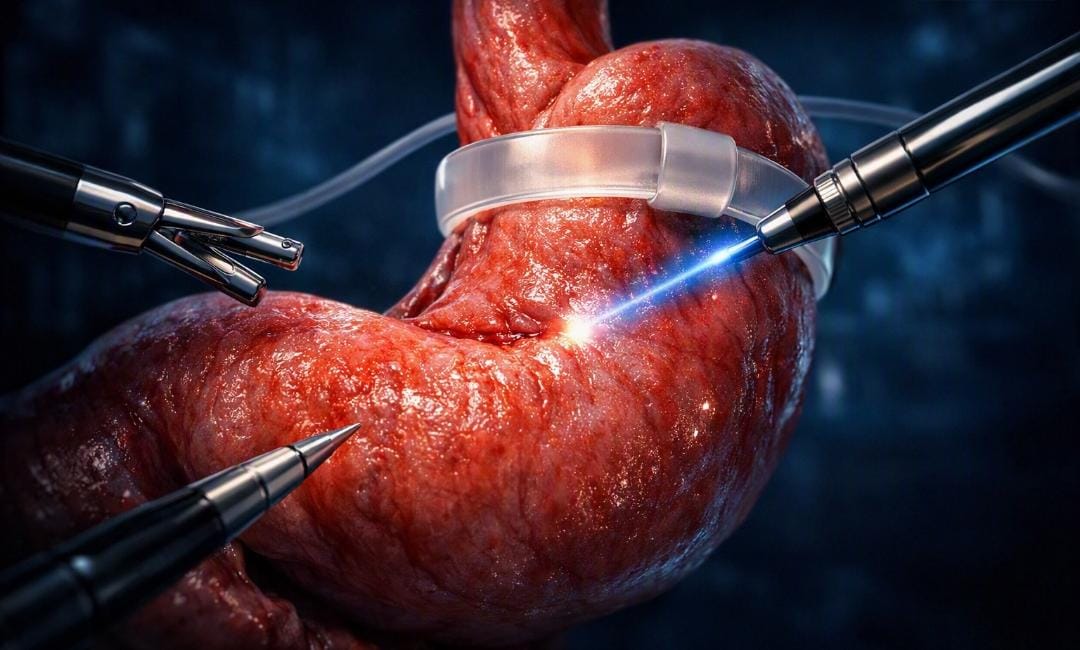
The procedure involves placing an adjustable silicone band around the upper part of the stomach, creating a small gastric pouch that promotes earlier satiety and limits the amount of food a person can consume at one time.
Unlike sleeve gastrectomy or gastric bypass, the procedure does not involve removing part of the stomach or rerouting the intestines. It is therefore considered primarily a restrictive procedure, as its main effect is to limit food intake.
However, its long-term effectiveness has not always met expectations, and its use has declined compared with procedures such as sleeve gastrectomy and gastric bypass.
When Problems Begin: Band Slippage or Erosion
Among the important late complications that can occur years after gastric band placement are band slippage and band erosion.
1. Band Slippage
The band may move from its original position, changing the shape of the gastric pouch above it.
This can lead to:
Difficulty or pain when swallowing.
Severe acid reflux.
Recurrent vomiting.
Difficulty tolerating food.
Enlargement of the upper stomach or, in some cases, the esophagus.
The severity varies from one patient to another, and these symptoms do not necessarily mean that a complete obstruction has occurred.
2. Band Erosion
This is one of the more important late complications.
In some patients, prolonged pressure from the band on the stomach wall can gradually cause the band to become embedded in the surrounding tissue and eventually penetrate partially or completely into the stomach.
Symptoms may initially be subtle, but can later include abdominal pain, bleeding, infection, or problems related to the function of the band.
For this reason, new symptoms in someone with an old gastric band should not automatically be dismissed as simple heartburn or a temporary digestive problem.
Why Can Weight Return Years Later?
Another issue, separate from mechanical complications, is the gradual loss of effectiveness of the band and subsequent weight regain.
The band works primarily by restricting food intake and does not produce the same physiological changes associated with some other bariatric procedures.
Over time, some patients may also rely increasingly on calorie-dense foods and beverages that pass relatively easily through the restricted opening, such as sugary drinks, sweets, and soft foods.
As a result, excess calorie intake can return despite the presence of the band.
However, weight regain alone does not necessarily mean that the band has malfunctioned. Behavioral changes, physical activity, adaptation to the procedure, and metabolic factors may all contribute.
What Happens When the Band Becomes a Problem?
This is where another stage of treatment may become necessary:
Revisional Bariatric Surgery — surgery performed to correct or modify the results of a previous bariatric procedure.
Depending on the patient's condition, the goal may be:
Removing the band alone.
Removing the band and performing another bariatric procedure.
Converting the patient later to Sleeve Gastrectomy or Gastric Bypass, depending on the individual circumstances.
However, there is no single approach that works for every patient.
If there is erosion, inflammation, extensive scar tissue, or problems involving the esophagus, performing another bariatric procedure during the same operation may carry additional risks.
In some cases, surgeons may therefore choose a Two-Stage Approach: remove the band and treat the underlying problem first, then allow the tissues to heal before performing another bariatric procedure.
There is no universal waiting period, such as two or three months, that applies to everyone. The timing depends on the presence of inflammation or erosion, the condition of the stomach tissues, the planned procedure, and the assessment of the surgical team.
How Is the Problem Diagnosed?
Evaluation depends on the patient's symptoms, surgical history, and clinical examination. More than one diagnostic test may sometimes be required.
Upper Endoscopy
Upper Endoscopy is particularly important when band erosion, inflammation, or bleeding is suspected, as it allows direct visualization of the inside of the stomach.
Upper GI Contrast Study
An Upper Gastrointestinal Contrast Study can help assess the shape of the stomach, the position of the band, and the movement of food through the upper digestive tract.
CT Scan
A CT scan may be used in selected cases when additional information about complications or surrounding tissues is needed.
The appropriate test depends on the suspected problem; there is no single diagnostic test that is ideal for every patient.
When Should You Not Ignore the Symptoms?
If you had a gastric band placed years ago and develop:
New or recurrent vomiting.
Increasing difficulty swallowing.
Persistent pain in the upper abdomen or behind the breastbone.
Severe or persistent acid reflux.
Difficulty eating or drinking normally.
Vomiting blood or passing black stools.
These symptoms warrant prompt medical evaluation, and some require urgent assessment.
Does Everyone With an Old Gastric Band Need It Removed?
No.
Simply having a gastric band for many years does not mean that it has become dangerous or must be removed.
However, patients with older bands should be aware of their condition and should not ignore new symptoms, particularly problems with swallowing, reflux, weight changes, or possible complications.
If a genuine complication is suspected, evaluation by a surgeon or multidisciplinary team experienced in revisional bariatric surgery is preferable, because surgery after a previous bariatric procedure can be technically very different from performing the operation for the first time.
The Bottom Line
Gastric banding was once an important tool in the treatment of severe obesity, but it no longer occupies the same position as some of the newer bariatric procedures.
Years after implantation, some patients may develop complications such as band slippage, band erosion, or severe reflux, while others may experience weight regain without a serious mechanical complication.
Most importantly, developing a problem does not automatically mean that the patient needs a sleeve gastrectomy or gastric bypass.
Diagnosis comes first. Then the cause of the problem must be identified, followed by a decision about the appropriate intervention and its timing.
With revisional bariatric surgery in particular, the question is not simply:
Which operation should we perform?
The more important question is:
Are the stomach and surrounding tissues ready for that operation now?
Written by Prof. Dr. Mohamed Henaish
Professor and Consultant of General Surgery | Laparoscopy | Bariatric | Cosmetic and Oncologic Surgery
Information reviewed by HealthNato Scientific Team
on August 19, 2026 at 3:30 PM
Related articles
 General Health
The Hidden Battle After Abdominal Surgery: Understanding Postoperative Peritoneal Adhesions
 General Health
The Revolution in New Obesity Medications vs. Bariatric Surgery... Has the Era of the Scalpel Come to an End?
 General Health
7 Simple Habits That Could be Time Bombs in Your Daily Life !
 General Health