Oxygen Facial Treatments for Younger-Looking Skin… Do They Really Stimulate Collagen and Fight Wrinkles?

Written by Dr. Nasser El Shishini
Editorial Director | Pharmacist | Clinical Nutrition & Weight Management Specialist | Researcher in Pharmaceutical & Cosmetic Sciences.
Fact-checked by HealthNato Scientific Team
on July 31, 2026 at 4:30 PM
Does Your Skin Really Need an Extra Dose of Topical Oxygen?
The question may seem simple, but the answer is not.
In the modern beauty industry, “oxygen” has become an appealing buzzword used to market a wide range of treatments: oxygen facials and masks, topical oxygen products, and even treatments involving ozone or carbon dioxide.
As a result, substances and gases that are chemically and physiologically very different are sometimes placed under the same umbrella: “oxygen for the skin.”
But the scientific reality is far more complex.
Oxygen is indeed essential for life, and the skin needs it to perform its normal functions. It also plays an important role in wound healing and tissue regeneration. However, this does not automatically mean that healthy skin needs to be “infused with oxygen” from the outside to become more radiant, or that every treatment carrying the word “Oxygen” can stimulate collagen production or combat skin aging.
This is precisely where we need to distinguish between the true biology of oxygen and the marketing language surrounding it.
First: Does the Skin “Breathe”?
Yes… but not in the same way the lungs do.
Skin cells need oxygen, like most cells in the body, and the oxygen they require is supplied primarily through the bloodstream and the network of tiny blood vessels that nourish the skin tissues.
By contrast, the contribution of oxygen that diffuses from the air through the skin’s surface is extremely limited and does not represent the primary source of oxygen relied upon by most skin cells.
Therefore, the phrase:
«“The skin needs to breathe”»
may work as a marketing metaphor, but it is not an accurate physiological description.
More importantly, the presence of oxygen on the skin’s surface does not necessarily mean that it will reach deeper skin cells in significant amounts, nor does increasing oxygen exposure beyond normal physiological levels automatically result in younger-looking skin.
This is a crucial point, because many cosmetic claims begin with a scientifically correct fact and then make a leap to a conclusion that has not necessarily been proven.
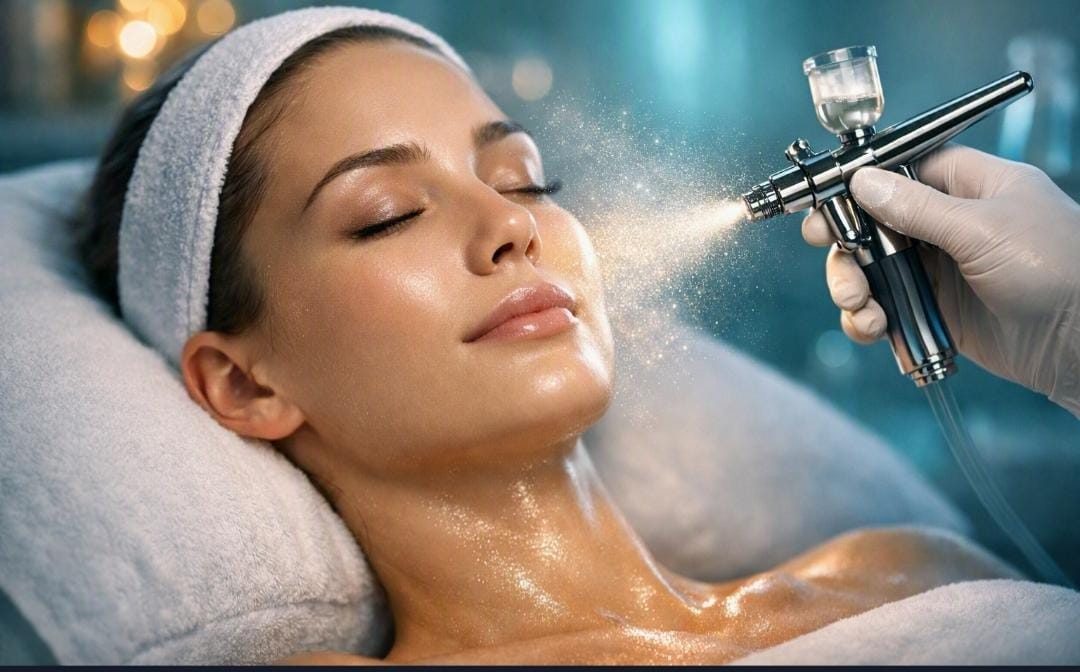
Oxygen Facial
Oxygen Facial Treatment
Does the Skin Really Receive a “Dose of Oxygen” That Restores Its Youth?
Oxygen facial treatments are offered in various forms. They may include cleansing, exfoliation, the application of serums or cosmetic products, and the use of a device or method claimed to deliver oxygen to the skin’s surface.
The scientific issue is that the term “oxygen facial” does not refer to a standardized medical protocol. What is offered in one clinic may be completely different from what is provided at another beauty center.
In many cases, the immediate improvement in the appearance of the skin after a session may be real. However, the explanation is not necessarily that oxygen has “entered the cells” and switched them back on.
The improvement may instead result from:
- Removal of dead surface skin cells. - Improved hydration of the stratum corneum. - The use of products containing moisturizing or active ingredients. - The mechanical effects of cleansing or massage. - A temporary improvement in the overall appearance of the skin’s surface.
Therefore, saying that a session can give the skin an immediate glow may be reasonable from a cosmetic perspective. However, interpreting this glow as evidence that oxygen itself is responsible requires stronger clinical evidence.
The Scientific Verdict:
Immediate glow: Possible.
Oxygen reaching the skin’s surface: May be possible.
Oxygen reaching deeper tissues at therapeutic levels: Depends on the technique and the circumstances.
Rebuilding collagen simply by exposing the skin to oxygen: Not sufficiently established as a general rule.
Treating skin aging or pigmentation with oxygen alone: There is no strong evidence to place it among the established first-line treatments for these concerns.
So… Is “Oxygen for the Skin” a Myth?
No.
And is it the “magic key” to radiant, youthful skin?
Also no.
The truth lies somewhere in between.
There are legitimate medical uses of oxygen in specific clinical settings, and there is promising research on topical oxygen therapy for certain chronic wounds.
There are also cosmetic techniques that may leave the skin looking more radiant or hydrated after a session.
The problem begins when these limited or context-specific findings are transformed into broad claims such as:
«“Oxygen rejuvenates the skin from within.”»
Or:
«“Oxygen rebuilds collagen.”»
Or:
«“The skin suffocates and needs oxygen treatments.”»
Or:
«“Oxygen treats aging, pigmentation, and acne.”»
Such claims require strong clinical evidence before they can be presented as established facts.
The Bottom Line
Oxygen is essential for healthy skin, but healthy skin does not typically suffer from “suffocation” that requires an oxygen facial.
Some oxygen facial treatments may leave the skin looking more radiant and hydrated, quickly and temporarily. However, it is scientifically difficult to attribute these results to oxygen alone, particularly when other factors are involved in the treatment, such as cleansing, exfoliation, hydration, and the application of active cosmetic products.
Written by Dr. Nasser El Shishini
Editorial Director | Pharmacist | Clinical Nutrition & Weight Management Specialist | Researcher in Pharmaceutical & Cosmetic Sciences.
Fact-checked by HealthNato Scientific Team
on July 31, 2026 at 4:30 PM
Get new articles in your inbox
One short email a week, no spam.
Your privacy is important to us.
Related Articles
 General Health
The Hidden Battle After Abdominal Surgery: Understanding Postoperative Peritoneal Adhesions
 General Health
The Revolution in New Obesity Medications vs. Bariatric Surgery... Has the Era of the Scalpel Come to an End?
 General Health
7 Simple Habits That Could be Time Bombs in Your Daily Life !
 General Health