A Medical Breakthrough Beyond Imagination: A Vaccine Designed from a Tumor’s Fingerprint… Have We Entered the Era of Personalized Cancer Vaccines ?

Written by Prof. Dr. Mohamed Henaish
Professor and Consultant of General Surgery | Laparoscopy | Bariatric | Cosmetic and Oncologic Surgery
Information reviewed by HealthNato Scientific Team
on October 27, 2026 at 12:30 PM
Are we approaching an era in which cancer treatment is tailored to the genetic fingerprint of each patient?
For decades, vaccines have been associated with preventing infections before they occur. However, cancer research is moving toward a different concept: designing a vaccine specifically for each patient based on the mutations in their individual tumor, training their immune system to recognize and attack cancer cells.
In a notable development, Moderna and Merck announced the results of a major clinical trial in October 2026, testing this approach in patients with melanoma, one of the most dangerous types of skin cancer, following surgical removal of their tumors.
A Trial Involving More Than 1,100 Patients: What Did the Results Show?
The Phase III trial, known as INTerpath-001, included approximately 1,137 patients with high-risk cutaneous melanoma, ranging from stage IIB to stage IV, following complete surgical removal of their tumors.
The researchers compared two groups:
The first received an experimental personalized vaccine known as Intismeran autogene, alongside the immunotherapy drug pembrolizumab, commercially known as Keytruda.
The second group received the same immunotherapy alongside a placebo vaccine.
After approximately two years of follow-up, the results showed:
- A 42% reduction in the risk of cancer recurrence or death among patients who received the vaccine plus immunotherapy, compared with those who received immunotherapy alone. - The two-year recurrence-free survival rate in the vaccine group was 12.2 percentage points higher than in the other group. - The risk of distant metastasis or death decreased by 38% with the combination of both treatments.
How Is a Vaccine Designed from a Tumor’s Fingerprint?
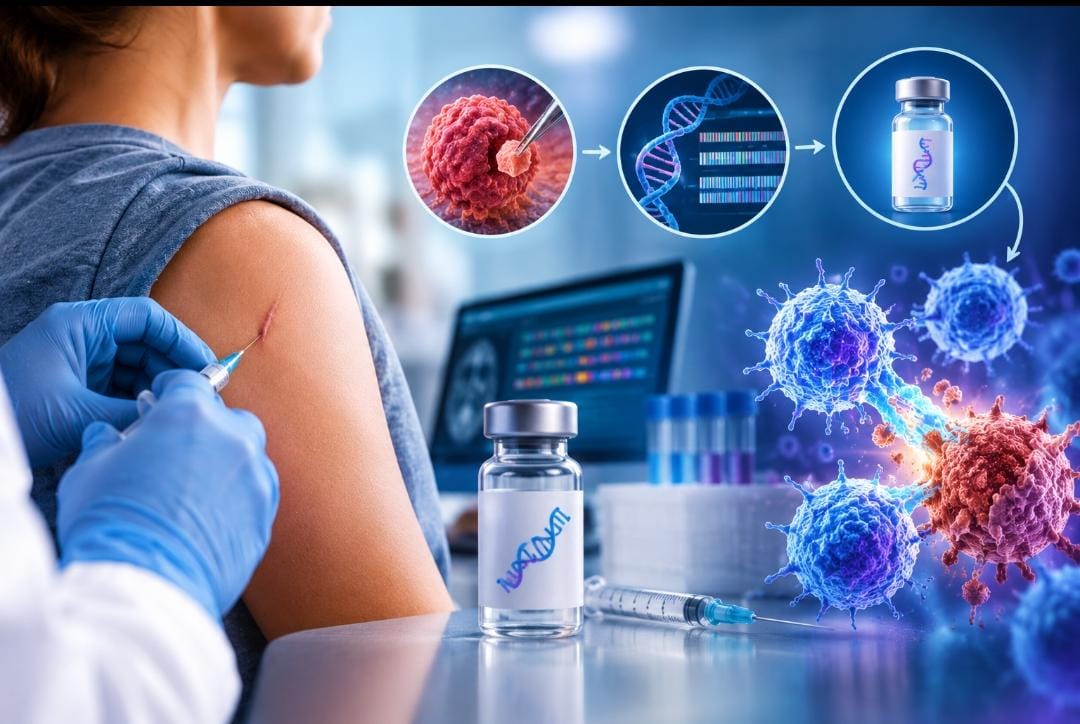
The idea is not to give every patient the same vaccine, as is the case with many conventional vaccines. Instead, the process involves several steps:
Tumor analysis: A sample of the patient's tumor is examined to identify its unique mutations and select up to 34 tumor-specific antigens.
Vaccine production: An mRNA vaccine is developed to carry instructions that help the body's cells produce these antigens and present them to the immune system, training T cells to attack cancer.
Combination therapy: The vaccine is administered alongside an immunotherapy drug, such as pembrolizumab, to enhance the immune system's ability to eliminate cancer cells.
Why Are These Vaccines Given After Surgery?
Surgery may successfully remove the visible tumor, but this does not guarantee that every cancer cell has been eliminated from the body. Microscopic cancer cells that cannot be detected through routine tests may remain and contribute to the disease returning later.
The importance of the vaccine therefore lies in targeting residual microscopic cancer cells after tumor removal, with the aim of reducing the risk of recurrence.
Note: The vaccine is not a replacement for surgery and is not currently used as a universal treatment for all types of cancer. Its current development focuses on patients with high-risk melanoma.
Do These Results Mean We Can Now Prevent Cancer from Returning?
The results are encouraging in terms of reducing recurrence, but they do not mean a complete cure or guarantee that the cancer will never return. Data on overall survival and whether the treatment extends patients' lives require longer follow-up.
Regarding safety, the most common side effects associated with adding the vaccine were fever, injection-site pain, and fatigue.
When Will the Vaccine Become Available to Patients?
As of October 2026, the vaccine remains experimental, and the two companies developing it are working to submit the data to regulatory authorities in preparation for seeking approval.
The same approach is being tested in other types of cancer, but success in melanoma does not guarantee similar results in other tumors.
The cost and speed of manufacturing, along with demonstrating clinical benefits for each cancer type, remain important challenges.
Conclusion
Personalized vaccines are opening a new path in cancer treatment by training the immune system to recognize mutations specific to each patient's tumor.
The significance of the October 2026 results lies in demonstrating the benefits of this approach in a randomized Phase III trial when combined with immunotherapy after melanoma surgery. However, determining how long these benefits last and whether they can be extended to other cancers will require further follow-up and research.
Written by Prof. Dr. Mohamed Henaish
Professor and Consultant of General Surgery | Laparoscopy | Bariatric | Cosmetic and Oncologic Surgery
Information reviewed by HealthNato Scientific Team
on October 27, 2026 at 12:30 PM
Related articles
 General Health
The Hidden Battle After Abdominal Surgery: Understanding Postoperative Peritoneal Adhesions
 General Health
The Revolution in New Obesity Medications vs. Bariatric Surgery... Has the Era of the Scalpel Come to an End?
 General Health
7 Simple Habits That Could be Time Bombs in Your Daily Life !
 General Health