Is the End of Insulin Injections Approaching?

Written by Prof. Dr. Fatma Younis
Scientific Development Director at HealthNato | Professor of Hepatology and Gastroenterology
Fact-checked by HealthNato Scientific Team
on August 5, 2026 at 10:30 AM
Key Points
- Stem cell therapy is one of the most promising research approaches for type 1 diabetes, aiming to replace the insulin-producing beta cells destroyed by the immune system.
- Researchers have successfully generated functional beta cells from induced pluripotent stem cells (iPSCs), and early clinical trials have shown restored insulin production in a limited number of carefully selected patients.
- Stem cell therapy remains experimental, with immune rejection still a major challenge. Until further research confirms its long-term safety and effectiveness, insulin therapy remains the cornerstone of type 1 diabetes management.
Is the End of Insulin Injections Approaching?
The Full Story Behind Stem Cells and Type 1 Diabetes Treatment
Not every scientific breakthrough means a treatment is ready for everyday clinical practice. However, some discoveries have the potential to reshape the future of medicine.
Over the past few years, stem cell therapy has become one of the most exciting areas of diabetes research. Encouraging clinical trial results have shown that some people with type 1 diabetes were able to produce insulin again after receiving stem cell-derived beta cells, with a small number becoming temporarily independent of insulin injections under close medical supervision.
So, are we finally approaching the end of the insulin era?
The answer is filled with hope—but it also requires a healthy dose of realism.
Why Is Type 1 Diabetes Different?
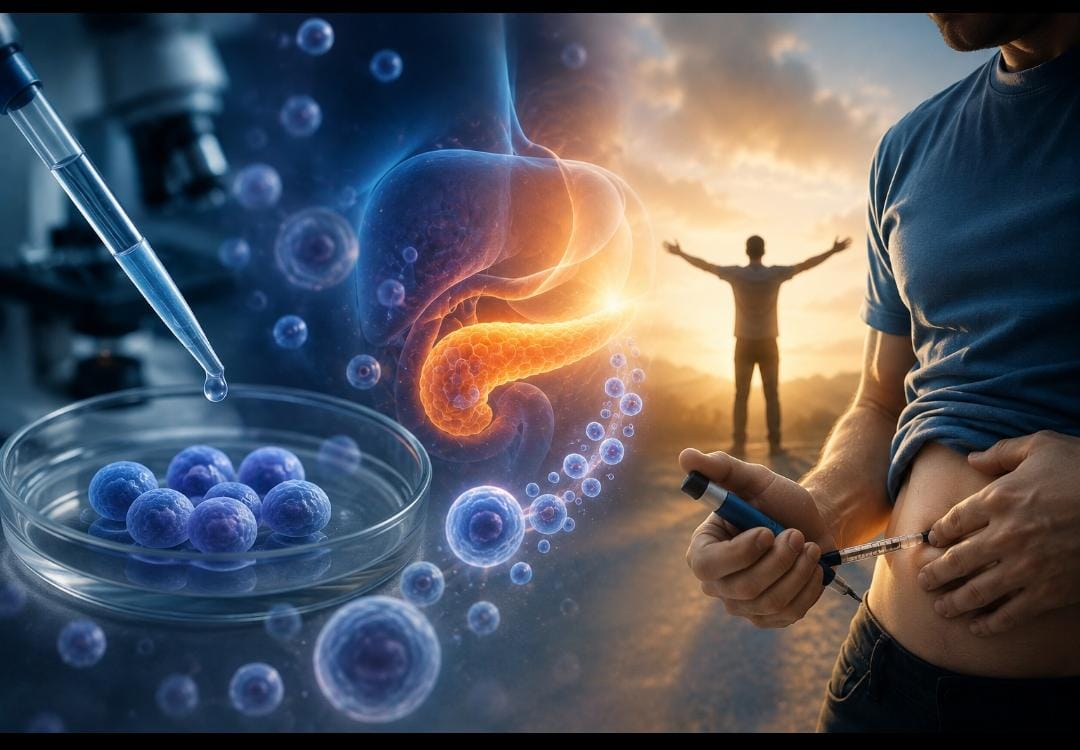
Inside the pancreas are tiny clusters of cells known as the Islets of Langerhans, which contain beta cells responsible for producing and secreting insulin.
In type 1 diabetes, the immune system mistakenly attacks and destroys these beta cells. As a result, the body loses its ability to produce sufficient insulin, leaving patients dependent on insulin injections or insulin pumps for life.
For this reason, replacing the lost beta cells has become one of the most promising strategies for treating the disease at its source.
Type 2 diabetes, however, is a different story. The problem extends beyond beta-cell dysfunction and includes insulin resistance and complex metabolic abnormalities. Consequently, stem cell therapy is not currently considered an appropriate solution for most people with type 2 diabetes.
How Can a Skin Cell Become an Insulin-Producing Cell?
This is where one of the most remarkable achievements of regenerative medicine begins.
Scientists can take ordinary cells from the body—such as skin cells—and reprogram them into induced pluripotent stem cells (iPSCs), which have the ability to develop into many different cell types.
These stem cells are then carefully guided through a series of developmental stages in the laboratory until they become mature beta cells capable of sensing blood glucose levels and secreting insulin in a manner that closely resembles natural pancreatic cells.
Once successfully generated, these cells can be transplanted into the body using advanced techniques designed to support their long-term survival and function.
If the Technology Works, Why Isn't It Available Everywhere?
Because the greatest challenge is no longer creating the cells—it's protecting them.
The same immune system that destroyed the patient's original beta cells may also attack the newly transplanted ones.
To overcome this obstacle, researchers are investigating several innovative approaches, including:
- Microencapsulation: Encasing beta cells within microscopic protective membranes that allow oxygen, glucose, and insulin to pass through while limiting access by immune cells.
- Gene Editing: Using technologies such as CRISPR to modify transplanted cells and reduce immune recognition. Although highly promising, these approaches remain under active investigation and are not yet part of routine clinical care.
Where Does the Science Stand Today?
Recent clinical studies have produced encouraging results.
Trials involving stem cell-derived beta cells have demonstrated that some individuals with type 1 diabetes regained endogenous insulin production, while a small number achieved temporary insulin independence alongside significantly improved blood glucose control.
However, these outcomes have been observed in a limited number of carefully selected patients participating in clinical trials. They do not mean that this therapy is currently available or suitable for everyone with type 1 diabetes.
Beware of the Stem Cell Hype
Alongside legitimate scientific progress, numerous clinics now claim to treat diabetes by simply injecting stem cells into the bloodstream.
To date, there is no strong scientific evidence supporting these practices as an effective treatment for diabetes. In fact, such procedures may carry significant risks when performed outside properly regulated clinical research or specialized medical centers.
For this reason, it is essential to distinguish between well-designed clinical research and commercial claims that exploit patients' hopes.
Are We Really Approaching the End of Insulin Injections?
Not yet.
For the first time since the discovery of insulin more than a century ago, scientists have successfully generated functional beta cells in the laboratory—an achievement that once seemed closer to science fiction than reality.
Although substantial challenges remain before these therapies become widely available, the progress achieved so far represents a genuine milestone in the pursuit of transformative treatments for type 1 diabetes.
The Bottom Line
Stem cell therapy is neither a miracle cure nor an unrealistic dream.
It is one of the most promising fields in type 1 diabetes research and may eventually reduce—or, in carefully selected patients, even eliminate—the need for lifelong insulin injections.
Until that day arrives, insulin therapy and evidence-based medical care remain the foundation of diabetes management, while regenerative medicine continues to move steadily toward a goal that once seemed impossible: restoring the body's ability to produce insulin once again.
Written by Prof. Dr. Fatma Younis
Scientific Development Director at HealthNato | Professor of Hepatology and Gastroenterology
Fact-checked by HealthNato Scientific Team
on August 5, 2026 at 10:30 AM
Get new articles in your inbox
One short email a week, no spam.
Your privacy is important to us.
Related Articles
 General Health
The Hidden Battle After Abdominal Surgery: Understanding Postoperative Peritoneal Adhesions
 General Health
The Revolution in New Obesity Medications vs. Bariatric Surgery... Has the Era of the Scalpel Come to an End?
 General Health
7 Simple Habits That Could be Time Bombs in Your Daily Life !
 General Health