The Time Bomb Beneath the Skin... How Can a Simple Hernia Become a Threat to the Intestines?

Written by Prof. Dr. Mohamed Henaish
Professor and Consultant of General Surgery | Laparoscopy | Bariatric | Cosmetic and Oncologic Surgery
Information reviewed by HealthNato Scientific Team
on July 18, 2026 at 10:30 AM
Key points
- A reducible hernia can progress to an incarcerated or strangulated hernia if left untreated.
- Strangulated hernias can interrupt blood flow to the intestine, leading to tissue death and perforation.
- Severe pain, an irreducible bulge, vomiting, abdominal swelling, or inability to pass stool or gas require immediate medical attention.
- Elective hernia repair is generally safer than emergency surgery after complications develop.
Many people believe that a hernia is nothing more than a small bulge beneath the skin that can be safely ignored for years, particularly if it causes little or no pain. As a result, some patients postpone surgery, assuming the condition is merely cosmetic or of little clinical significance.
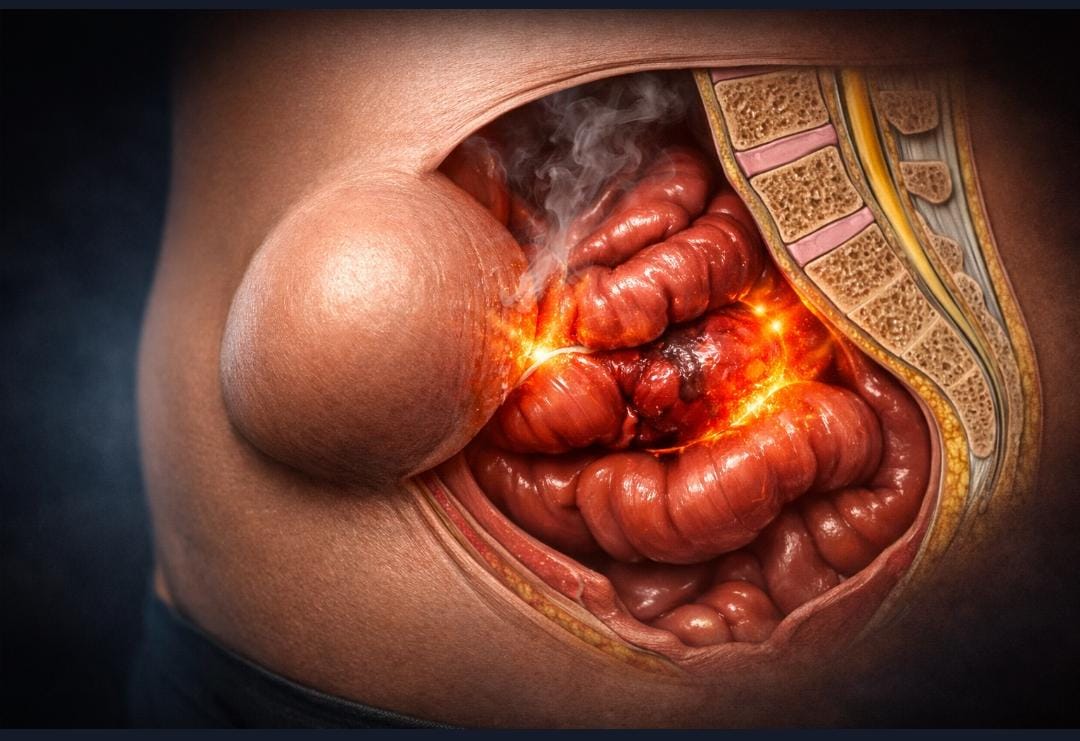
In reality, however, some hernias can suddenly progress into a life-threatening surgical emergency when a segment of the intestine becomes trapped inside the hernia and its blood supply is compromised.
This condition, known as a strangulated hernia, requires urgent surgical intervention to preserve the affected intestine and prevent potentially fatal complications.
What Is a Hernia?
A hernia develops when a weakness or defect forms in the abdominal wall, allowing part of the intestine or fatty tissue to protrude through it, creating a visible bulge beneath the skin. The bulge often becomes more prominent while standing, coughing, or lifting heavy objects because of increased intra-abdominal pressure.
Common types of abdominal hernias include:
Inguinal hernia
Umbilical hernia
Incisional hernia, which develops through the site of a previous surgical incision
In many cases, the protruding tissue can be gently pushed back into the abdominal cavity. This is known as a reducible hernia.
When Does a Hernia Become Dangerous?
A hernia becomes dangerous when the protruding intestine becomes trapped within the hernia defect and can no longer return to its normal position inside the abdomen.
This process generally progresses through two stages.
Stage One: Incarcerated Hernia
At this stage, the intestine becomes trapped inside the hernia sac and cannot be returned to the abdominal cavity.
Patients may experience localized pain and notice a persistent bulge that does not disappear when lying down. As incarceration persists, symptoms of bowel obstruction may begin to develop.
Stage Two: Strangulated Hernia
If pressure on the trapped intestine continues, blood flow is progressively compromised.
Initially, venous drainage becomes obstructed, causing congestion and swelling of the affected bowel.
As pressure increases further, arterial blood flow also becomes impaired, reducing oxygen delivery to the intestinal tissue. Without prompt treatment, the affected segment may become necrotic (gangrenous).
If left untreated, the damaged intestine may perforate, allowing intestinal contents to spill into the abdominal cavity. This can lead to peritonitis and may subsequently progress to sepsis, both of which are life-threatening conditions requiring immediate surgical intervention.
Warning Signs That Require Immediate Medical Attention
Anyone with a known hernia should seek emergency medical evaluation if any of the following symptoms develop:

Severe or progressively worsening pain at the hernia site.
A bulge that cannot be pushed back into the abdomen.
Redness or discoloration of the skin over the hernia.
Persistent nausea or repeated vomiting.
Abdominal distension.
Inability to pass stool or gas.
Fever or signs of general clinical deterioration.
These symptoms may indicate intestinal strangulation and should never be ignored.
What Happens During Surgery?
For uncomplicated hernias, the objective of surgery is to return the protruding tissue to its normal position and repair the weakened abdominal wall, often using a surgical mesh when appropriate.
In cases of a strangulated hernia, however, the primary goal is to save the affected intestine.
The surgeon first releases the trapped bowel to restore its blood circulation, then carefully assesses its viability.
If the intestine regains its normal color and an adequate blood supply returns, it can usually be preserved.
However, if part of the intestine has become irreversibly necrotic, that segment must be surgically removed, and the healthy ends of the bowel are reconnected.
When contamination of the abdominal cavity is present, the surgeon may choose not to implant a synthetic mesh during the same operation in order to reduce the risk of infection, selecting the most appropriate repair strategy based on the patient's condition.
Can These Complications Be Prevented?
The most effective way to prevent these complications is not to delay surgical evaluation, particularly if the hernia is enlarging or becoming symptomatic.
Elective hernia repair performed under planned conditions is generally safer and associated with a smoother recovery than emergency surgery performed after intestinal strangulation has occurred.
Take-Home Message
Most hernias are not surgical emergencies when they are first diagnosed. However, they can occasionally progress to a dangerous condition if a segment of the intestine becomes trapped and loses its blood supply.
For this reason, a hernia should never be dismissed as merely a cosmetic bulge beneath the skin. Timely surgical assessment and appropriate management can prevent serious complications, including bowel resection and life-threatening illness.
In hernia surgery, timing is about more than performing the operation promptly—it is about preventing a preventable emergency before it occurs.
Written by Prof. Dr. Mohamed Henaish
Professor and Consultant of General Surgery | Laparoscopy | Bariatric | Cosmetic and Oncologic Surgery
Information reviewed by HealthNato Scientific Team
on July 18, 2026 at 10:30 AM
Related articles
 General Health
The Hidden Battle After Abdominal Surgery: Understanding Postoperative Peritoneal Adhesions
 General Health
The Revolution in New Obesity Medications vs. Bariatric Surgery... Has the Era of the Scalpel Come to an End?
 General Health
7 Simple Habits That Could be Time Bombs in Your Daily Life !
 General Health