The Hidden Battle After Abdominal Surgery: Understanding Postoperative Peritoneal Adhesions

Written by Prof. Dr. Mohamed Henaish
Professor and Consultant of General Surgery | Laparoscopy | Bariatric | Cosmetic and Oncologic Surgery
Fact-checked by HealthNato Scientific Team
on July 13, 2026 at 10:30 AM
Key Points
- Postoperative peritoneal adhesions develop in a large proportion of patients after abdominal or pelvic surgery—exceeding 90% after some major procedures—although most remain completely asymptomatic.
- Adhesions form when the body's fibrin-clearing (fibrinolytic) system is impaired, allowing fibrin to persist and become replaced by collagen-rich scar tissue that permanently connects abdominal structures.
- Although many adhesions never cause problems, some may lead to chronic abdominal pain, bowel obstruction, or surgical complications. Careful tissue handling, minimally invasive surgery, and bioresorbable adhesion barriers can help reduce their risk.
The operation was successful… but the real battle inside your abdomen may have just begun.
When the final surgical stitch is placed and the surgeon declares the operation a success, most patients believe their journey has finally come to an end. Yet deep inside the abdominal cavity, another story may be unfolding—one that cannot be seen or felt immediately.
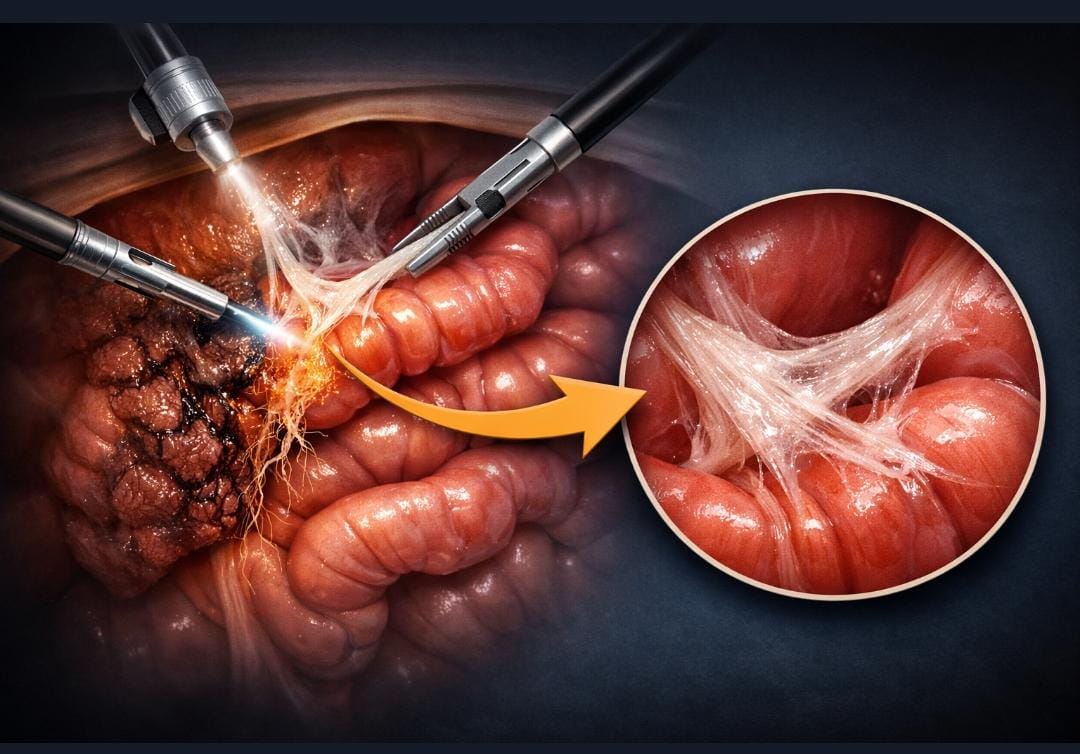
This is the story of postoperative peritoneal adhesions: bands of fibrous scar tissue that may develop between abdominal organs or between organs and the abdominal wall after surgery. Studies have shown that adhesions occur in a large proportion of patients following abdominal and pelvic procedures, with reported rates exceeding 90% after certain major operations.
While many adhesions remain completely asymptomatic, others may gradually lead to chronic abdominal pain, impaired bowel mobility, female infertility in selected gynecological cases, or even life-threatening bowel obstruction years after an apparently successful operation.
Why do adhesions develop?
To understand this process, we must first understand the peritoneum—the thin, smooth membrane that lines the abdominal cavity and covers most abdominal organs. Under normal circumstances, this membrane provides a slippery, friction-free surface that allows the intestines and other organs to move freely during digestion and normal body movement.
During abdominal surgery, however, the peritoneum may be exposed to tissue injury, bleeding, temporary drying, or unavoidable surgical manipulation. Although these events are part of many surgical procedures, they trigger the body's natural wound-healing response.
In most patients, this healing process proceeds normally. In some cases, however, it results in the formation of permanent adhesions.
Inflammation and fibrin: the beginning of adhesion formation
Immediately after tissue injury, inflammatory cells release chemical mediators that increase the permeability of nearby blood vessels.
As a result, plasma proteins leak into the injured area, including fibrinogen, which is converted into fibrin. This fibrin forms a temporary biological scaffold that helps stabilize injured tissues during the early stages of healing.
At this point, fibrin is beneficial—it acts as a temporary bridge while tissue repair takes place.
When the body's natural cleanup system falls behind
Under normal conditions, the body activates its fibrinolytic system, a specialized mechanism responsible for removing excess fibrin once healing has begun.
This process depends on several enzymes, particularly tissue plasminogen activator (tPA), which generates plasmin—the enzyme responsible for breaking down fibrin.
However, factors such as extensive surgical trauma, reduced local blood supply, prolonged inflammation, infection, or tissue ischemia may suppress this system. When fibrin persists for longer than intended, it becomes a scaffold for fibroblasts, the cells responsible for producing collagen.
Over time, collagen fibers are deposited, while new blood vessels and nerve fibers may grow into the developing tissue. What initially served as a temporary repair matrix gradually transforms into a permanent fibrous adhesion.
Why can adhesions become a problem?
Not all adhesions cause symptoms. In fact, many are discovered incidentally—or remain undetected throughout a person's life.
However, dense or strategically located adhesions may restrict the normal movement of the intestines or tether organs to surrounding tissues. This may lead to:
- Chronic or recurrent abdominal pain. - Abdominal bloating and discomfort. - Altered bowel function. - Partial or complete bowel obstruction in severe cases.
Adhesive small bowel obstruction remains one of the most common long-term complications following abdominal surgery and continues to represent a significant cause of emergency hospital admissions worldwide.
Can surgeons reduce the risk?
Modern surgery has significantly improved our understanding of adhesion prevention.
Whenever clinically appropriate, minimally invasive (laparoscopic) surgery generally causes less tissue trauma than traditional open surgery and has been associated with a lower risk of adhesion formation in many procedures.
In addition, experienced surgeons employ meticulous tissue-handling techniques to minimize unnecessary injury, maintain adequate tissue hydration throughout the procedure, and ensure meticulous control of bleeding.
For selected patients and procedures, bioresorbable adhesion barrier materials—such as hyaluronic acid/carboxymethylcellulose membranes or oxidized regenerated cellulose barriers—may also be used to temporarily separate injured surfaces during the critical early healing period, thereby reducing the likelihood of permanent adhesion formation.
Conclusion
Although postoperative peritoneal adhesions are a common consequence of abdominal and pelvic surgery, they do not inevitably lead to symptoms or complications. Nevertheless, they remain one of the leading causes of adhesive small bowel obstruction, chronic abdominal pain, and technical difficulties during future operations.
Understanding the biological mechanisms behind adhesion formation has transformed modern surgical practice. Today, meticulous tissue handling, minimally invasive techniques whenever appropriate, and evidence-based adhesion prevention strategies have become integral components of high-quality surgical care.
Ultimately, the success of an operation should not be measured solely by what happens inside the operating room, but also by how effectively long-term complications are prevented after the patient leaves it.
Written by Prof. Dr. Mohamed Henaish
Professor and Consultant of General Surgery | Laparoscopy | Bariatric | Cosmetic and Oncologic Surgery
Fact-checked by HealthNato Scientific Team
on July 13, 2026 at 10:30 AM
Get new articles in your inbox
One short email a week, no spam.
Your privacy is important to us.
Related Articles
 General Health
The Revolution in New Obesity Medications vs. Bariatric Surgery... Has the Era of the Scalpel Come to an End?
 General Health
7 Simple Habits That Could be Time Bombs in Your Daily Life !
 General Health
5 Drinks That May Harm Your Kidneys and Why They Deserve a Second Look.
 General Health