A Promising Discovery Opens A New Door For Treating Fatty Liver Disease : A Hidden Enzyme That Could Halt Its Progression.

Written by Prof. Dr. Fatma Younis
Scientific Development Director at HealthNato | Professor of Hepatology and Gastroenterology
Information reviewed by HealthNato Scientific Team
on October 11, 2026 at 12:30 PM
Fatty liver disease begins with the accumulation of fat inside liver cells without obvious symptoms. However, the greater concern is that the disease progresses to steatohepatitis in 20% to 25% of affected individuals. This is a critical stage in which excess fat combines with acute inflammation, cell damage, and fibrosis that may advance to stages threatening liver function.
According to the American Liver Foundation, approximately 100 million people in the United States alone have metabolic dysfunction-associated steatotic liver disease (MASLD).
For years, management of the disease has focused on lifestyle improvements and addressing metabolic risk factors.
However, a new study published in Nature Metabolism has revealed a biological mechanism that may help limit liver damage in the future through an enzyme that acts as an internal line of defense against cellular deterioration.
What is this enzyme, and could it become a new therapeutic target?
When the Liver’s Cellular Powerhouses Become Dysfunctional
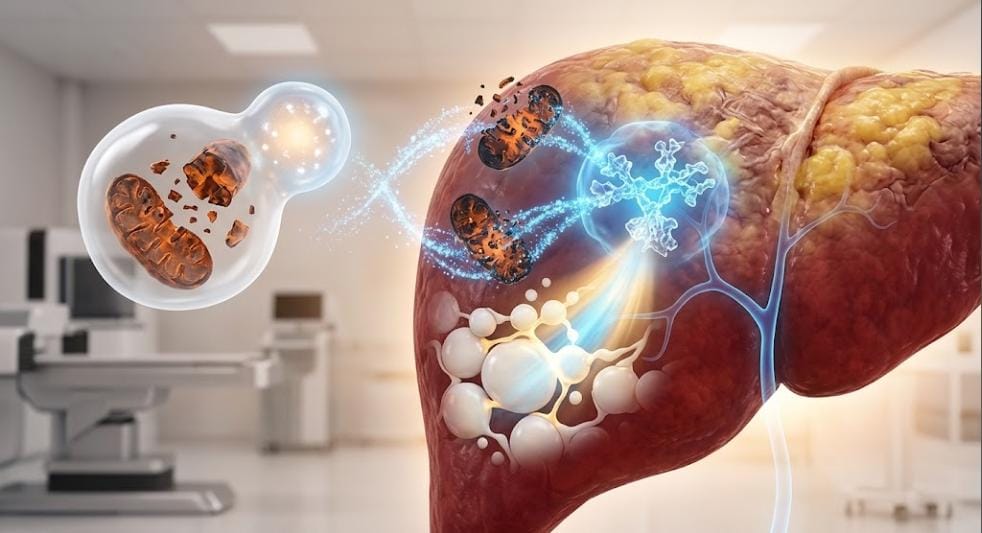
Mitochondria are the energy-producing centers inside cells. Their role extends beyond energy production; they also contribute to regulating metabolic processes (energy use within cells) and handling fats.
When these components become damaged inside liver cells, metabolic disturbances and inflammatory signaling may worsen, contributing to disease progression.
This highlights the importance of mitophagy, a process through which the body removes damaged mitochondria to maintain cellular function.
The UBE2N Enzyme… The New Discovery
Researchers observed that levels of the enzyme UBE2N decline in liver cells as the disease progresses in the models they studied.
The enzyme appears to help remove damaged mitochondria and support fat breakdown mechanisms, thereby helping limit fat accumulation, inflammation, and cellular damage.
When researchers restored the enzyme’s levels to normal in the livers of experimental mice, they observed reductions in fat accumulation, inflammation, and fibrosis.
These findings suggest that enhancing this pathway could represent a potential therapeutic target by supporting the liver’s natural protective mechanisms rather than focusing on fat alone.
However, this does not mean that a new treatment is now available to patients. The current evidence comes from preclinical animal research, and the effectiveness and safety of this approach have not yet been established in humans.
Has the Era of Fatty Liver Disease Come to an End ?
Not yet. This discovery adds an important piece to our understanding of the mechanisms underlying the disease, but it does not diminish the role of established interventions with proven benefits in reducing risk, such as:
Weight loss when appropriate.
Regular physical activity.
Improving dietary quality.
Managing diabetes and abnormal blood lipid levels.
Furthermore, restoring enzyme levels in experimental mice does not establish that advanced fibrosis can be reversed in humans, nor does it mean that all stages of the disease can be treated in the same way.
Further studies are needed to determine how the enzyme can be safely targeted and whether enhancing its activity will deliver meaningful clinical benefits to patients.
In Conclusion…
The importance of this discovery lies in highlighting an internal mechanism that may help the liver eliminate damaged mitochondria and counteract inflammation and fat accumulation.
It is a promising therapeutic target, not yet a proven treatment.
Between encouraging laboratory findings and their potential application in clinical practice, human studies remain the decisive test.
For now, early detection, lifestyle improvements, and management of metabolic risk factors remain among the most important pillars of fatty liver disease care.
Written by Prof. Dr. Fatma Younis
Scientific Development Director at HealthNato | Professor of Hepatology and Gastroenterology
Information reviewed by HealthNato Scientific Team
on October 11, 2026 at 12:30 PM
Related articles
 General Health
The Hidden Battle After Abdominal Surgery: Understanding Postoperative Peritoneal Adhesions
 General Health
The Revolution in New Obesity Medications vs. Bariatric Surgery... Has the Era of the Scalpel Come to an End?
 General Health
7 Simple Habits That Could be Time Bombs in Your Daily Life !
 General Health