Creatine: The Popular Gym Supplement… Its Effects on the Brain and Resistance to Aging

Written by Dr. Saeed Attia
Scientific Development Team at HealthNato | Pharmacist | Pharmacology & Supplements Specialist
Information reviewed by HealthNato Scientific Team
on October 9, 2026 at 12:30 PM
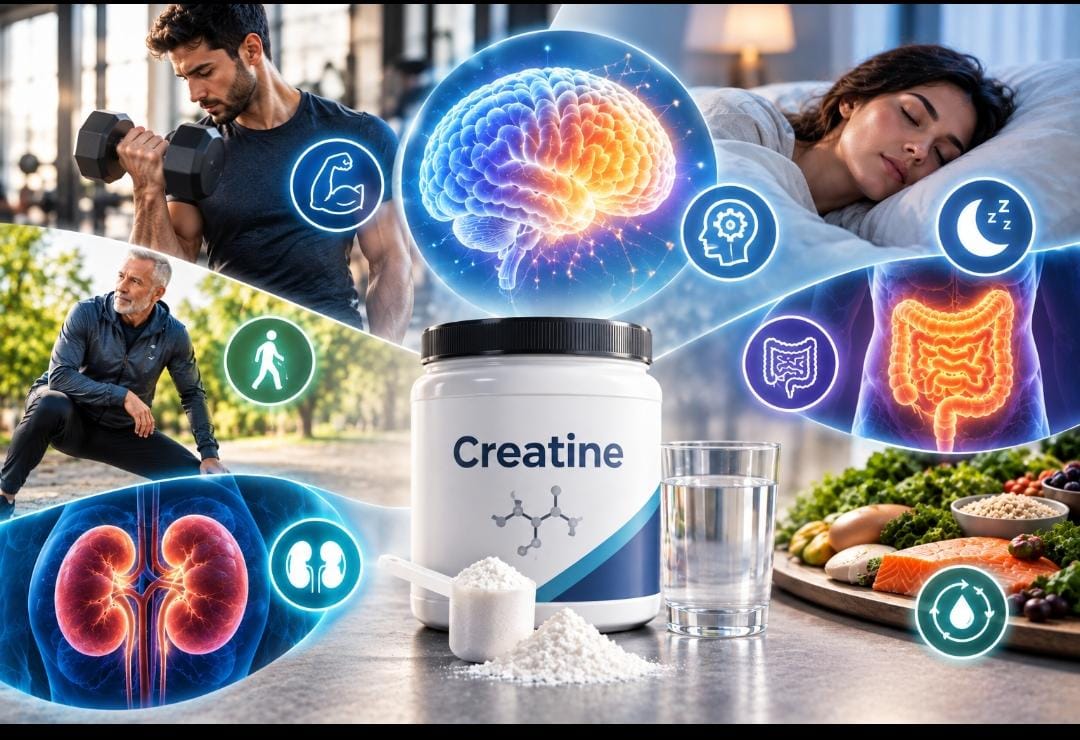
However, scientific interest in creatine is no longer limited to improving physical performance. Researchers are investigating its potential role in supporting brain function, addressing some of the effects of sleep deprivation, and preserving muscle strength with advancing age.
Has creatine truly become a supplement for overall body and brain health, or do some of the claims circulating about it go beyond the available scientific evidence?
How Does Creatine Work in the Body ?
Creatine is a compound naturally produced by the body from amino acids. We also obtain some of it from foods such as meat and fish. Most creatine is stored in the muscles, with smaller amounts present in other tissues, including the brain.
When muscles require rapid energy, phosphocreatine helps support the continued production of energy during short, high-intensity efforts.
The Brain and Memory… Can Creatine Improve Mental Performance ?
Some studies suggest improvements in certain aspects of mental performance in some individuals, particularly under conditions such as sleep deprivation or stress. Other studies, however, have found no clear benefits in healthy individuals who get sufficient sleep.
The brain does use creatine as part of its energy-production system.
However, evidence that supplementation reliably improves memory or concentration remains limited, and the subject is still under investigation. There is insufficient evidence to recommend creatine as a general memory enhancer for everyone.
Can Creatine Protect Against Alzheimer’s and Parkinson’s Disease ?
There is insufficient clinical evidence to establish that creatine supplements prevent these diseases or halt their progression.
Therefore, it is more accurate to describe creatine as a subject of ongoing research rather than a proven supplement for protecting the brain against neurodegenerative diseases.
Its Role in Combating Muscle Loss After the Age of 50
With advancing age, muscle mass, strength, and the ability to perform daily activities may decline. These changes increase the risk of falls and loss of independence.
Here, systematic reviews and meta-analyses suggest that adding creatine to resistance training may provide additional gains in lean body mass and strength in older adults compared with exercise alone, although results vary across studies and individuals.
However, taking creatine without resistance training does not guarantee the prevention of muscle loss.
Therefore, combining regular resistance training with adequate nutrition, sufficient protein, and creatine when appropriate represents a useful strategy for maintaining strength with age.
Can Creatine Compensate for Lack of Sleep ?
A recent research review suggests preliminary promising results in certain aspects of cognitive and motor performance during acute sleep deprivation. However, the number of studies remains limited, and the findings are not consistent across all tests. This does not mean that creatine can replace lost sleep or protect the body against all the harmful effects of staying up late.
Adequate, regular sleep remains the priority.
Does Creatine Harm the Kidneys ?
Evidence suggests that creatine monohydrate is generally safe for healthy adults when used at studied doses. Blood creatinine levels may rise in some users without necessarily indicating kidney damage, because creatinine is a metabolic byproduct whose levels are also influenced by creatine intake and muscle mass.
However, changes in laboratory results should not be ignored, particularly in people with kidney disease or those taking medications that may affect kidney function. In such cases, use should be assessed in consultation with a physician.
The Most Common Type and Dosage
- Creatine monohydrate is the most extensively studied form and the one best supported by scientific evidence.
- Common dosage: 3–5 grams daily for healthy adults.
Not everyone needs supplementation, as some people may obtain sufficient amounts from their diet.
People with kidney disease, pregnant women, and those with specific medical conditions or taking medications that may affect kidney function should consult a physician before using creatine.
In Conclusion…
Creatine is not merely a muscle-building supplement, but neither is it a comprehensive treatment for brain health, aging, or metabolic diseases.
The strongest evidence supports its role in improving certain aspects of physical performance, particularly when combined with resistance training.
As for its potential benefits for memory, mitigating the effects of sleep deprivation, and improving metabolic markers, further research is still needed to determine who may benefit, and to what extent.
Written by Dr. Saeed Attia
Scientific Development Team at HealthNato | Pharmacist | Pharmacology & Supplements Specialist
Information reviewed by HealthNato Scientific Team
on October 9, 2026 at 12:30 PM
Related articles
 Pharmaceuticals
The Invisible War Inside Your Gut : How Antibiotics Reshape the “Microbiome”
 Pharmaceuticals
The Silent Killer in Your Kitchen: When Can Potassium Salt and Potassium Supplements Put Your Heart at Risk?
 Pharmaceuticals
When Does a Dietary Supplement Become a Drug Dose? The Truth About the 600,000-IU Vitamin D Injection
 Pharmaceuticals