The Silent Killer in Your Kitchen: When Can Potassium Salt and Potassium Supplements Put Your Heart at Risk?

Written by Dr. Saeed Attia
Scientific Development Team at HealthNato | Pharmacist | Pharmacology & Supplements Specialist
Fact-checked by HealthNato Scientific Team
on August 10, 2026 at 12:30 PM
Key Points
- ACE inhibitors and other medications can reduce the body's ability to eliminate potassium, increasing the risk of hyperkalemia in susceptible patients.
- Potassium supplements and salt substitutes containing potassium chloride can further increase potassium intake and may become dangerous when combined with certain medications.
- Severe hyperkalemia can disrupt the heart's electrical activity and cause dangerous cardiac arrhythmias, making medical monitoring important for people at risk.
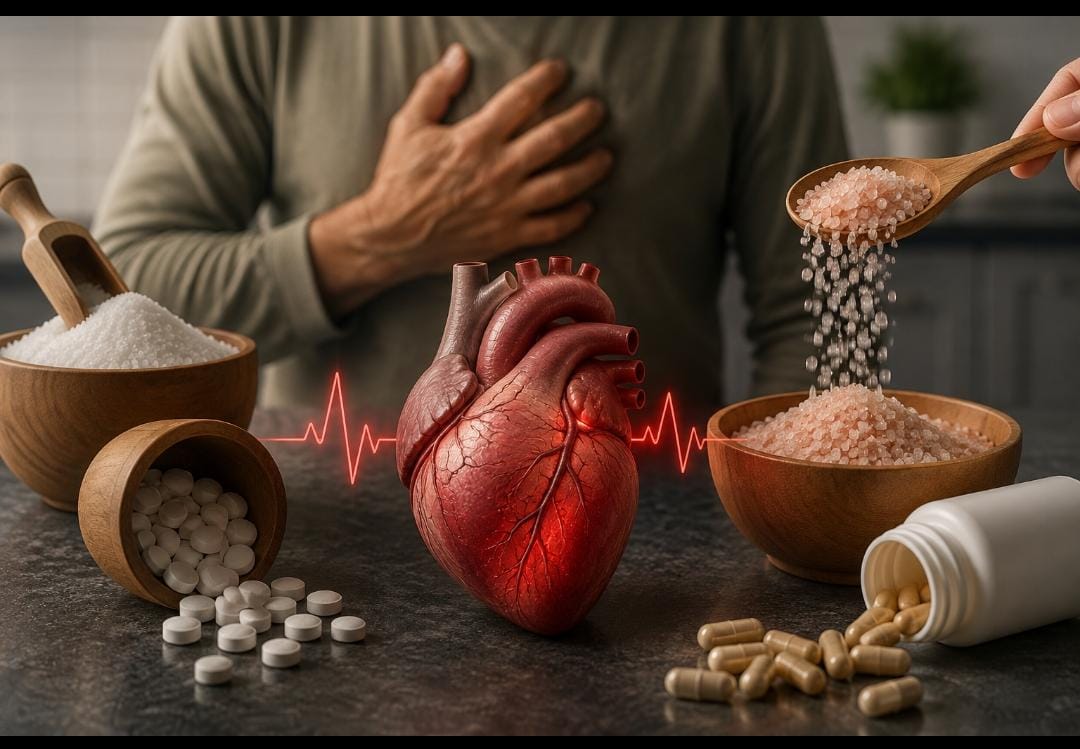
Potassium is an essential mineral that plays an important role in cardiovascular health. However, for certain patients, potassium supplements or potassium-rich salt substitutes can become a genuine health risk, particularly when combined with certain medications used to treat high blood pressure.
The problem is not potassium itself, but its accumulation in the bloodstream when the kidneys are unable to eliminate it efficiently.
How Does the Problem Start?
Some blood-pressure medications, including captopril, enalapril, lisinopril, and ramipril, belong to a class known as angiotensin-converting enzyme inhibitors (ACE inhibitors).
These medications reduce the formation of angiotensin II and consequently decrease the secretion of aldosterone, a hormone that helps the kidneys eliminate potassium.
As a result, blood potassium levels may rise in some patients, particularly those with impaired kidney function or those taking other medications that can increase potassium levels.
The Trap: Potassium Supplements and Salt Substitutes
When a patient adds potassium supplements to their diet or uses salt substitutes containing potassium chloride, the amount of potassium entering the body may increase further.
This can lead to hyperkalemia, a potentially serious condition when potassium levels become significantly elevated.
The risk is not limited to ACE inhibitors. It may also increase with medications such as:
Losartan, valsartan, and candesartan.
Spironolactone and eplerenone.
Nonsteroidal anti-inflammatory drugs (NSAIDs), such as ibuprofen and diclofenac, particularly with frequent use or in people with kidney disease.
Why Is High Potassium Dangerous for the Heart?
Potassium is essential for regulating the electrical activity of cardiac cells. When blood potassium levels become significantly elevated, the heart's electrical conduction and rhythm can be disrupted.
Symptoms may include muscle weakness, tingling, nausea, or palpitations. However, some cases may produce few or no noticeable symptoms despite potentially serious disturbances in cardiac electrical activity.
In severe hyperkalemia, dangerous cardiac arrhythmias can develop and, in extreme cases, may progress to cardiac arrest.
How Can You Protect Yourself?
Do not take potassium supplements on your own if you are taking blood-pressure medications or have kidney disease.
If you are taking medications that may increase potassium levels, your physician should determine whether you need regular monitoring of blood potassium and kidney function.
You should also check the ingredients of salt substitutes. The term "low sodium" does not necessarily mean low in potassium; some products contain substantial amounts of potassium chloride.
The Bottom Line
Potassium is essential for life, but a dose that is appropriate for one person may become dangerous for another, depending on their medications, kidney function, and overall health.
Therefore, do not add potassium supplements or potassium-based salt substitutes to your diet simply because they appear to be a "healthier" choice—especially if you take blood-pressure medication.
Talk to your doctor or pharmacist first. A seemingly harmless change in your kitchen can sometimes interact with your medication and create a serious risk to your heart.
Written by Dr. Saeed Attia
Scientific Development Team at HealthNato | Pharmacist | Pharmacology & Supplements Specialist
Fact-checked by HealthNato Scientific Team
on August 10, 2026 at 12:30 PM
Get new articles in your inbox
One short email a week, no spam.
Your privacy is important to us.
Related Articles
 Pharmaceuticals
The Invisible War Inside Your Gut : How Antibiotics Reshape the “Microbiome”
 Pharmaceuticals
When Does a Dietary Supplement Become a Drug Dose? The Truth About the 600,000-IU Vitamin D Injection
 Pharmaceuticals
One Injection Could Change the “Cholesterol Gene”.. Has the Era of Once-Only Lipid Treatment Begun?
 Pharmaceuticals