How Concentrated Vitamins Turn into Hidden Toxins in Our Bodies

Written by Dr. Saeed Attia
Scientific Development Team at HealthNato | Pharmacist | Pharmacology & Supplements Specialist
Fact-checked by HealthNato Scientific Team
on July 11, 2026 at 3:00 AM
Key Points
- Fat-soluble vitamins can accumulate in the body and cause toxicity.
- Excess vitamin A may damage the liver and increase intracranial pressure.
- Excess vitamin D can cause hypercalcemia and kidney complications.
- Safe supplement use depends on proper testing and the appropriate dosage.
How Concentrated Vitamins Turn into Hidden Toxins in Our Bodies
In recent years, dietary supplements have become an integral part of many people's daily routines. This has entrenched a misconception among some that consuming higher doses of vitamins equates to better health, increased energy, and stronger immunity. However, the human body does not operate by this logic.
Just as a deficiency in vitamins can cause health problems, the excessive intake of certain vitamins can also lead to adverse effects—particularly if utilized in high doses and for prolonged periods without a medical indication or laboratory monitoring. This clinical issue manifests more clearly with fat-soluble vitamins, with vitamins A and D being the most prominent examples.
Why Do Certain Vitamins Become a Problem?
Vitamins are categorized into two primary groups: Water-soluble vitamins: Such as vitamin C and the B-vitamin complex, from which the body can readily excrete a large portion of the excess through urine. Fat-soluble vitamins: Such as A, D, E, and K, which are stored to varying degrees in the liver and adipose tissues. Consequently, overconsuming them for extended periods can cause them to accumulate gradually, increasing the risk of toxicity.
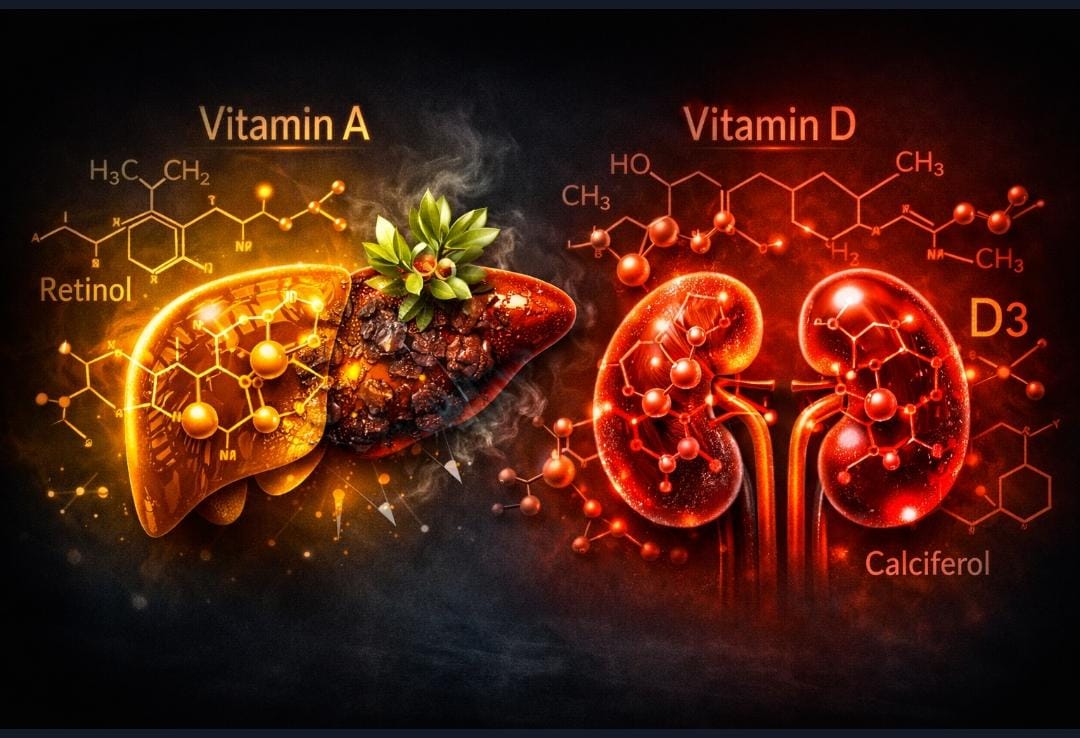
Therefore, these vitamins are not inherently dangerous; rather, the issue lies in the elevated, continuous doses that exceed the body's physiological requirements. Vitamin A: When the Essential Becomes Harmful Vitamin A (retinol) plays an essential role in maintaining vision, cellular turnover, and supporting the immune system. However, excessive intake—especially in the form of high-concentration supplements—can lead to elevated levels in the body, which can exert toxic effects on several organs. With chronic exposure to high doses, hepatocytes (liver cells) can be adversely affected, potentially activating the cells responsible for collagen deposition, which over time may contribute to liver fibrosis.
Furthermore, exceptionally high doses are associated with increased intracranial pressure—a condition that can cause severe headaches, visual disturbances, and neurological symptoms that necessitate prompt medical evaluation. Vitamin D: When Calcium Equilibrium is Disrupted Although vitamin D is known as a "vitamin," it operates within the body as an important hormonal regulator of calcium and phosphorus balance.
With growing awareness surrounding vitamin D deficiency, many individuals have taken to consuming high therapeutic doses, such as 50,000 IU, without undergoing the necessary blood tests or adhering to the duration specified by a physician. The clinical danger does not reside in the vitamin itself, but rather in the fact that excessively elevated levels can induce Hypercalcemia (abnormally high calcium levels in the blood). This can result in symptoms such as nausea, loss of appetite, constipation, increased thirst, and frequent urination. In severe cases, or when elevation persists for long periods, calcium can precipitate into certain soft tissues, such as the kidneys. This increases the risk of renal calculi (kidney stones) formation and impairs renal efficiency, and the deposition may extend to other tissues in the body as well. Signs That Many Might Overlook The danger of vitamin overconsumption lies in the fact that its initial symptoms can be non-specific, leading individuals to mistake them for routine fatigue or daily life stressors.
These symptoms include:
Nausea.
Loss of appetite.
Constipation.
Headaches.
Lethargy.
Muscle weakness.
Persistent thirst.
Frequent urination.
Consequently, the persistence of these symptoms in an individual taking high-dose supplements warrants consulting a physician and re-evaluating the necessity of these doses.
How to Use Supplements Safely ?
Modern medical practice relies on a simple principle: high therapeutic doses should not be utilized unless there is a clear clinical indication. Therefore, it is preferable to measure the baseline level of the vitamin when necessary, and subsequently determine the appropriate dosage and duration of treatment based on laboratory findings and the patient's health status, while adhering to the Tolerable Upper Intake Levels (UL) when applicable.
Furthermore, obtaining vitamins through a balanced diet remains the safest option in most cases, as the body possesses intrinsic mechanisms that regulate the absorption of nutrients found in food far better than the haphazard use of high-concentration supplements. Conclusion Dietary supplements are neither a substitute for healthy food nor are they more beneficial as their dosage increases. Vitamins are essential elements for life, but overconsuming certain types can turn their benefits into harm, particularly with fat-soluble vitamins like A and D.
Hence, the safe use of supplements begins with a simple question: Do I actually need them? In medicine, the largest dose is not always the best; rather, it is the right dose for the right person at the right time.
Written by Dr. Saeed Attia
Scientific Development Team at HealthNato | Pharmacist | Pharmacology & Supplements Specialist
Fact-checked by HealthNato Scientific Team
on July 11, 2026 at 3:00 AM
Get new articles in your inbox
One short email a week, no spam.
Your privacy is important to us.