Can Exercise Restore Youthful Muscle? A New Discovery Offers Hope for Combating Muscle Aging

Written by Coach. Asiya Darwish
Fitness & Exercise Program Design Specialist
Information reviewed by HealthNato Scientific Team
on October 30, 2026 at 12:30 PM
However, a recent study reveals how exercise may intervene in this process by influencing a gene associated with muscle aging and reactivating cellular maintenance mechanisms.
Gene That Accelerates Muscle Aging
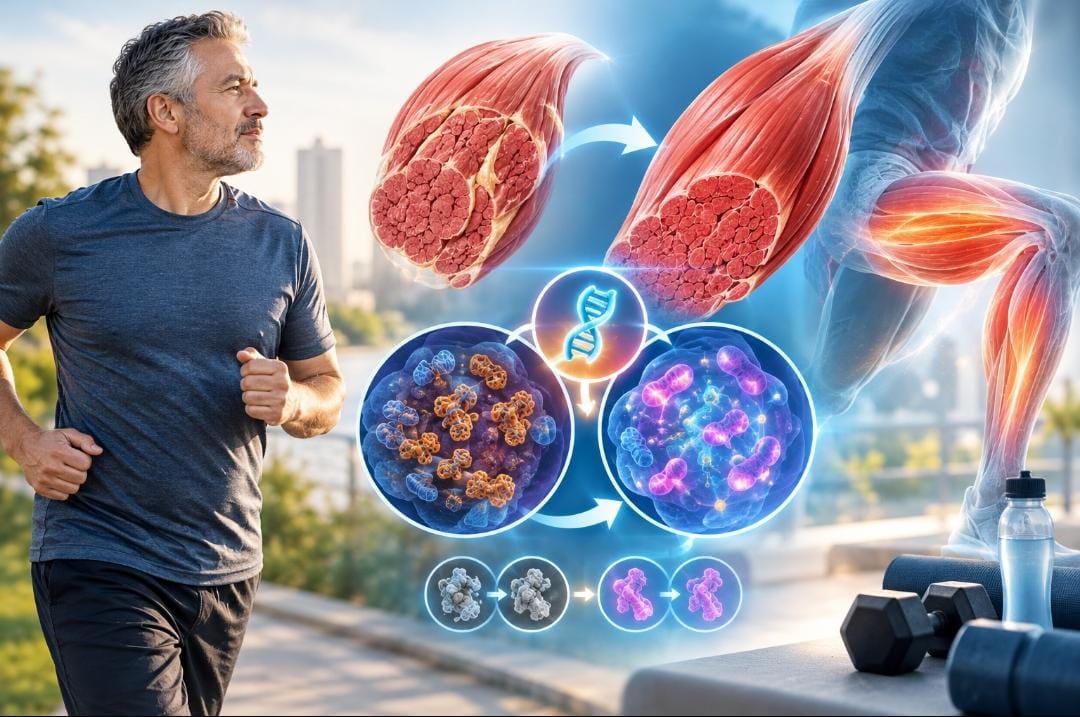
In a study led by researchers from Duke-NUS Medical School, in collaboration with Singapore General Hospital and Cardiff University, and published in the journal PNAS, scientists identified a gene known as DEAF1, whose activity increases with age and contributes to muscle deterioration.
The problem is that this gene increases the activity of a biological pathway responsible for regulating protein production inside cells.
When this pathway becomes excessively active, cells tend to produce more proteins while becoming less efficient at removing old and damaged ones. As a result, these components accumulate inside muscle cells, affecting their function and ability to repair themselves.
How Exercise Reactivates the Repair System
The researchers discovered that physical activity can help reduce this problem and improve the cells’ ability to eliminate damaged proteins while continuing to produce new ones.
In other words, exercise does more than stimulate muscle growth; it also helps muscles carry out an internal maintenance process that is essential for preserving their strength and integrity.
Can Muscle Aging Be Reversed?
The researchers tested this mechanism in mice. The experiments showed that reducing DEAF1 activity helped improve protein balance and restore muscle strength, while increasing its activity accelerated muscle deterioration.
However, it is important not to overinterpret these findings at this stage.
The Bottom Line
The study reveals that maintaining healthy muscles is not just about building proteins, but also about the cells’ ability to eliminate damaged components and continuously repair themselves.
The discovery of the DEAF1 gene may pave the way for developing treatments that target muscle repair mechanisms, potentially helping people who are unable to exercise because of illness, surgery, or limited mobility.
Most importantly, the findings suggest that exercise may influence muscle aging at the molecular level, not merely their appearance and strength, highlighting the additional importance of physical activity in preserving mobility and independence as we grow older.
Written by Coach. Asiya Darwish
Fitness & Exercise Program Design Specialist
Information reviewed by HealthNato Scientific Team
on October 30, 2026 at 12:30 PM
Related articles
 Fitness & Wellness
Exercise Is Not Just About Losing Weight… It’s About Living Better
 Fitness & Wellness
Why Do You Start with Enthusiasm, Then Stop? 10 Science-Based Steps to Turn Exercise into a Sustainable Lifestyle
 Fitness & Wellness
Your First Steps at the Gym: How to Start Training Safely and Effectively
 Fitness & Wellness