Exercise During Pregnancy: Is It Safe for the Mother and Baby ?

Written by Coach. Asiya Darwish
Fitness & Exercise Program Design Specialist
Information reviewed by HealthNato Scientific Team
on October 14, 2026 at 12:30 PM
The truth is that a normal pregnancy does not require a woman to stop being physically active. On the contrary, appropriate physical activity can support maternal health and reduce the risk of certain pregnancy complications, provided there are no medical contraindications that require exercise to be restricted or avoided.
Benefits of Exercise During Pregnancy
Regular physical activity helps improve cardiorespiratory fitness, reduce back pain and constipation, support healthy weight gain during pregnancy, and lower the risk of gestational diabetes and certain complications, such as preeclampsia and cesarean delivery.
It also supports mental health and the ability to perform daily activities.
How Many Minutes of Exercise Does a Pregnant Woman Need?
The World Health Organization recommends that pregnant women without medical contraindications engage in at least 150 minutes of moderate-intensity aerobic activity (cardio) per week, with a variety of activities that include muscle-strengthening exercises. Gentle stretching exercises may also be included.
Suitable options for many pregnant women include walking, swimming, using a stationary bicycle, and strength training adapted to their abilities and stage of pregnancy.
This activity can be divided across several days or into shorter sessions.
Women who are not accustomed to exercising should start gradually and increase the duration and intensity over time.
Can Pregnant Women Do Resistance Training and Running?
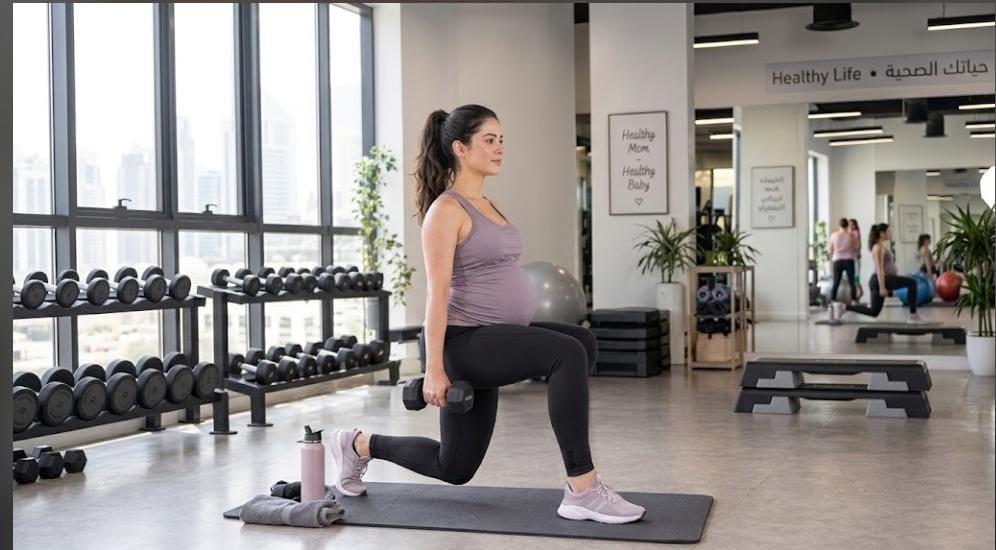
Yes. Resistance training may be appropriate during an uncomplicated pregnancy, provided that weights and movements are adjusted to suit the woman's condition, balance, and physical abilities. The goal is to maintain strength, not to lift maximum weights or push the body beyond its capacity.
As for running and high-intensity exercise, whether a woman can continue depends on her activity level before pregnancy, her medical condition, and the nature of the exercise.
Women who are accustomed to these activities may be able to continue after appropriate medical assessment, whereas beginners are not advised to start a strenuous program abruptly.
It is best to avoid sports that carry a high risk of falling or abdominal impact, scuba diving, and exercising in extremely hot conditions.
As pregnancy progresses, some positions and movements may need to be modified, particularly prolonged periods of lying on the back after the first trimester.
How Can a Pregnant Woman Tell Whether Her Exercise Intensity Is Appropriate?
The talk test can be helpful: during moderate-intensity activity, a woman should be able to talk while exercising, although singing may be difficult.
She should also ensure adequate hydration before, during, and after exercise, avoid high temperatures and excessive humidity, and stop if she experiences unusual pain or fatigue.
When Should Exercise Be Stopped and Medical Help Sought?
Exercise should be stopped, and the woman should contact her healthcare provider promptly if any of the following warning signs occur:
- Vaginal bleeding or leakage of amniotic fluid. - Chest pain or shortness of breath before starting exercise. - Severe dizziness or fainting. - A severe headache or weakness affecting balance. - Pain or swelling in the calf. - Regular, painful uterine contractions or concerning abdominal pain.
Some symptoms may require urgent medical evaluation, particularly bleeding, fluid leakage, chest pain, or severe shortness of breath.
If the pregnancy is high-risk or medical complications are present, appropriate physical activity should be determined in consultation with an obstetrician.
The Bottom Line
Exercise during pregnancy is not automatically prohibited, just as not every exercise is suitable for every pregnant woman.
In an uncomplicated pregnancy, regular physical activity adapted to the woman's condition can support maternal health and help her maintain fitness.
The goal is not to exercise at maximum intensity, but to choose appropriate activities, increase intensity gradually, and pay attention to the body's signals.
ــــــــــــــــ
This article is intended for general health education and does not replace medical assessment. Some pregnancy conditions may require different physical activity recommendations.
Written by Coach. Asiya Darwish
Fitness & Exercise Program Design Specialist
Information reviewed by HealthNato Scientific Team
on October 14, 2026 at 12:30 PM
Related articles
 Fitness & Wellness
Exercise Is Not Just About Losing Weight… It’s About Living Better
 Fitness & Wellness
Why Do You Start with Enthusiasm, Then Stop? 10 Science-Based Steps to Turn Exercise into a Sustainable Lifestyle
 Fitness & Wellness
Your First Steps at the Gym: How to Start Training Safely and Effectively
 Fitness & Wellness