Walking Speed and Longevity: Can Your Steps Reveal Your Health and Future?

Written by Coach. Asiya Darwish
Fitness & Exercise Program Design Specialist
Information reviewed by HealthNato Scientific Team
on November 20, 2026 at 12:30 PM
Research suggests that walking speed is not merely a measure of physical fitness, but may also be an important functional indicator of the body's overall capacity, particularly with advancing age.
What Do the Studies Say?
In a systematic review and meta-analysis published in 2024 in the Journal of Sports Sciences, researchers analyzed 13 studies involving more than 530,000 participants.
They found that:
- Individuals in the fastest walking-speed group had a 43% lower risk of death from any cause compared with those in the slowest walking-speed group. - Every 0.1 m/s increase in walking speed was associated with a 6% relative reduction in the risk of death.
These are statistical associations, not evidence that brisk walking alone extends life or guarantees protection against death.
Why Is Walking Speed an Important Health Indicator?
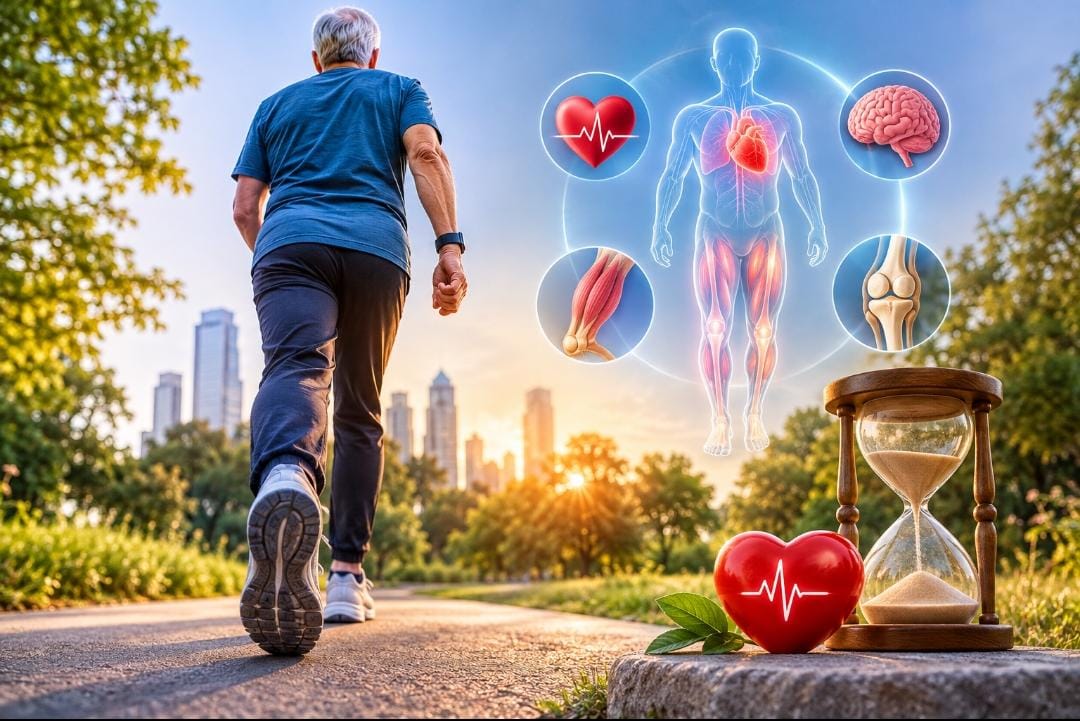
Walking requires coordination between several body systems and functions, including:
1- The heart and lungs: Their ability to deliver oxygen efficiently to the muscles.
2- Muscles and joints: Muscle strength, balance, flexibility, and motor coordination.
3- Metabolism: The efficiency with which muscles use energy, and the role of physical activity in improving insulin sensitivity and regulating blood glucose.
. The nervous system: Coordination between the brain, nerves, and muscles to maintain a stable walking pattern.
Therefore, slow walking may reflect a decline in functional capacity or the presence of an underlying health problem, but it does not identify the cause on its own.
Can Walking Speed Reveal Your Biological Age?
Walking speed may help assess functional status, particularly in older adults. A person who can walk independently and at an appropriate speed generally has better physical mobility.
However, walking speed is not an independent test of biological age, nor can it be used alone to predict a person's lifespan.
The Recent JAMA Study
A study published in the specialized scientific journal JAMA Network Open in October 2026, involving 4,067 participants from the Whitehall II study, found that both clinically measured walking speed and daily-life step rate, assessed using motion-monitoring devices, were associated with a lower risk of death from any cause.
These findings suggest that assessing everyday movement may provide valuable health information, rather than relying on step count alone.
How Can You Maintain a Good Walking Speed?
- Walk regularly at a pace appropriate for your health and physical capacity. - Perform resistance training to strengthen the muscles of the legs, thighs, and hips. - Pay attention to balance and motor coordination. - Gradually improve cardiorespiratory fitness. - Maintain good nutrition, sleep, and recovery habits.
For older adults and people with chronic diseases or joint problems, any increase in walking speed should be gradual and suited to their abilities, with a health assessment when necessary.
Conclusion
Walking speed is more than just a number. It is a simple indicator that may reflect the efficiency of the heart, muscles, nervous system, and the body's overall functional capacity.
Evidence suggests that faster walking is associated with a lower risk of death, particularly among older adults. However, it does not determine a person's fate or guarantee a longer life.
What matters most is not walking at the fastest possible pace, but maintaining the ability to move independently and efficiently as you grow older.
Written by Coach. Asiya Darwish
Fitness & Exercise Program Design Specialist
Information reviewed by HealthNato Scientific Team
on November 20, 2026 at 12:30 PM
Related articles
 Fitness & Wellness
Exercise Is Not Just About Losing Weight… It’s About Living Better
 Fitness & Wellness
Why Do You Start with Enthusiasm, Then Stop? 10 Science-Based Steps to Turn Exercise into a Sustainable Lifestyle
 Fitness & Wellness
Your First Steps at the Gym: How to Start Training Safely and Effectively
 Fitness & Wellness