Two Food Pyramids in 2026: How Do You Choose Between Them ?

Written by Dr. Nasser El Shishini
Editorial Director | Pharmacist | Clinical Nutrition & Weight Management Specialist | Researcher in Pharmaceutical & Cosmetic Sciences.
Information reviewed by HealthNato Scientific Team
on November 8, 2026 at 12:30 PM
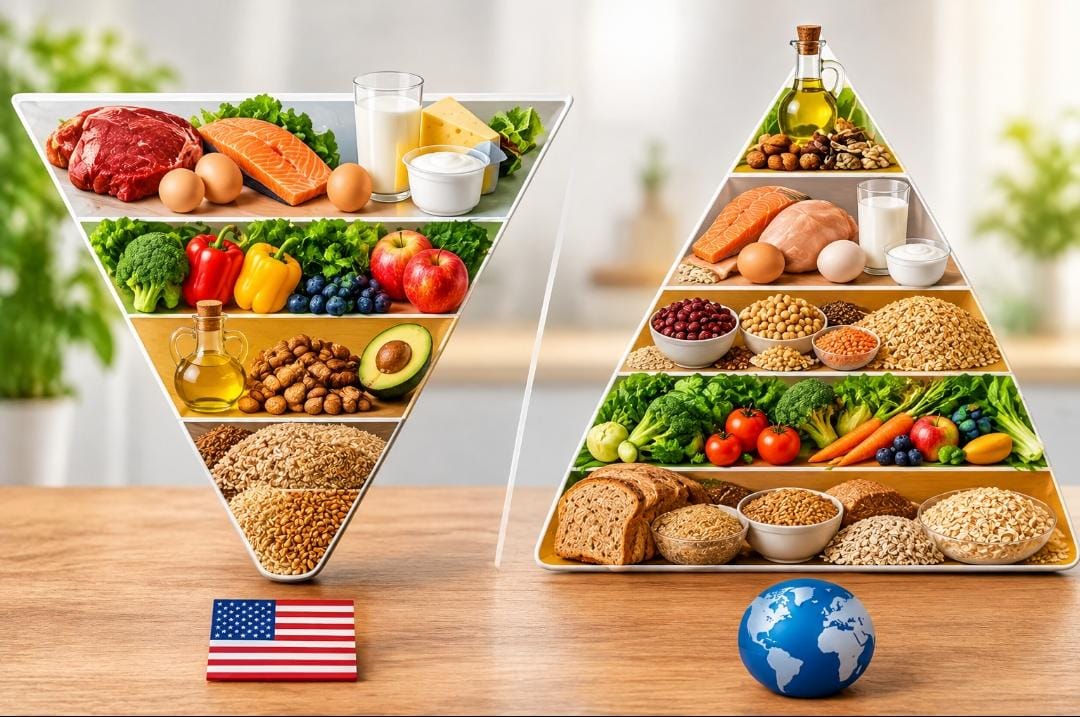
In a notable development in the field of nutrition, two food pyramids emerged in 2026, presenting two different perspectives on what we should eat every day.
The first is an official American model that turns the traditional food pyramid upside down, giving greater prominence to protein, meat, and full-fat dairy products. The second is an international proposal developed by researchers from several countries, placing plant-based foods, whole grains, and legumes at the heart of the diet.
But which model encourages greater meat consumption? And where do protein, fats, and carbohydrates fit into each approach?
First: The American Pyramid — Protein Takes Center Stage
On January 7, 2026, the U.S. Department of Agriculture and the Department of Health and Human Services announced the new Dietary Guidelines for Americans for 2025–2030, introducing an inverted food pyramid that reshuffles dietary priorities.
The pyramid's broadest and most prominent section features protein sources, including red meat, poultry, fish, and eggs, alongside full-fat dairy products, vegetables, fruits, and healthy fats.
Whole grains appear in the narrower section, with an emphasis on reducing refined grains, added sugars, and highly processed foods.
Among the key American recommendations are:
- Include protein in every meal, with the recommended daily intake raised to approximately 1.2–1.6 grams per kilogram of body weight. - Favor unsweetened, full-fat dairy products. - Eat vegetables and fruits every day. - Obtain fats from a variety of sources, including olive oil, nuts, fish, eggs, and certain animal-based sources. - Focus on whole grains while reducing refined carbohydrates. - Limit added sugars and highly processed foods.
However, one important detail deserves attention: despite the visual prominence given to butter and animal fats, the American guidelines still recommend that saturated fat account for no more than 10% of total daily calories.
Second: The International Pyramid — Plants First
On September 23, 2026, the journal Advances in Nutrition published a scientific proposal for a new international food pyramid, developed by researchers within the International Carbohydrate Quality Consortium (ICQC). It draws on a review of dietary guidelines from different countries and regions, scientific evidence, and the EAT-Lancet Planetary Health Diet model.
Rather than making meat the centerpiece of the diet, this pyramid prioritizes vegetables, fruits, whole grains, and legumes.
Its key recommendations include:
- Making whole plant foods the foundation of the diet. - Increasing the consumption of lentils, fava beans, other legumes, nuts, and seeds. - Favoring whole grains and traditional grains with a lower impact on blood sugar, including certain types of rice, legumes, and minimally processed grains. - Relying on olive oil and unsaturated vegetable oils rather than fats rich in saturated fat. - Consuming animal protein in moderation, with a preference for fish and poultry over red meat. - Reducing red and processed meat, sweetened beverages, added sugars, and foods high in saturated fat.
The model proposes limiting animal-protein sources to approximately two servings per day: one serving of dairy and another from sources such as fish, poultry, eggs, or limited amounts of red meat.
Notably, it does not exclude fully plant-based diets. Instead, it can accommodate both vegetarian and predominantly plant-based eating patterns.
Where Do the Two Pyramids Really Differ?
The difference is not that one allows protein while the other prohibits it. Both recognize the importance of protein, but they differ in its sources, quantities, and position within the overall diet.
- Meat: The American model gives animal protein a prominent place, while the international model favors plant protein and treats red meat as a limited option.
- Fats: The American model highlights healthy fats from both plant and animal sources, including butter and beef tallow. The international model places greater emphasis on unsaturated vegetable oils, nuts, and seeds, while limiting saturated fats.
- Carbohydrates: Neither model encourages excessive consumption of white bread or added sugars. However, the international model gives greater prominence to whole grains and traditional grains rich in fiber and associated with a lower impact on blood sugar.
- Dairy: The American model leans toward full-fat dairy products, while the international model recommends moderate consumption, highlighting fermented products such as yogurt and kefir.
Which Model Should We Follow?
It is important not to treat either food pyramid as a medical prescription or as proof that consuming larger quantities of meat or animal fats is safe for everyone.
Scientific evidence does not assess dietary quality based on protein quantity alone. It also considers its source, the type of fat, carbohydrate quality, and the overall composition of a person's diet.
The international pyramid is also a scientific proposal that can be adapted to different cultures and dietary patterns; it is not a set of government-mandated guidelines for every country.
Perhaps the most important message shared by both models is the need to reduce added sugars and highly processed foods while relying on a varied diet based on real, minimally processed foods.
Yet their differences raise a question worth discussing: Should animal protein occupy a prominent position in the food pyramid, or is it better for whole plant foods, legumes, and fiber-rich grains to remain the foundation?
The most widely accepted answer is that both are important, and that intelligently combining them is the most reliable clinical approach to achieving complete nutritional balance.
Ultimately, the food pyramid is not a binding rule. It is a guiding framework based on expert recommendations and scientific research, reflecting a philosophy of balance and dietary variety to meet the body's daily nutritional needs.
Written by Dr. Nasser El Shishini
Editorial Director | Pharmacist | Clinical Nutrition & Weight Management Specialist | Researcher in Pharmaceutical & Cosmetic Sciences.
Information reviewed by HealthNato Scientific Team
on November 8, 2026 at 12:30 PM
Related articles
 Clinical Nutrition
The Hidden Battle After Abdominal Surgery: Understanding Postoperative Peritoneal Adhesions
 Natural Supplements
Beware of Ashwagandha: The Famous Herb Could Turn into a Deadly Toxin for Liver Cells!
 Nutrition & Diet
Everyday Foods That May Promote Inflammation Without You Realizing It…
 nutrition