Artificial Food Colors in Children's Foods… Are They Just About Color?

Written by Dr. Amira Eltawil
Scientific Development Team at HealthNato | Pharmacist | Clinical Nutritionist
Fact-checked by HealthNato Scientific Team
on August 21, 2026 at 8:34 PM
Key Points
- Research suggests that certain mixtures of artificial food colors may be associated with small behavioral changes in some children, but not every child appears to be affected.
- Artificial food colors have not been proven to cause ADHD, and sensitivity to specific colors or food mixtures may vary considerably between children.
- The broader dietary pattern matters: brightly colored sweets and drinks are often highly processed and may also contain added sugars and other ingredients with limited nutritional value.
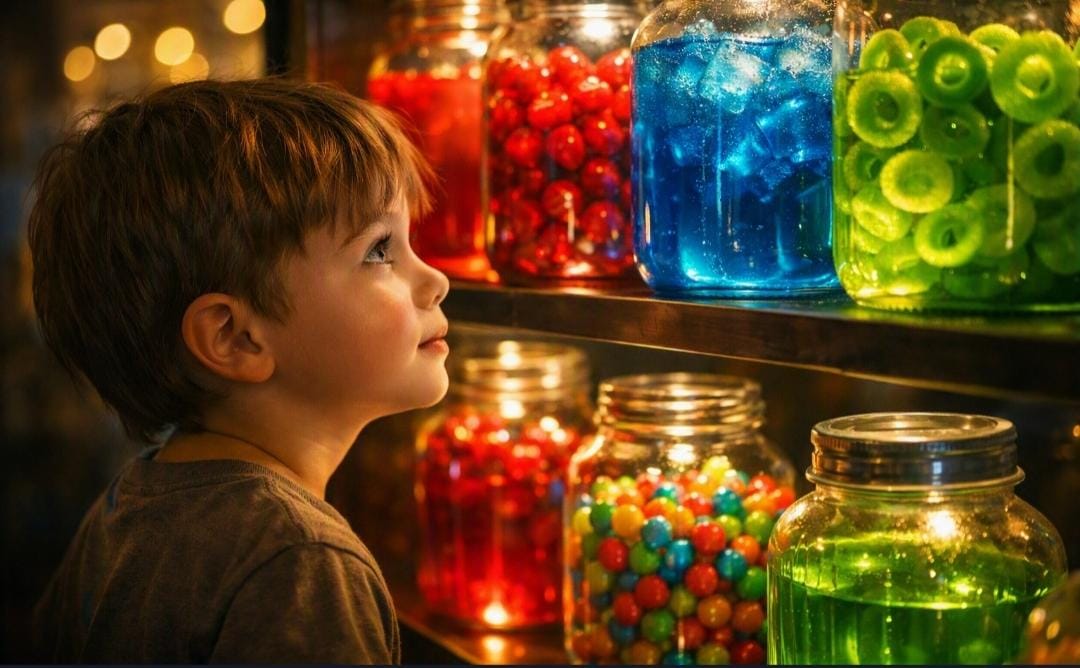
A child stands in front of a shelf filled with sweets.
His eyes immediately go to the red candy, the blue drink, and the green jelly.
To him, those colors mean one thing:
“I want that one!”
But for us, another question may come to mind:
Why is this food so brightly colored in the first place? And should we be concerned about repeated exposure to these artificial colors?
The question is not about a piece of candy eaten occasionally. It is about repeated exposure to artificial food colors as part of a child's everyday diet.
And that is where the story begins.
Children Are Not Simply “Small Adults”
Much of the brain and nervous system develops during childhood, while the way the body metabolizes and eliminates certain substances also changes with age.
At the same time, children may consume relatively larger amounts of some food ingredients in relation to their body weight.
That is why food additives—including artificial colors—receive particular attention when their safety is evaluated in children.
But the more important question is:
Can these colors affect a child's behavior?
What Do the Studies Say?
Scientific interest in this relationship began decades ago. Some clinical trials have found that consuming mixtures of artificial food colors, sometimes together with preservatives, may be associated with increases in certain measures of hyperactive behavior in some children.
One of the most well-known studies in this field was the Southampton Study, published in The Lancet in 2007. It reported increases in some measures of hyperactive behavior following exposure to certain mixtures of artificial food colors in children.
Meta-analyses of clinical trials have also suggested a small effect on certain behavioral symptoms, although responses vary considerably between children and the available evidence has important methodological limitations.
So, what can we actually conclude?
Not that every child will be affected.
And certainly not that artificial food colors cause ADHD (Attention-Deficit/Hyperactivity Disorder).
Rather, the evidence suggests that some children may be more sensitive to certain food colors than others.
What About Cancer?
Here, precision is especially important.
There is no scientific rule stating that all artificial food colors cause cancer.
However, some individual color additives have undergone regulatory reassessment as new safety data have emerged.
One prominent example is Red No. 3 (Erythrosine). In 2025, the U.S. Food and Drug Administration revoked authorization for its use in foods and orally administered drugs in the United States following an evaluation of the available toxicological data.
This does not mean that eating a product containing Red No. 3 once causes cancer. Nor can findings from animal studies automatically be applied to humans without considering exposure levels, biological mechanisms, and the overall body of evidence.
The Problem May Not Be the Color Alone
When a child eats brightly colored candy, the child is not consuming only the coloring.
The product often also contains added sugars, multiple food additives, and relatively little nutritional value.
So perhaps the more important question is:
Has this type of food become a regular part of the child's diet?
A child who occasionally eats a piece of brightly colored candy is in a completely different situation from a child who consumes colored drinks, candy, highly processed breakfast cereals, and packaged snacks every day.
At that point, the goal should not simply be to eliminate one particular color.
It should be to reduce reliance on highly processed foods as a whole.
What Should We Do as Healthcare Professionals?
There is no need to turn a child's diet into a long list of forbidden foods.
Instead, we can focus on a few practical steps:
- Choose minimally processed foods whenever possible.
- Read the ingredient list rather than judging a product by its packaging or appearance.
- Avoid making brightly colored sweets and drinks a daily habit.
- Focus more on fruits, vegetables, whole grains, and a variety of protein sources.
- Avoid broad elimination diets without a clear reason.
- If parents notice a consistent pattern of behavioral changes after consuming a particular product, the situation can be assessed systematically under the guidance of an appropriate healthcare professional.
The Bottom Line
Artificial food colors are not simply a story of “poisons” versus “completely harmless substances.”
Current evidence suggests that some children may be more sensitive to certain artificial food colors and may experience small behavioral changes, but this does not mean that artificial food colors cause ADHD.
At the same time, some individual colors have undergone new regulatory actions, such as Red No. 3 in the United States. However, this does not mean that all artificial food colors cause cancer or that occasional exposure to a single product carries the same risk.
Ultimately, the best focus may not be one particular color, but the bigger picture:
What is the child eating most days of the week?
So instead of asking:
“Is this brightly colored candy forbidden?”
Perhaps the more important question is:
“How often has this type of food become a part of my child's diet?”
Written by Dr. Amira Eltawil
Scientific Development Team at HealthNato | Pharmacist | Clinical Nutritionist
Fact-checked by HealthNato Scientific Team
on August 21, 2026 at 8:34 PM
Get new articles in your inbox
One short email a week, no spam.
Your privacy is important to us.
Related Articles
 Clinical Nutrition
The Hidden Battle After Abdominal Surgery: Understanding Postoperative Peritoneal Adhesions
 Natural Supplements
Beware of Ashwagandha: The Famous Herb Could Turn into a Deadly Toxin for Liver Cells!
 Nutrition & Diet
Everyday Foods That May Promote Inflammation Without You Realizing It…
 nutrition