How Does Breast Milk Support Infant Gut Development and Immunity?

Written by Dr. Mona Saeed
Family Medicine Physician & Clinical Nutrition and Weight Management Specialist | Scientific Development Team,
HealthNato
Information reviewed by HealthNato Scientific Team
on October 15, 2026 at 12:30 PM
Despite advances in the production of infant formula, scientists are still working to understand this complex mixture and replicate its various functions.
So, what makes breast milk unique?
1. Sugars That Do Not Directly Feed the Baby
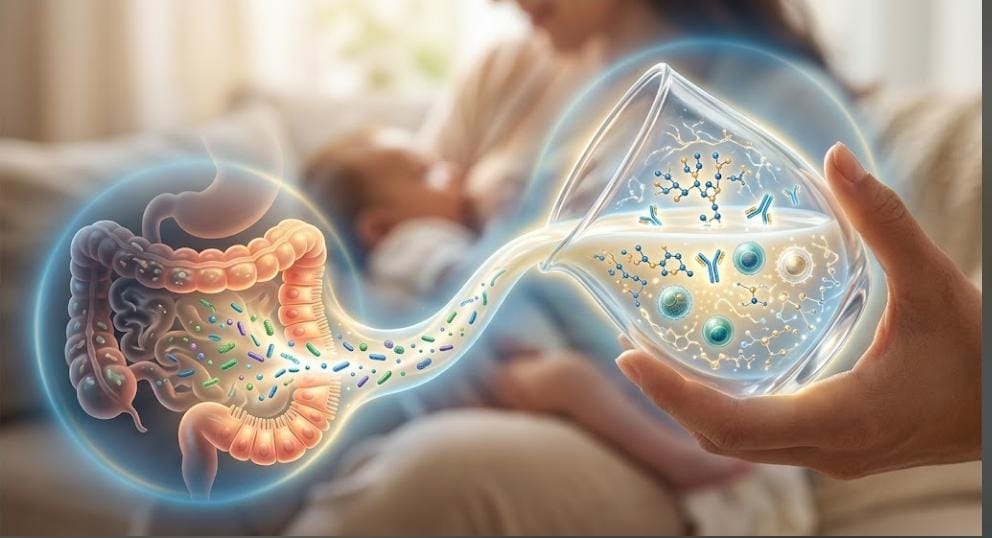
Among the distinctive components of breast milk are Human Milk Oligosaccharides (HMOs).
Although they are a type of carbohydrate, infants do not digest most of them in the same way they digest conventional sugars for energy.
Instead, they serve several important biological functions, including:
- Supporting the growth of beneficial bacteria in the gut. - Helping reduce the adhesion of certain pathogens to the intestinal lining. - Interacting with the immune system and contributing to the regulation of certain immune responses.
The types and concentrations of these sugars vary among mothers and change throughout lactation.
Scientists have successfully produced some types of HMOs using biotechnology and added them to certain infant formulas. However, this does not make infant formula identical to breast milk in all its components.
2. Antibodies That Provide Local Protection
Breast milk contains multiple immune components, including secretory immunoglobulin A (Secretory IgA).
These antibodies help protect mucosal surfaces in the gastrointestinal tract by binding to certain microbes and their components, reducing their ability to adhere to tissues.
Breast milk also contains other components, such as lactoferrin, lysozyme, and immune cells, which work through different mechanisms as part of an integrated defense system.
3. Milk That Changes Over Time—and Throughout the Day
Breast milk does not have a fixed composition. It changes throughout lactation, from colostrum in the first days after birth to mature milk. Some of its components also vary among mothers and are influenced by multiple factors.
Even more interestingly, certain components change over the course of the day. Scientific evidence has demonstrated daily variations in the levels of substances such as melatonin, tryptophan, and cortisol. These components may help convey signals related to the biological clock to the infant.
However, the evidence is not equally strong for all these components, and scientists are still investigating how these changes affect sleep and development.
4. Does Breast Milk Contain Living Cells?
Yes. Studies have identified various living cells in breast milk, including immune cells and cells that have demonstrated some stem-cell-like properties in laboratory studies.
Researchers are investigating the potential roles of these cells in lactation and infant development, including whether they contribute directly to the formation of specific tissues.
However, there is insufficient clinical evidence to establish that stem cells in breast milk travel to an infant's brain or liver to repair their cells, as is sometimes claimed.
5. Why Can't Infant Formula Replicate Breast Milk Completely?
Breast milk contains a complex mixture of nutrients, antibodies, enzymes, hormones, cells, and biologically active components, many of which change in concentration over time.
For this reason, infant formulas still cannot fully replicate all the components of human milk and their interactions.
Nevertheless, infant formulas are important and nutritionally safe alternatives when used appropriately, particularly when breastfeeding is not possible or does not provide sufficient nutrition.
The goal of understanding breast milk is not to diminish the value of necessary alternatives, but to expand our knowledge of infant needs and develop better ways to support their health.
The Bottom Line
Research shows that breast milk serves functions beyond nutrition, although some of its mechanisms and long-term effects remain under investigation.
The more precisely scientists understand these components, the greater the opportunities to develop better ways to support infant health while continuing to provide mothers with appropriate guidance based on each baby's needs.
Written by Dr. Mona Saeed
Family Medicine Physician & Clinical Nutrition and Weight Management Specialist | Scientific Development Team,
HealthNato
Information reviewed by HealthNato Scientific Team
on October 15, 2026 at 12:30 PM
Related articles
 Clinical Nutrition
The Hidden Battle After Abdominal Surgery: Understanding Postoperative Peritoneal Adhesions
 Natural Supplements
Beware of Ashwagandha: The Famous Herb Could Turn into a Deadly Toxin for Liver Cells!
 Nutrition & Diet
Everyday Foods That May Promote Inflammation Without You Realizing It…
 nutrition