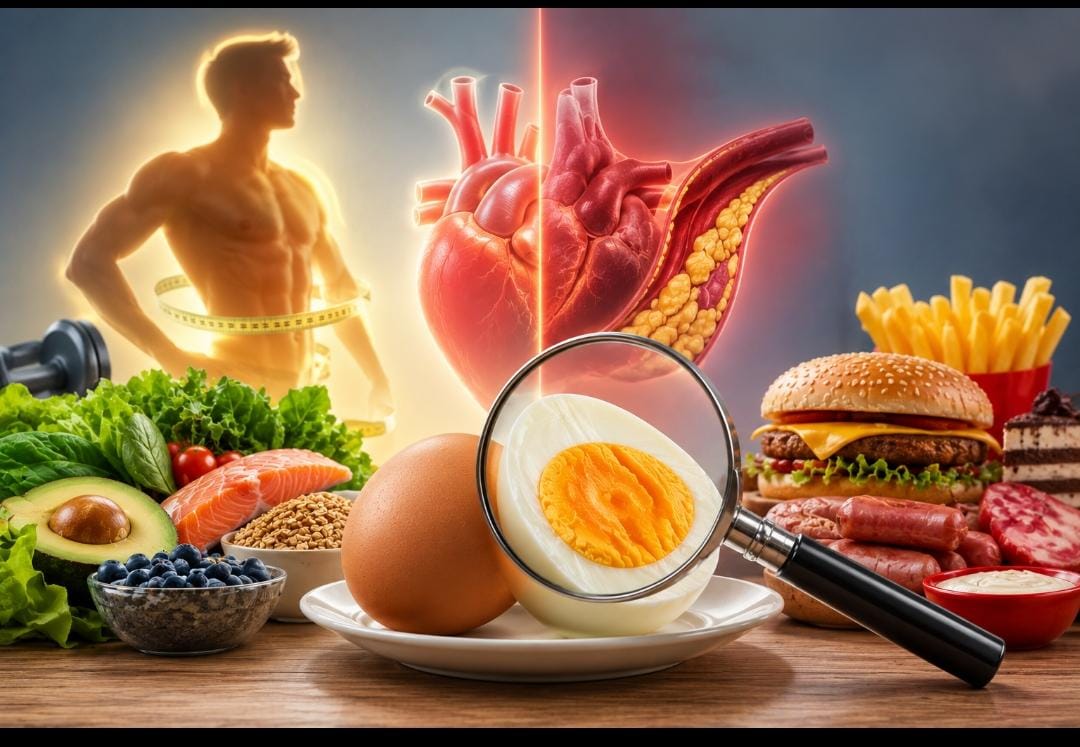
Eggs Under the Microscope.. Is It Truly an Ideal Food, or Does the “Daily Egg” Have Another Side?
Designed and published by HealthNato medical editorial team.
Information reviewed by HealthNato Scientific Team
on August 30, 2026 at 12:30 PM
Key points
- Eggs provide high-quality protein, choline, vitamin B12, riboflavin, selenium, and other important nutrients.
- Eggs may support weight management because protein can increase satiety and help preserve muscle during calorie restriction, but eggs do not directly burn fat.
- The boiled egg diet may produce short-term weight loss mainly because it restricts calories and food variety, not because eggs have a unique fat-burning effect.
- A large egg contains approximately 185–200 mg of dietary cholesterol, most of it in the yolk, but the effect of dietary cholesterol on blood LDL cholesterol varies between individuals.
- Overall dietary pattern and saturated fat intake are important when considering the effect of eggs on cholesterol and cardiovascular health.
- Healthy individuals may include one whole egg per day as part of a healthy dietary pattern, while people with elevated LDL cholesterol, cardiovascular disease, diabetes, or other risk factors may need individualized advice.
- The health impact of eggs depends partly on preparation and what is eaten with them; boiled eggs with vegetables and whole grains are different from eggs cooked in large amounts of butter and served with processed meats.
- Eggs can contribute to adequate protein intake for people interested in preserving muscle mass, but muscle growth also requires resistance training, sufficient energy, sleep, and overall adequate protein intake.
“Two eggs every day so I can lose weight”.. “Eggs raise cholesterol”.. “Eggs are dangerous for the heart”.. “Eggs are the best breakfast for a diet”..
Rarely has a single food sparked so much debate.
Eggs are a food rich in protein and beneficial nutrients, and one of the most well-known sources of dietary cholesterol. With the spread of what is known as the “boiled egg diet,” the question has returned strongly:
Do eggs really help with weight loss? And does eating them daily harm the heart and cholesterol levels?
The scientific answer is not simply “yes” or “no.”
Eggs themselves are neither the problem nor the magic solution.. rather, it depends on the dietary context in which they are consumed, the quantity, the method of preparation, and the person’s health status.
First.. Why Are Eggs Considered a Nutritious Food?
A large egg provides high-quality protein, along with a range of important vitamins, minerals, and nutrients.
Some of the key nutritional features include:
- High-quality protein containing essential amino acids. - Vitamin B12. - Riboflavin (B2). - Selenium. - Iodine in varying amounts. - Choline, an important nutrient for the brain, nervous system, and cell membranes.
A boiled egg is also a good dietary source of choline, with one large egg providing approximately 147 milligrams.
Eggs are also practical and easy to prepare, and they can be combined with vegetables, whole grains, and other protein sources as part of a balanced diet.
However, these advantages do not mean that eggs are a “complete food” that can replace the other food groups.
Do Eggs Really Help With Weight Loss?
This is where a common misunderstanding occurs.
Eggs may be useful in a weight-loss diet because they provide protein, and protein can help increase satiety and preserve muscle mass while reducing calorie intake.
But eggs do not burn fat by themselves.
If someone eats two eggs in a meal that also contains bread, butter, and full-fat cheese, and then adds a high-calorie snack, the diet does not become a “diet” simply because it contains eggs.
Put simply:
Eggs may help you build a filling meal.. but they do not cancel out a calorie surplus.
This explains why someone may lose weight initially when following a boiled egg diet: most likely because they have reduced their energy intake and restricted many foods, not because eggs have a magical effect on fat burning.
The “Boiled Egg Diet”
There are several versions of what is known as the “egg diet,” but the common version is based on consuming around 2–3 eggs per day, along with fruits, vegetables, and lean protein sources, while significantly reducing carbohydrates and grains.
This diet may lead to rapid weight loss in the short term, particularly because of reduced calorie and carbohydrate intake.
But this does not make it a superior diet for fat loss.
The problem is that restricting entire food groups makes the diet less diverse and may reduce fiber and certain nutrients. It can also be difficult to maintain over the long term.
Eggs themselves contain no fiber, so relying on them while reducing whole grains, legumes, fruits, and vegetables may create a clear nutritional problem.
Therefore, there is no good evidence showing that the “egg diet” is better than a balanced diet that creates an appropriate calorie deficit and can be maintained over time.
The conclusion here:
Eggs can be an excellent part of a weight-loss diet, but there is no need to turn them into the diet itself.
Eggs and LDL Cholesterol Levels in the Blood..
This is the most complex point.
A large egg contains approximately 185–200 mg of dietary cholesterol, with most of this cholesterol concentrated in the yolk.
But consuming dietary cholesterol does not mean that blood cholesterol levels will rise by the same amount in everyone.
The body regulates cholesterol production and absorption, and individual responses vary.
More importantly, the effect of the diet on LDL cholesterol does not depend on dietary cholesterol alone. The type of fat, particularly saturated fat, and the overall dietary pattern are also very important.
That is why the modern view has become more nuanced than the old message:
“Eggs contain cholesterol, therefore eggs cause heart disease.”
“The American Heart Association allows healthy individuals to include up to one whole egg per day as part of a healthy dietary pattern, while taking into consideration the individual’s health status and blood lipid levels.”
But Does That Mean Eating Two or Three Eggs Every Day Is Safe for Everyone?
No.
Here we must distinguish between:
“Eggs can be part of a healthy diet”
and
“Everyone can eat large amounts of eggs every day without limits.”
Research does not provide one answer for everyone.
Some trials have found that increasing egg consumption can raise LDL cholesterol to varying degrees.
In a recent study published in 2026, people with elevated blood lipids followed the DASH diet with two eggs per day for 8 weeks, and no significant adverse difference was found in LDL cholesterol, blood pressure, or other cardiovascular markers compared with a DASH diet without eggs.
Eggs and Blood Pressure..
Eggs themselves are not high in sodium, so we would not expect eating eggs alone to raise blood pressure.
However, studies do not support the idea that eggs are a “treatment for high blood pressure.”
In the recent trial that used the DASH diet, adding two eggs per day did not result in a significant change in blood pressure compared with the same diet without eggs.
At the same time, the problem may lie in what comes with the eggs:
Eggs with sausage, processed meats, highly salted cheese, and large amounts of bread are very different from boiled eggs with vegetables and whole grains.
Therefore, the better questions to ask are:
“How do I eat eggs? And what do I eat with them?”
Boiled or Fried Eggs?
Here we come to a simple but important point.
The egg itself does not become a “harmful food” simply because it is placed in a frying pan, but the cooking method can significantly change the calorie content of the meal.
Boiled eggs, soft-boiled eggs, or eggs cooked without adding large amounts of fat can be a simple option.
On the other hand, eggs fried in large amounts of butter or ghee, or served with full-fat cheese and processed meats, become part of a meal that is higher in calories, saturated fat, and sodium.
So the problem is not always the egg.. sometimes the problem is how it is prepared and the type of food served with it.
The Egg Yolk..
The yolk is the part that contains most of the cholesterol, but at the same time, it contains an important proportion of the egg’s nutrients.
Therefore, routinely removing the yolk simply out of fear of cholesterol is not necessary for most healthy individuals.
However, someone with significantly elevated LDL cholesterol, cardiovascular disease, or a lipid disorder needs a full assessment of their dietary pattern, and reducing dietary cholesterol and saturated fat sources may be part of the plan depending on their condition.
This is where personalization becomes important:
“What is suitable for someone with normal lipid levels is not necessarily suitable for a patient with elevated LDL.”
So.. How Many Eggs Can I Eat Every Day?
There is no single answer that applies to everyone.
For a healthy person who follows a balanced diet, one whole egg per day can be part of a healthy dietary pattern according to the recommendations of the American Heart Association.
Eating more than that on a daily basis requires looking at the bigger picture:
- LDL and HDL cholesterol levels and triglycerides. - The presence of heart or vascular disease. - The presence of diabetes or other risk factors. - The total amount of saturated fat in the diet. - The amount of protein and calories the person needs. - Other sources of dietary cholesterol.
Therefore, it is not appropriate to turn “one egg a day” into a strict rule, just as it is not appropriate to turn it into “unlimited eggs.”
Eggs and Muscles.. A Point Worth Noting
Eggs are a good option for anyone interested in preserving muscle mass, particularly when combined with a diet that provides adequate protein and energy.
But eating eggs alone does not build muscle.
Muscle requires:
Adequate protein + appropriate energy intake + resistance training + sleep and recovery.
Therefore, eggs can be part of a post-workout meal, but they are neither a requirement nor a magical source of muscle building on their own.
So.. Are Eggs “Healthy” or “Harmful”?
The truth is that the question itself needs to be reconsidered.
It is not logical to ask about eggs in isolation from the overall diet.
Eggs are a nutrient-rich food, high-quality in terms of protein, and an important source of choline, and they can be part of a healthy diet for heart health and weight management in many people.
At the same time, the yolk contains a relatively high amount of cholesterol, and some people may respond to it more strongly than others. Therefore, large amounts of egg consumption should not be considered safe for everyone.
As for the “boiled egg diet,” its main problem is not that eggs are a bad food, but rather that it turns a good food into the centerpiece of a highly restrictive diet.
And that is a major difference.
Conclusion
Eggs are not a superhero for weight loss..
Nor are they an enemy of the heart as they were once portrayed.
They are simply a nutritious food that can be part of a good healthy diet.
If you are trying to lose weight, eggs can be a filling, protein-rich meal, but weight loss will ultimately remain linked to total energy intake, overall dietary quality, and sustainability.
If you are concerned about heart health, do not look at eggs alone. Look at the amount of saturated fat, fiber, vegetables, whole grains, other protein sources, and your LDL level.
If you have high cholesterol, heart disease, or multiple risk factors, then the appropriate number of eggs for you becomes an individualized decision rather than a fixed number for everyone.
Eggs do not need absolute acquittal.. nor do they need to be put on trial.
What matters is knowing where to place them within your overall diet.
Designed and published by HealthNato medical editorial team.
Information reviewed by HealthNato Scientific Team
on August 30, 2026 at 12:30 PM
Related articles
 Clinical Nutrition
The Hidden Battle After Abdominal Surgery: Understanding Postoperative Peritoneal Adhesions
 Natural Supplements
Beware of Ashwagandha: The Famous Herb Could Turn into a Deadly Toxin for Liver Cells!
 Nutrition & Diet
Everyday Foods That May Promote Inflammation Without You Realizing It…
 nutrition