Can You Burn Fat Without Eating Less?

Written by Dr. Nasser El Shishini
Editorial Director | Pharmacist | Clinical Nutrition & Weight Management Specialist | Researcher in Pharmaceutical & Cosmetic Sciences.
Information reviewed by HealthNato Scientific Team
on October 29, 2026 at 12:30 PM
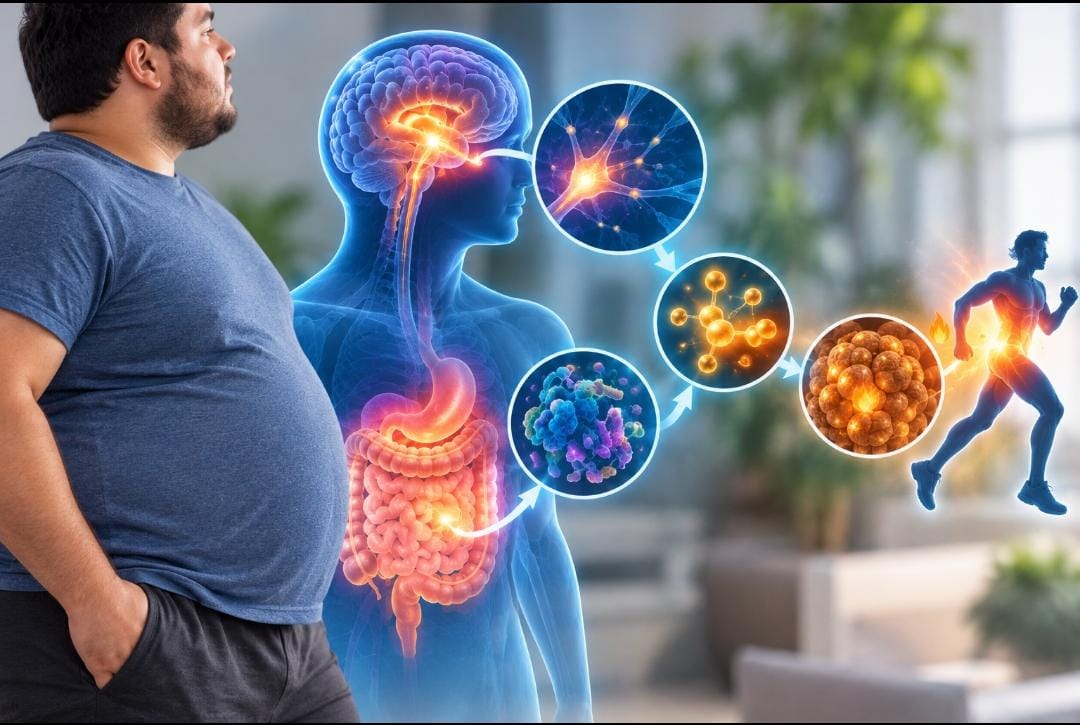
This question is driving new research into a naturally produced hormone known as FGF21, after researchers identified a neural circuit in the brain that helps the hormone increase energy expenditure and reduce body weight in obese mice.
The findings open up a research avenue beyond appetite suppression alone. However, they do not mean that a new treatment for weight loss in humans is available yet.
A Hormone That Goes Beyond Appetite to Target Energy Expenditure
The body naturally produces fibroblast growth factor 21 (FGF21), a hormone that plays a role in regulating metabolism and the body's response to nutrients.
In a recent study published in Cell Reports in 2026, researchers from the University of Oklahoma and their colleagues investigated how this hormone affects the brain. They discovered that its weight-reducing effects depend on a neural pathway located in the hindbrain, rather than the hypothalamus, which is commonly associated with appetite and weight regulation.
The experiments showed that activating this pathway was necessary to increase energy expenditure and achieve the hormone's weight-reducing effects in mice.
What Happens Inside the Brain?
When people think about losing weight, the first things that usually come to mind are reducing calorie intake or using well-known appetite-suppressing medications, such as GLP-1 drugs, which primarily work by reducing food intake.
However, researchers identified a specific neural pathway in the brainstem—particularly in two regions known as the nucleus of the solitary tract (NTS) and the area postrema—that responds directly to FGF21.
This pathway sends signals to another brain region known as the parabrachial nucleus, resulting in:
- Activation of the body's energy-expenditure mechanisms. - Stimulation of the nervous system associated with brown adipose tissue, which has the distinctive ability to convert energy into heat.
The Key Difference
Popular GLP-1 medications: Primarily promote weight loss by reducing appetite and limiting food intake.
FGF21: In contrast, demonstrated an ability to increase the body's energy expenditure without requiring a reduction in the amount of food consumed.
This does not mean that one approach replaces or competes directly with the other. Rather, they represent different biological pathways that may complement one another, opening up broader possibilities for future obesity treatments and improved metabolic health.
Does This Mean You Can Lose Weight Without Dieting?
Not entirely. There are several important scientific limitations to consider:
- The experiments were conducted in mice: The research involved administering the hormone to mice, not testing a natural method of increasing its levels in humans. Animal findings cannot be directly applied to people without clinical testing and confirmation.
- Higher energy expenditure does not mean unlimited eating: Even if energy expenditure increases, this does not establish that humans can eat unrestricted amounts of food and still lose weight.
- Potential side effects: Previous drug trials involving this hormone have identified issues such as gastrointestinal disturbances and potential concerns regarding bone health.
For these reasons, scientists are working to understand this pathway in greater detail, with the goal of developing safe treatments that harness increased energy expenditure while minimizing potential adverse effects.
Could FGF21 Become a Competitor to Obesity Medications?
Understanding this pathway could help researchers develop new treatments for obesity and possibly certain metabolic and liver disorders. However, it remains a research avenue rather than an established treatment ready for clinical use.
Importantly, the study does not demonstrate that naturally increasing FGF21 levels through food or supplements produces the same results, nor does it justify using the hormone or its derivatives without medical supervision.
The Bottom Line
Research on FGF21 highlights an important possibility: weight regulation may depend not only on how much we eat, but also on how the brain controls the body's energy expenditure.
Turning this discovery into an effective and safe treatment for humans will require further research.
Until then, dietary management, physical activity, and evidence-based medical treatments when needed remain the foundations of obesity management.
Written by Dr. Nasser El Shishini
Editorial Director | Pharmacist | Clinical Nutrition & Weight Management Specialist | Researcher in Pharmaceutical & Cosmetic Sciences.
Information reviewed by HealthNato Scientific Team
on October 29, 2026 at 12:30 PM
Related articles
 Clinical Nutrition
The Hidden Battle After Abdominal Surgery: Understanding Postoperative Peritoneal Adhesions
 Natural Supplements
Beware of Ashwagandha: The Famous Herb Could Turn into a Deadly Toxin for Liver Cells!
 Nutrition & Diet
Everyday Foods That May Promote Inflammation Without You Realizing It…
 nutrition