5 Dietary Choices That May Contribute to Accelerated Aging After 50

Designed and published by HealthNato medical editorial team.
Fact-checked by HealthNato Scientific Team
on September 7, 2026 at 12:30 PM
Biological Age… Aging Is Not Just a Number
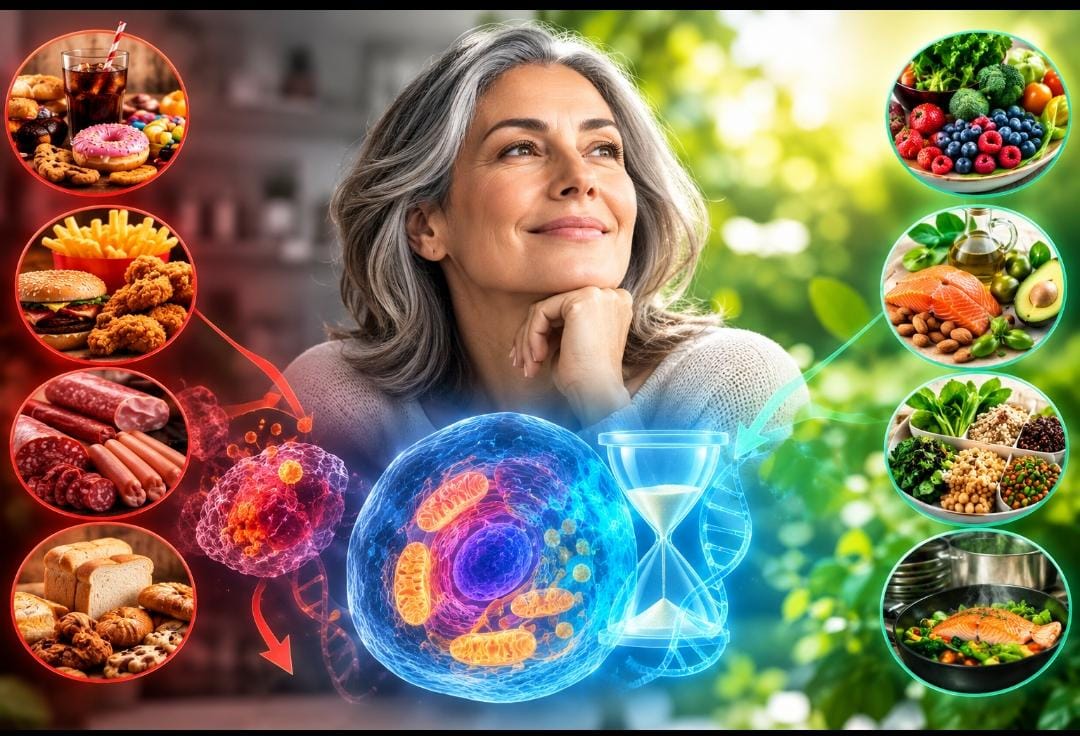
The passing of years does not necessarily mean that all the cells in the body age at the same rate. Chronological (numeric) age tells us how many years we have lived, while biological age describes the condition of tissues and cells and the extent to which they are exposed to damage and age-related changes.
As time passes… changes accumulate, including certain functional impairments, disruptions in cellular repair mechanisms, and changes in the rates of inflammation and metabolism.
Therefore, one of the most important things we should focus on in our daily lives is the dietary choices that may increase the biological burden on the body over time.
This is where sugars, cooking methods, ultra-processed foods, trans fats, and processed meats come into the picture.
1. Free Sugars and Excessive Fructose
The problem is not that a sugar molecule “accelerates aging” simply by being consumed. Rather, chronic excessive sugar intake, particularly within a high-calorie diet, may predispose the body to chronic disorders.
This is where Advanced Glycation End-products (AGEs) come into play: these are compounds that are formed when blood sugar levels rise above the normal range, causing these molecules to begin attaching and interacting with proteins and fats in the body without permission. Over time, this sugar, once attached and under the effect of body heat, turns into distorted and sticky compounds known as Advanced Glycation End-products (AGEs).
They affect the structure of important proteins such as collagen, causing the skin to lose its radiance and wrinkles to appear, while arteries lose their elasticity and become stiffer. They are also associated with increased oxidative stress and activation of inflammatory pathways.
As for consuming high amounts of fructose, particularly when consumed in sugar-sweetened beverages, it is associated with increased fat production in the liver and metabolic disturbances.
The takeaway here: the problem is not a single piece of candy, but chronic exposure to high amounts of sugar within an unbalanced dietary pattern.
ـ
2. Soft Drinks and Sugary Beverages
The main problem with sugary beverages is that they provide large amounts of sugar and calories easily, without the sense of satiety provided by whole foods. Therefore, excessive consumption is associated with weight gain, metabolic disturbances, and chronic health risks.
Studies have also found associations between regular consumption of sugary beverages and some markers of cellular aging.
Therefore, after the age of 50, it is preferable that soft drinks do not become a regular daily part of the diet, whether they are sugar-sweetened or low-calorie ultra-processed beverages.
3. Trans Fats and Repeated Frying
Here again, we must distinguish between trans fats and all vegetable oils.
The greater concern lies in trans fats, deep and repeated frying, reusing oil, and prolonged exposure to high temperatures, as these conditions can lead to the formation of lipid oxidation products and other compounds that contribute to oxidative stress and inflammation, which are associated with a wide range of diseases related to aging, including cardiovascular disease, metabolic disorders, and neurodegeneration.
Therefore, the problem is not with “vegetable oil” as a single category, but rather with the type of fat, how it is used, and the overall quality of the dietary pattern.
4. Processed and Salted Meats
Sausages, luncheon meats, and processed and salted meats are not a problem because they directly “accelerate cellular aging,” but their frequent consumption is associated with important health risks.
These products contain a mixture of sodium and substances used in processing, and harmful compounds such as N-nitroso compounds, as well as other heat-generated compounds, can form during processing or cooking.
The International Agency for Research on Cancer (IARC) has classified processed meat as carcinogenic to humans, with an association between increased consumption and an increased risk of colorectal cancer.
High sodium levels in some of these products may also increase the burden on blood pressure and the cardiovascular system in people who are sensitive to sodium.
Therefore, reducing processed meat is not an anti-aging diet in the literal sense, but it is a logical choice for reducing a range of chronic risks that become increasingly important with advancing age.
ـ
5. Refined Carbohydrates with a High Glycemic Index
White bread, pastries, and sweets made from refined flour can rapidly raise blood glucose and insulin levels, particularly when consumed in large amounts and when physical activity is low.
But the problem is not a single “spike” in blood glucose.
The problem arises when these choices become a frequent part of a high-calorie diet that is low in fiber, protein, and nutrients, potentially contributing over time to increased insulin resistance and metabolic disturbances and directly affecting the cell’s ability to eliminate harmful waste and damaged components through a process known as autophagy.
The Safety Code for Preventing Cellular Aging
1. Do Not Look for a Single Food That Stops Aging
Biological aging is a multifactorial process, and therefore no single food or nutrient can reverse it on its own.
What matters most is maintaining a healthy long-term dietary pattern while reducing sugars, sugary beverages, processed meats, and ultra-processed foods.
2. Give Your Cells an Opportunity for Maintenance
Autophagy is a natural process that occurs inside cells to recycle some damaged cellular components and directly affects the aging process.
Recent evidence suggests that restricting food intake for specific periods may have a positive effect on this pathway, but the magnitude of the effect and its importance for aging are still under investigation. Therefore, intermittent fasting should not be presented as a proven treatment for extending lifespan.
What matters most, however, is avoiding continuous and random eating and organizing meal times according to one’s health status and lifestyle.
3. Choose Fats and Plant Compounds Wisely
Oily fish provide omega-3 fatty acids, while extra virgin olive oil provides monounsaturated fats and beneficial polyphenolic compounds.
Fruits, vegetables, berries, and green tea also provide a wide range of polyphenols and active plant compounds.
These choices are part of a dietary pattern associated with supporting metabolic health and reducing the inflammatory and oxidative burden.
4. Cooking Method Is Part of the Equation
The higher the dry heat and the longer the cooking time, the greater the potential for the formation of some harmful compounds.
Therefore, exposure to these compounds can be reduced by using alternative methods such as steaming, boiling, cooking with moisture, and using moderate heat, rather than relying continuously on frying and intense browning.
Conclusion
What happens inside the body is influenced by what we eat, how we cook it, how much we move, and how we maintain the health of our vital organs.
Therefore, after the age of 50, the goal is not to eat less out of fear of aging…
but to make every meal less burdensome for your cells and more supportive of their natural ability to maintain and repair themselves.
Designed and published by HealthNato medical editorial team.
Fact-checked by HealthNato Scientific Team
on September 7, 2026 at 12:30 PM
Get new articles in your inbox
One short email a week, no spam.
Your privacy is important to us.
Related Articles
 Clinical Nutrition
The Hidden Battle After Abdominal Surgery: Understanding Postoperative Peritoneal Adhesions
 Natural Supplements
Beware of Ashwagandha: The Famous Herb Could Turn into a Deadly Toxin for Liver Cells!
 Nutrition & Diet
Everyday Foods That May Promote Inflammation Without You Realizing It…
 nutrition