Nutrition Is Not Just Food and Drink… It Also Shapes How Your Genes Express Themselves: How Does Your Diet Influence Your Cellular Function ?

Written by Dr. Nasser El Shishini
Editorial Director | Pharmacist | Clinical Nutrition & Weight Management Specialist | Researcher in Pharmaceutical & Cosmetic Sciences.
Information reviewed by HealthNato Scientific Team
on August 25, 2026 at 12:30 PM
We are accustomed to thinking of food merely as a source of calories, proteins, vitamins, and minerals. However, the picture is much broader than that. What we consume can influence the cellular signaling cascades within our bodies, as well as the activity and expression of specific genes.
This is where a specialized scientific field known as Nutrigenomics enters the stage, alongside Epigenetics—a discipline studying how diet and environmental factors can alter gene expression without altering the underlying DNA sequence itself.
Does Food Change Our Genes ? A clear distinction must be made between two distinct concepts:
1- Altering the gene itself (i.e., changing the DNA sequence).
2- Altering gene expression (i.e., upregulating or downregulating a gene's transcriptional activity).
The quality and composition of our diet can influence the second pathway through mechanisms such as adding simple chemical tags to the DNA molecule (such as DNA methylation), histone protein modifications, and non-coding RNA regulation.
These molecular modifications can alter how a cell interprets and reads certain genetic instructions.
Enter the Gut Microbiota This story does not unfold solely inside the cell.
The food that reaches the intestinal tract directly shapes the gut microbiome—the complex community of bacteria and microorganisms residing within the digestive system.
These microorganisms possess the biochemical capability to metabolize dietary components into active metabolites, such as Short-Chain Fatty Acids (SCFAs), which can cross-talk with the regulatory mechanisms of gene expression.
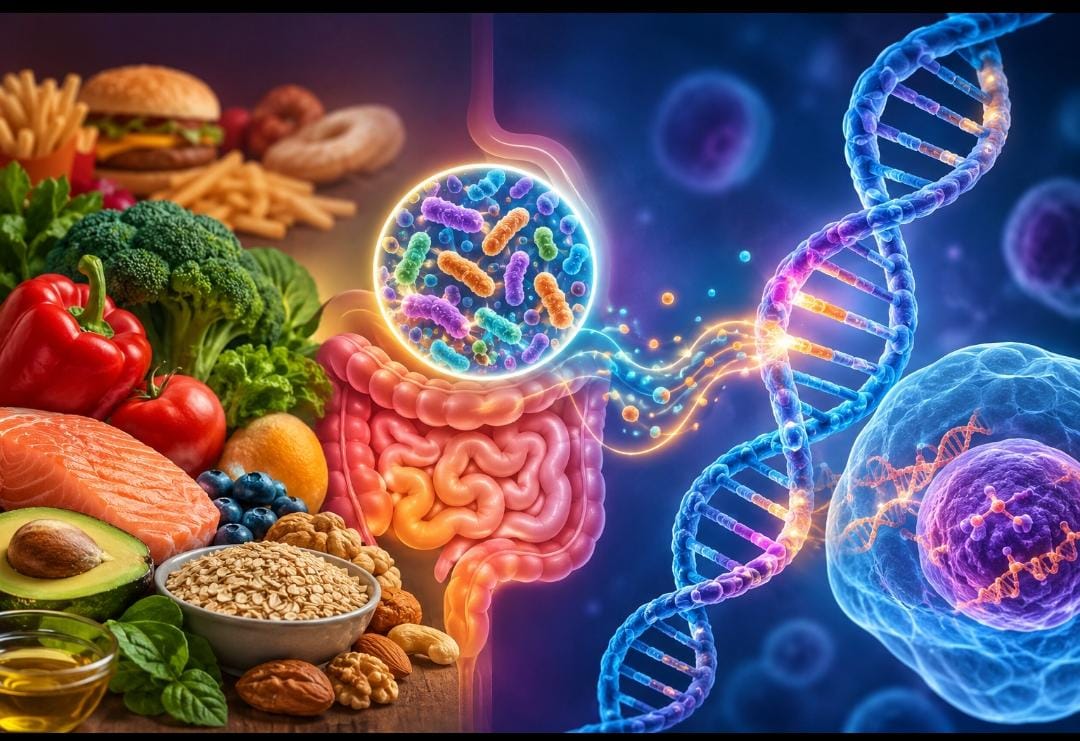
Hence, a critical sequence emerges : (Food) is transformed by the (gut microbiome) into (metabolites) that influence (cellular signaling), which in turn induces certain (epigenetic modifications), leading to interactions and changes in the (regulation of gene activity and expression patterns).
Not All Foods Are Created Equal Certain dietary constituents provide biochemical signals associated with beneficial cellular processes. Dietary fiber, vegetables, fruits, nuts, whole grains, and bioactive plant compounds like polyphenols can positively influence the microbiome and modulate pathways linked to epigenetic modifications. Conversely, dietary patterns high in added sugars, unhealthy fats, and ultra-processed foods are associated with increased systemic inflammation and metabolic dysregulation—factors that can also interfere with the regulation of gene expression.
What About Artificial Sweeteners?
Non-sugar sweeteners serve as an excellent example of the complexity surrounding the interplay between diet and genetics.
Some studies suggest that specific types of artificial sweeteners may alter gut microbial composition or certain metabolic markers in some individuals. However, clinical findings in humans remain heterogeneous, as responses appear to vary based on the specific sweetener used, the dosage, and the individual's baseline microbiome profile. Therefore, stating that "artificial sweeteners alter genes and cause diabetes" as an established scientific fact is inaccurate. More precisely, certain sweeteners may influence the microbial and metabolic environment, and researchers are actively investigating whether these alterations extend to regulating gene expression and what their true clinical significance might be.
What Does the Evidence Say About Ultra-Processed Foods?
Scientific interest in this domain is rapidly expanding. A recent exploratory study observed an association between high consumption of ultra-processed foods and variations in gene activity patterns among women; however, it was a small-scale study and does not establish a direct causal relationship.
In another study involving 3,152 children, several correlations were observed between the intake of ultra-processed foods and gene regulation, but these did not reach the required threshold of statistical significance, highlighting the need for larger, more rigorous prospective studies.
This brings us to a fundamental scientific principle: The existence of a genetic or epigenetic association does not automatically imply direct causation.
So… Can We "Reprogram" Our Genes Through Food? It is not that simple. Diet does not rewrite the inherited genetic code (DNA) we were born with. However, it can alter the chemical and microbial environment within the body, as well as the signaling pathways that govern gene activity.
Furthermore, these biological effects vary from one person to another, influenced by age, baseline genetics, physical activity, sleep quality, gut microbiome composition, and overall health status. Thus, there is no "magic meal" that switches on health-promoting genes, nor is there a single food item that permanently silences disease-causing genes.
Summary :
Food is far more than just fuel. It constitutes an integral part of the biochemical environment in which our cells operate. What we eat can modulate the microbiome, systemic inflammation, metabolic outputs, and certain gene expression mechanisms. This does not mean that food alters the genetic code (DNA) we were born with, nor does every epigenetic shift lead to pathological conditions. Yet, the core message is becoming increasingly clear: Our dietary choices do not merely influence our body weight or routine blood test results today… they may also shape the molecular signals determining how our cells function. Therefore, dietary quality is not simply a matter of calorie counting; it is a fundamental pillar of the biological ecosystem in which our genes reside every single day.
Written by Dr. Nasser El Shishini
Editorial Director | Pharmacist | Clinical Nutrition & Weight Management Specialist | Researcher in Pharmaceutical & Cosmetic Sciences.
Information reviewed by HealthNato Scientific Team
on August 25, 2026 at 12:30 PM
Related articles
 Clinical Nutrition
The Hidden Battle After Abdominal Surgery: Understanding Postoperative Peritoneal Adhesions
 Natural Supplements
Beware of Ashwagandha: The Famous Herb Could Turn into a Deadly Toxin for Liver Cells!
 Nutrition & Diet
Everyday Foods That May Promote Inflammation Without You Realizing It…
 nutrition