Probiotics and Prebiotics… Beneficial Bacteria or Their Food? How Does the Microbiome System Work Inside Your Gut?

Written by Dr. Amira Eltawil
Scientific Development Team at HealthNato | Pharmacist | Clinical Nutritionist
Fact-checked by HealthNato Scientific Team
on August 28, 2026 at 12:30 PM
Key Points
- Probiotics are live microorganisms that may provide health benefits when consumed in adequate amounts.
- Prebiotics are substrates that are selectively utilized by certain gut microbes and can produce a health benefit.
- Not every product containing bacteria is an effective probiotic, and probiotic effects can vary significantly by strain.
- Gut microbes ferment certain prebiotic substrates and produce short-chain fatty acids such as butyrate, acetate, and propionate.
- Foods such as garlic, onions, legumes, oats, barley, nuts, flaxseeds, and certain fruits provide fibers or substrates that can support gut microbes.
- Increasing fiber and fermentable carbohydrates too quickly can cause bloating, gas, and abdominal discomfort in some people.
- When choosing a probiotic supplement, strain identity, CFU count, and storage conditions are more informative than the CFU number alone.
“Take beneficial bacteria for your gut health”… a piece of advice that has become increasingly common.
But probiotics and prebiotics are often confused with one another.
Both are related to the health of the gut microbiome, but they are not the same thing.
Probiotics are live microorganisms that may provide a health benefit when consumed in adequate amounts, while prebiotics are substrates that are selectively utilized by certain gut microbes and may result in a health benefit.
And the story goes far beyond simply “improving digestion.”
Probiotics… Not All Bacteria Are the Same
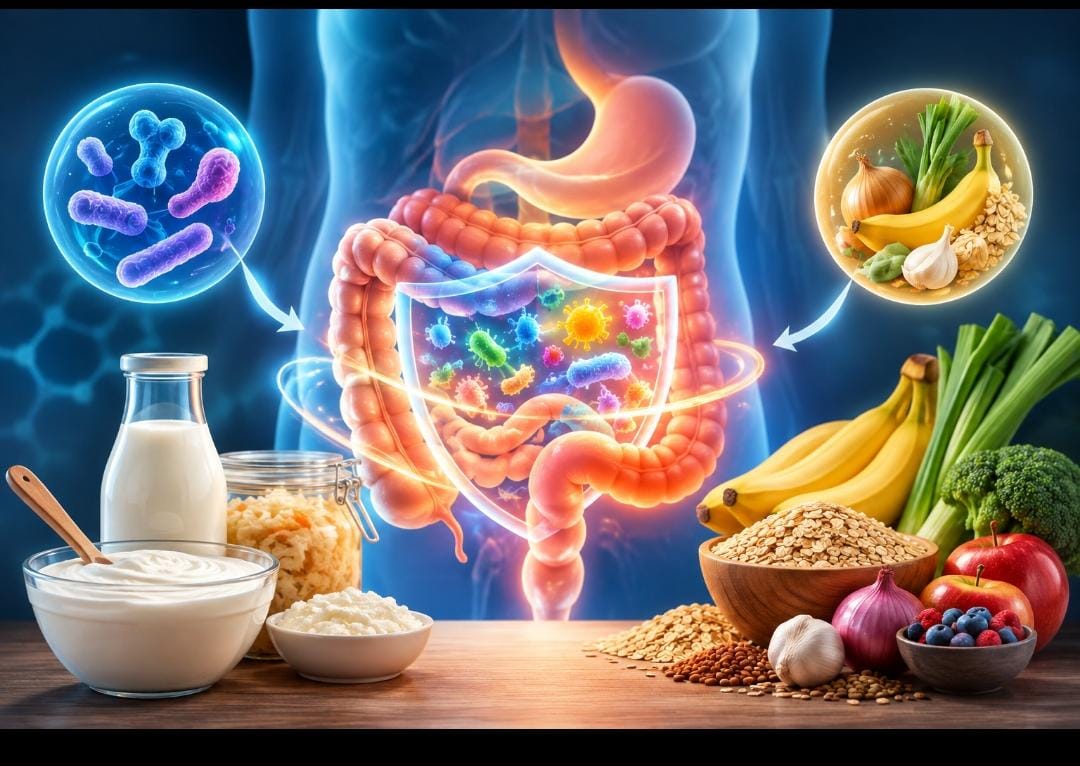
Probiotics are live microorganisms, including certain bacteria and yeasts, that may provide health benefits when consumed in adequate amounts.
Some of the most extensively studied groups include Lactobacillus, Bifidobacterium, and certain yeasts such as Saccharomyces boulardii.
But there is an important point:
Not every product containing bacteria should automatically be considered an effective probiotic, and not every strain produces the same effects.
In fact, the potential benefit can vary substantially from one strain to another.
Most probiotics also do not permanently colonize the gut. They may pass through the digestive system and influence the microbial environment, immune responses, or intestinal functions while they are present, after which their levels may decline once supplementation stops.
So the idea cannot simply be reduced to:
“I consumed beneficial bacteria… so they have permanently become part of my gut.”
Prebiotics Are Food for Certain Gut Microbes
Prebiotics are not simply another name for fiber.
They are substances or substrates that are not completely digested by the human body and can be selectively utilized by certain microorganisms in the gut, resulting in a health benefit.
Examples include certain types of inulin, fructooligosaccharides (FOS), and other fermentable carbohydrates and fibers.
This is where the important relationship between diet and the microbiome begins.
What Happens Inside the Colon?
When certain prebiotic substrates reach the colon, gut microbes can ferment them.
This fermentation produces important compounds known as short-chain fatty acids (SCFAs), including butyrate, acetate, and propionate.
These compounds are more than simple by-products of digestion.
Butyrate, for example, is an important energy source for cells lining the colon. Short-chain fatty acids also participate in maintaining intestinal barrier function and regulating certain immune responses.
A broader picture therefore emerges:
You are not only feeding your body. You are also influencing the environment in which trillions of microorganisms live inside your gut.
Where Can You Get Probiotics?
Live microorganisms can be found in certain foods, including yogurt containing live cultures and some fermented products that retain viable microorganisms.
Some naturally fermented foods may also contain live microorganisms, depending on how they are produced, processed, and stored.
However, not every fermented food should automatically be labeled a “probiotic.”
Processing, storage, heating, and other treatments can affect whether microorganisms remain alive and whether the product provides a demonstrated health benefit.
What About Prebiotics in Food?
This is where the composition of your daily diet becomes especially important.
Prebiotic compounds and fermentable fibers can be found in a wide range of foods, including garlic, onions, leeks, certain vegetables, legumes, oats, barley, nuts, flaxseeds, and certain fruits.
Less-ripe bananas also contain more resistant starch, a type of carbohydrate that can reach the colon and be utilized by some gut microbes.
This is one reason why dietary diversity and a variety of fiber sources may be more useful than searching for a single “magic food” for the microbiome.
Can Prebiotics Cause Bloating?
Yes.
When fiber or fermentable carbohydrates are increased too quickly, gut microbes may produce more gas, which can result in bloating, flatulence, cramping, or abdominal discomfort.
For this reason, increasing dietary fiber gradually while maintaining adequate fluid intake may be better tolerated.
Some people, particularly those with significant symptoms of irritable bowel syndrome, may also have difficulty tolerating large amounts of certain prebiotic ingredients such as inulin.
There is no single approach that works equally well for everyone.
How Should You Choose a Probiotic Supplement?
Do not focus on the CFU number alone.
CFU, or colony-forming units, indicates the number of viable microorganisms, but the number by itself does not tell you whether a particular product will provide the health benefit you are looking for.
When evaluating a probiotic supplement, pay attention to:
The microorganism name.
The specific strain name.
The CFU count.
The recommended storage conditions.
This matters because a health effect demonstrated for one specific strain cannot automatically be assumed for another strain simply because both belong to the same genus.
The Bottom Line
Probiotics and prebiotics are not the same thing, and neither should simply be viewed as a generic “gut supplement.”
Probiotics are live microorganisms that may provide specific health benefits when consumed in appropriate amounts.
Prebiotics are substrates that selected gut microbes can utilize, potentially producing a health benefit through the compounds generated during microbial metabolism.
When gut microbes ferment certain prebiotic substrates, they produce important metabolites such as butyrate and other short-chain fatty acids, which participate in supporting the intestinal environment and regulating aspects of immune function.
But a healthy microbiome does not depend on one capsule.
Dietary diversity, a wide variety of fiber sources, and the overall quality of the diet are important components of a balanced gut environment.
So instead of asking only which probiotic to buy, a more useful question may be:
“What am I putting on my plate every day to support the microbes living inside my gut?”
Written by Dr. Amira Eltawil
Scientific Development Team at HealthNato | Pharmacist | Clinical Nutritionist
Fact-checked by HealthNato Scientific Team
on August 28, 2026 at 12:30 PM
Get new articles in your inbox
One short email a week, no spam.
Your privacy is important to us.
Related Articles
 Clinical Nutrition
The Hidden Battle After Abdominal Surgery: Understanding Postoperative Peritoneal Adhesions
 Natural Supplements
Beware of Ashwagandha: The Famous Herb Could Turn into a Deadly Toxin for Liver Cells!
 Nutrition & Diet
Everyday Foods That May Promote Inflammation Without You Realizing It…
 nutrition